


 English (English)
 Deutsch (German)
 Čeština (Czech)
 Italiano (Italian)
 Hrvatski (Croatian)
 Română (Romanian)
 български език (Bulgarian)
 Magyar (Hungarian)
 Español (Spanish)
 Français (French)
 Nederlands (Dutch)
 Polski (Polish)
 Slovenčina (Slovak)
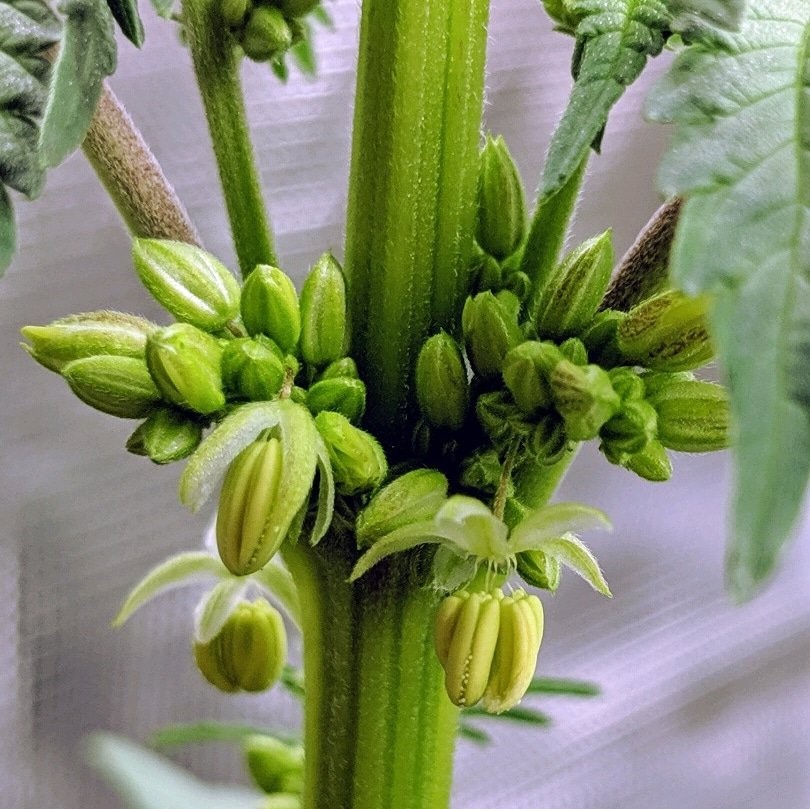



Every cannabis grower has heard that male plants are useless. But the truth is different – males have their important place in cannabis cultivation. In this article, you will learn what role male plants actually play and when they are absolutely indispensable for the entire process.
In the world of cannabis seed collecting, male plants are often considered undesirable. This widespread perception, however, masks their fundamental importance in the cannabis genetic ecosystem. For any passionate genetics collector, understanding the role of males is crucial to appreciating the complexity of genetic lineages and the art of strain development.
Identifying male characteristics in cannabis genetics
Recognizing male traits is a fundamental skill for any cannabis genetics enthusiast. Male plants have distinctive morphological characteristics that clearly differentiate them from their female counterparts.
Male reproductive structures
Male flowers develop as small, spherical structures grouped in clusters. These reproductive organs, suspended by fine pedicels, release the pollen needed for reproduction once mature. This floral architecture contrasts sharply with the elongated calyces of female plants.
Morphologically, male specimens generally exhibit a more compact stature with less dense branching. Their vegetative development is often less vigorous, typically reaching half the weight of their female counterparts. This growth difference reflects their reproductive specialization rather than their biomass production capacity.
Developmental timeline
Sexual characteristics become identifiable relatively early in the development cycle, generally 4 to 6 weeks after germination under optimal conditions. This early onset allows collectors to quickly identify specimens according to their genetic goals.
A remarkable aspect is that males reach reproductive maturity several weeks before females, an evolutionary adaptation that ensures pollen availability during female receptivity.
Genetic applications of male specimens
Contrary to popular belief, male plants represent an essential element for certain specialized applications in cannabis genetics. Their value far transcends their reputation as unwanted plants.
Production of authentic collectible seeds
Creating collectible seeds absolutely requires the male genetic contribution. For collectors wishing to preserve rare genetic lineages or develop their own strains, males are an irreplaceable link.
Regular seeds naturally produce a balanced distribution between male and female specimens, providing the genetic material necessary for natural reproduction. This genetic diversity preserves the integrity of ancestral lineages and maintains essential genetic variability.
Conversely, feminized seeds, while useful for certain applications, result from specific genetic manipulations and do not allow complete natural reproduction without technical intervention.
Controlled pollination methodology
Controlled pollination requires a methodical approach to ensure the genetic quality of the resulting seeds:
- Rigorous selection: Choose only specimens exhibiting the most desirable genetic characteristics
- Spatial isolation: Maintain physical separation to precisely control crosses
- Optimal timing: Identify the ideal moment of pollen maturity for successful fertilization
- Targeted application: Use fine tools to transfer pollen to specific reproductive sites
- Complete maturation: Allow full seed development until their characteristic brown-tiger coloring appears
Strain development and genetic improvement
In the field of strain development, males play a central role in creating new genetic expressions. This application represents the most sophisticated aspect of their use in cannabis genetics.
Hybridization and genetic stabilization
The process of controlled hybridization allows combining desirable traits from distinct lineages. This approach requires a thorough understanding of parental genetic profiles and their modes of hereditary transmission.
The difference between simple reproduction and true genetic improvement lies in intentionality: while reproduction aims to preserve an existing line, hybridization seeks to create new combinations of desirable traits.
Stabilizing a new variety generally requires several generations of selective backcrossing with parental lines. This particularly demanding process fixes desired characteristics and eliminates undesirable genetic expressions.
Preserving genetic diversity
Male specimens contribute significantly to maintaining the genetic diversity of cannabis populations. This diversity constitutes a valuable genetic heritage for future generations of collectors and researchers.
Each male carries a unique combination of alleles that, once transmitted, enriches the available gene pool. This genetic contribution can reveal latent characteristics or create unexpected synergies with other lineages.
Technical and industrial applications
Beyond their reproductive role, male plants offer practical applications in the field of technical materials. Their fibrous structure presents interesting properties for various industrial applications.
Biomass valorization
Stems and leaves of male specimens contain technical fibers usable in different industrial sectors. This valorization of male biomass demonstrates the complete usefulness of these plants beyond their reproductive function.
Applications include the production of textile materials, ecological building components, and various technical parts. This versatility illustrates the sustainable approach possible in the complete use of plant resources.
Genetic precautions and considerations
Managing male specimens requires certain precautions to avoid potential genetic problems. Vigilance regarding hermaphroditic expressions is a crucial aspect of this management.
Hermaphroditic plants, simultaneously exhibiting both male and female traits, can compromise the genetic stability of collections. These specimens generally result from environmental stress or particular genetic predispositions.
For serious collectors, early identification and elimination of these unstable plants guarantees the genetic purity of preserved lineages. This attention to detail separates amateur collections from professional genetic archives.