


 English (English)
 Deutsch (German)
 Čeština (Czech)
 Italiano (Italian)
 Hrvatski (Croatian)
 Română (Romanian)
 български език (Bulgarian)
 Magyar (Hungarian)
 Español (Spanish)
 Français (French)
 Nederlands (Dutch)
 Polski (Polish)
 Slovenčina (Slovak)
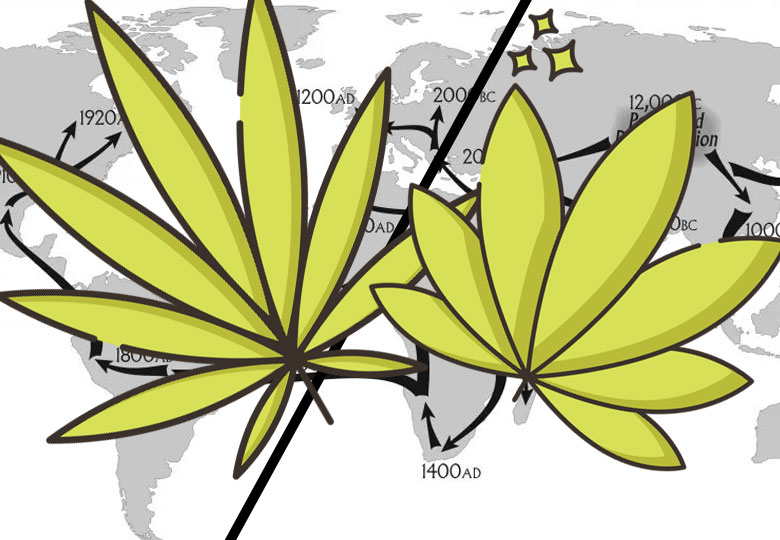



Cannabis has accompanied humanity for millennia, finding its place in a wide range of applications from textile agriculture to traditional medicine. Today, let's explore the captivating universe of this exceptional plant through its main genotypes and discover the true distinctions between Cannabis Sativa and Cannabis Indica.
Although there are three fundamental cannabis lineages – Sativa, Indica and Ruderalis – this article will focus mainly on the first two, which remain the most prized among collectors. You will come to understand why these varieties are so sought after and how they differ at a fundamental level.
Sativa vs Indica – The essential differences
To grasp the distinctions quickly, here is an overview of the fundamental characteristics that set these two remarkable genetics apart.
Geographic origins and environmental adaptation
Cannabis Sativa:
- Origin: warm regions (South Asia, Africa, Latin America)
- Adapted to tropical and subtropical climates
- Evolved in environments with intense sunlight
Cannabis Indica:
- Origin: the harsh conditions of the Hindu Kush
- Adapted to mountain and continental climates
- Evolved in environments with short seasons
Morphology and botanical characteristics
Sativa profile:
- Tall, imposing stature
- Foliage with thin, elongated leaflets
- Widely spaced internodes
- Extended flowering period
Indica profile:
- Compact, bushy structure
- Leaves with broad, robust leaflets
- Tightly spaced internodes
- Accelerated flowering cycle
Cannabinoid composition
Analyses reveal distinct tendencies in cannabinoid profiles:
- Sativa genetics: a propensity for higher THC concentrations
- Indica genetics: a balance that often favours CBD
Cannabis Sativa – An in-depth look at the genetic material
Where does it come from? How can you identify its characteristics? What are its botanical properties? Let's dive into the study of this fascinating genetic lineage.
Native environment and geographic distribution
Cannabis Sativa, also known as cultivated hemp, is a heat-loving variety native to southern and south-western Asia. This genetic line gradually spread to Central America and Africa – territories characterised by high temperatures and tropical conditions.
Distinctive morphological characteristics
Sativa stands out for its impressive stature and elegant growth habit. The plant develops a sturdy, fibrous central stem, from which long branches emerge, adorned with leaves bearing slender leaflets. Despite its structural strength, this stem retains the flexibility needed to withstand strong winds.
This genetic line is particularly fond of heat and intense sunshine – it requires a substantial amount of natural light, which makes it a preferred choice for outdoor collector's seeds.
Cannabinoid and terpene profile
Generally speaking, Sativa genetics present higher concentrations of THC (tetrahydrocannabinol), a psychoactive compound regulated in many countries. The level of CBD (cannabidiol), a cannabinoid with recognised therapeutic properties, tends to be more moderate in pure Sativa lineages.
However, contemporary breeding programmes have given rise to new varieties based on Sativa genetics, characterised by high concentrations of legal CBD combined with reduced THC levels.
Applications and genetic value
Cannabis Sativa is particularly appreciated for its resilience and tolerance of climatic variation, qualities sought after in crossbreeding programmes and in the development of new outdoor genetics. This variety is also used extensively as industrial hemp – it proves valuable in agriculture, in the textile industry and even in construction.
Cannabis Indica – A study of the mountain genetic heritage
Let's now explore the specific features of this genetic lineage adapted to harsh conditions and discover its unique characteristics.
Geographic origins and climatic adaptation
Cannabis Indica comes from the mountainous regions of the Hindu Kush, a range stretching across Afghanistan, Pakistan and northern India. This genetic line developed in an environment characterised by short summers and demanding climatic conditions.
Morphology and specific adaptations
Indica displays a compact, dense architecture, the result of its adaptation to the environmental constraints of its regions of origin. Its leaves, with particularly broad leaflets, optimise light capture during the short favourable seasons.
This compact morphology makes Indica an optimal choice for indoor collector's seeds, where space can be a constraint.
Chemical and aromatic profile
Indica genetics are renowned for their relaxing, soothing profile, often associated with more balanced concentrations of THC and CBD. Their terpene profile tends towards earthy, musky aromas, sometimes enriched with fruity or spicy notes.
These chemical characteristics make Indica seeds particularly prized collector's specimens for the study of aromatic profiles and cannabinoid compositions.
Hybrids and modern genetic evolution
The art of modern breeding has given rise to countless hybrids combining the qualities of the Sativa and Indica lineages. These creations allow collectors to appreciate unique genetic profiles, pairing, for example, the vigorous growth of Sativa with the compactness of Indica.
Selection and genetic preservation
Collector's seeds play a crucial role in preserving this exceptional genetic diversity. Each variety constitutes a unique botanical heritage, bearing witness to millennia of evolution and natural selection.
For passionate collectors, these seeds represent far more than mere specimens: they embody the history, geography and complex chemistry of cannabis, offering a fascinating glimpse into the biodiversity of this remarkable plant.