


 English (English)
 Deutsch (German)
 Čeština (Czech)
 Italiano (Italian)
 Hrvatski (Croatian)
 Română (Romanian)
 български език (Bulgarian)
 Magyar (Hungarian)
 Español (Spanish)
 Français (French)
 Nederlands (Dutch)
 Polski (Polish)
 Slovenčina (Slovak)
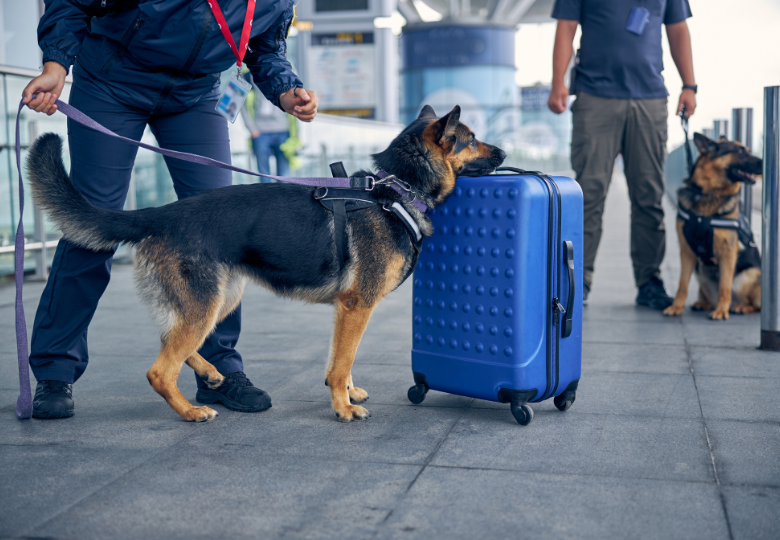



The World of Drug Detection Dogs: Specialized Companions of Law Enforcement
Drug detection dogs are a fundamental element of public safety operations. These four-legged specialists regularly accompany police officers and security personnel at airports, train stations, and major public events. Their exceptionally developed sense of smell makes them incredibly effective detection tools, capable of tracking down a wide range of substances with a precision that far exceeds human abilities.
Encountering these dogs can trigger anxiety even when one isn't carrying anything illegal. Their mere presence activates a natural sense of alertness - proof of the psychological effectiveness of their deterrent function. But how worried should we really be? And above all: can these dogs detect CBD products?
Training and Specialization: The Science Behind a Dog's Sense of Smell
Training dogs to detect substances has its roots in a long tradition of using the canine sense of smell. Historically, several breeds were specialized for hunting, using their superior sense of smell to track down specific prey. This natural predisposition was later adapted for investigative and security purposes.
Modern drug detection dogs are trained through highly specialized training programs that last several years. During this time, they learn to recognize the specific scent profiles of various substances, not limiting themselves exclusively to cannabis. Their repertoire typically includes:
- Narcotics: heroin, cocaine, ecstasy, ketamine
- Explosives and hazardous materials
- Specific biological traces
As for cannabis, these dogs are trained to recognize certain characteristic terpenes such as caryophyllene, beta-caryophyllene, and pinene. These aromatic compounds form the olfactory signature that allows for the identification of cannabis genetic material.
CBD and Detection: What Specialized Dogs Can Perceive
The question of whether drug detection dogs can recognize CBD is complex and deserves closer examination. Technically speaking, these dogs can be trained to recognize CBD products, especially those with concentrated scent profiles such as oils. This is because CBD retains many of the characteristic terpenes of the cannabis plant, creating a recognizable olfactory signature.
However, it's important to keep in mind that a dog's sense of smell is 10,000 to 100,000 times more sensitive than a human's. This incredible ability means that, with appropriate training, they can theoretically recognize any substance with characteristic olfactory traits.
In modern practice, many training programs focus primarily on substances classified as high-risk, such as hard drugs and explosives, rather than on hemp products with low THC content. This shift reflects changes in operational priorities and legislation.
Airport Operations: Protocols and Procedures
At airports, drug detection dogs follow specific and strict operational protocols. Their work is divided into several phases: checking carry-on luggage at security checkpoints, screening passengers, and, if necessary, inspecting the cargo hold and aircraft cabin.
A crucial aspect of their training concerns the manner of discreet alerting. When they detect a suspicious substance, these dogs don't bark or cause a disturbance. Instead, they adopt a characteristic posture - often sitting down next to the luggage or the person - to silently alert their handler.
This method makes it possible to maintain a calm environment while the necessary checks are carried out. Their detection ability remains effective even when substances are carefully hidden or sealed, thanks to the pervasive nature of scent molecules.
Behavior During a Check: Appropriate Conduct
When encountering drug detection dogs, the most appropriate approach is to remain calm and not interfere with their work. If the dog doesn't detect anything suspicious, it moves on, and you can continue on your way as normal.
If the dog signals by sitting down nearby, this doesn't automatically mean an accusation. Officers will assess the situation and decide whether additional checks based on various factors are necessary. These could include a personal search, removing outer clothing, or the use of a metal detector.
It's always advisable to mentally note the details of the interaction, including the stated reasons for any additional checks. This information could prove useful should any legal complications arise in the future.
Accuracy and Reliability: The Limits of the System
Despite the extraordinary abilities of drug detection dogs, it's important to understand that no detection system is infallible. Factors such as environmental conditions, the dog's health, the quality of its training, and the presence of interfering odors can all affect performance.
Scientific research continues to examine the effectiveness of these methods, revealing both remarkable successes and operational limitations. For this reason, canine detection is generally used as an initial screening, followed by more precise technical checks when necessary.
In summary: while drug detection dogs represent a valuable tool for public safety, their presence shouldn't cause excessive concern for people transporting legal products. Understanding how they work and the check procedures can help make such encounters feel calmer and more informed.