


 English (English)
 Deutsch (German)
 Čeština (Czech)
 Italiano (Italian)
 Hrvatski (Croatian)
 Română (Romanian)
 български език (Bulgarian)
 Magyar (Hungarian)
 Español (Spanish)
 Français (French)
 Nederlands (Dutch)
 Polski (Polish)
 Slovenčina (Slovak)
In short: Cannabis Social Clubs are private nonprofit associations whose members grow cannabis collectively for their own use. They are not legal in the strict sense: no state law regulates them, and they rely on the right of association and the Supreme Court's shared consumption doctrine. Estimates range from 800 to 1,000 clubs. Public possession risks fines up to 30,000 euros.



| Legal basis | Article 22 of the Constitution and Organic Law 1/2002; no specific state law |
|---|---|
| Estimated number of clubs | 800 to 1,000 across Spain |
| Minimum age for membership | 18 or 21 years, depending on club bylaws |
| Typical monthly dispensing | 60 to 90 grams, set by declared projected consumption |
| Fine for public consumption or possession | 601 to 30,000 euros (LOPSC, art. 36.16) |
| Key rulings | STS 484/2015, STC 144/2017 (Navarre), STC 100/2018 (Catalonia) |
Legal Disclaimer: This article is for informational purposes only and does not constitute legal advice. For specific legal inquiries, consult a qualified attorney. Legislation may have changed since the publication of this article.
Spain occupies a unique position in Europe's cannabis landscape. Although the plant remains illegal for recreational use, the country is home to hundreds of cannabis associations – known internationally as Cannabis Social Clubs (CSC) – that operate in a peculiar legal gray area. These private entities allow their members to cultivate cannabis collectively for personal consumption, relying on the decriminalization of private consumption and the constitutional right to association.
In this guide, we provide an in-depth analysis of what Cannabis Social Clubs are, their actual legal framework, how the situation varies between autonomous communities, and what anyone considering membership should know.
What Are Cannabis Social Clubs
Cannabis Social Clubs are private nonprofit associations established under Article 22 of the Spanish Constitution and Organic Law 1/2002, of March 22, regulating the Right of Association. Their members organize cooperatively to cultivate cannabis exclusively for shared personal consumption within the association itself.
Fundamental characteristics:
- Private nonprofit entities registered in the corresponding association registry
- Access restricted to previously registered and identified members
- Collective cultivation aimed at personal consumption of members
- Express prohibition on sales to third parties or any form of public distribution
- Closed-circuit operation: cannabis is produced and consumed exclusively within the collective
- Financing exclusively through member fees, with no external income
The Spanish cannabis association model emerged in the early 1990s. The first recognized entity was ARSEC (Ramón Santos Association for Cannabis Studies), founded in Barcelona in 1991. Since then, the movement grew steadily, with particularly intense expansion between 2012 and 2018, reaching estimates of between 800 and 1,000 active clubs throughout the country.
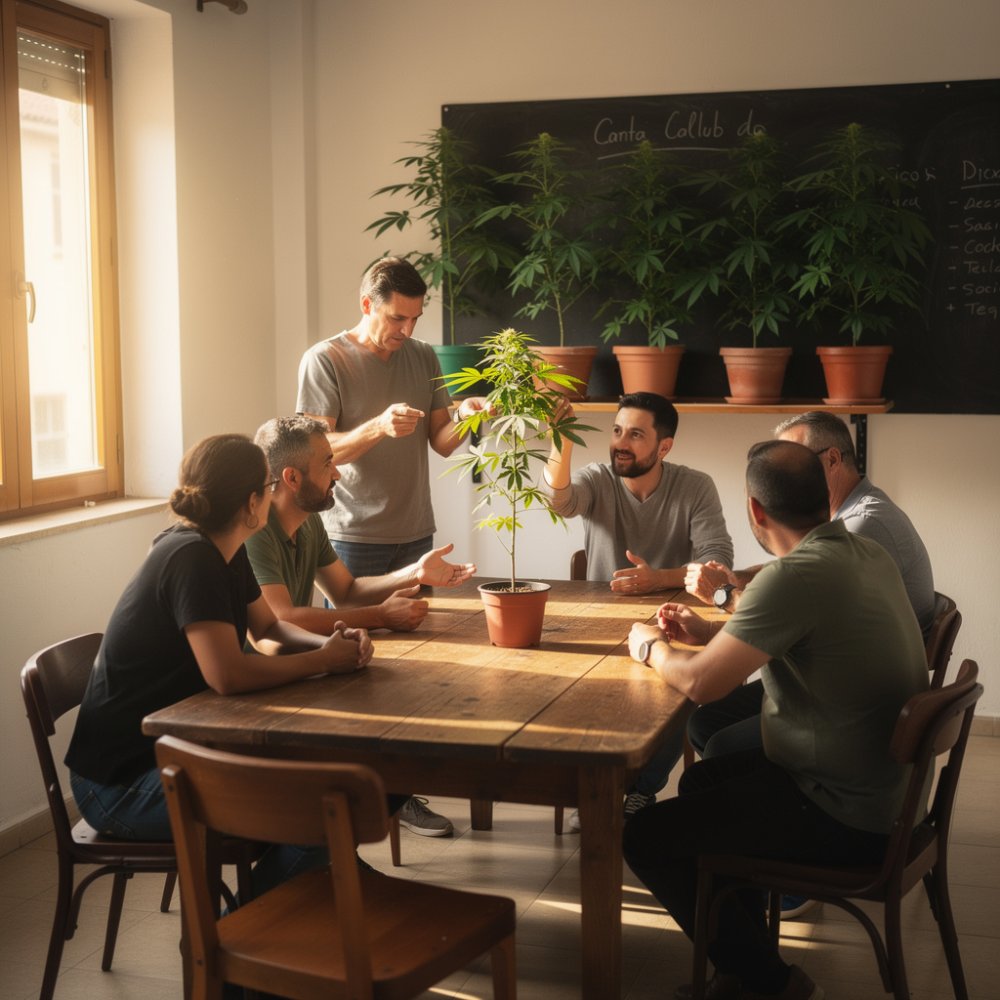
Legal Framework: A Persistent Gray Area
Unlike countries such as Germany, Canada, or Uruguay, Spain lacks state legislation that expressly regulates Cannabis Social Club activity. Their existence rests on constitutional principles and jurisprudential doctrine built case by case, without a clear or unified legislative basis at the national level.
Legal Foundations
| Norm or Principle | Relevant Content |
|---|---|
| Spanish Constitution, art. 22 | Fundamental right of association |
| Organic Law 1/2002 | Regulation of the exercise of the right of association |
| Penal Code, arts. 368-378 | Criminalization of offenses against public health (drug trafficking) |
| Organic Law 4/2015 (LOPSC) | Citizen Security Law: administrative sanctions for consumption or possession in public areas |
| Supreme Court Case Law | Doctrine of "shared consumption" and its requirements for penal atypicality |
The Shared Consumption Doctrine
The jurisprudential basis supporting CSCs is the shared consumption doctrine, developed by the Supreme Court through various rulings. According to this doctrine, collective drug consumption among a closed group of persons is not constitutive of a crime if the following requirements are met simultaneously:
- Consumers must be specific and previously identified persons
- Consumption must take place in a closed and private space, inaccessible to the general public
- The quantity must be reduced and intended for immediate or near-term consumption
- Participants must prove to be habitual consumers, to exclude any induction to consumption
- There must be no dissemination or access by third parties outside the group
However, the Supreme Court itself has repeatedly warned that this doctrine was designed for small groups and sporadic situations. Its extrapolation to associations with hundreds of members and continuous production is legally questionable and has been the basis for several convictions.
Penalties for Violation
| Type of Infraction | Legal Consequence |
|---|---|
| Consumption in public areas | Administrative fine of 601 to 30,000 euros (LOPSC, art. 36.16) |
| Possession in public areas | Administrative fine under the same legal basis |
| Drug trafficking or distribution | Imprisonment of 1 to 3 years and fine (art. 368 CP) |
| Distribution of substances causing serious harm | Imprisonment of 3 to 6 years and fine (art. 368 CP) |
| Distribution to minors | Aggravating factor: increased penalty (art. 369 CP) |
Regulation by Autonomous Community
Faced with the absence of state legislation, several autonomous communities attempted to regulate cannabis association activity in their territories. The results have been systematically struck down by the Constitutional Court, reflecting the tension between regional political will and the state's reserved powers over narcotics.
Comparative Table of Autonomous Regulations
| Autonomous Community | Legislative Initiative | Current Status |
|---|---|---|
| Catalonia | Law 13/2017, July 6, on cannabis consumer associations | Struck down by Constitutional Court (STC 100/2018): invasion of state competence |
| Navarre | Regional Law 24/2014, regulating cannabis user collectives | Struck down by Constitutional Court (STC 144/2017) |
| Basque Country | Law 7/2014 on addictions (provisions on cannabis clubs) | Partially in force; cannabis provisions were challenged and substantially limited |
| Andalusia | Non-legislative proposal for medical cannabis regulation (2018) | Approved only for medical use and research; recreational use rejected |
| Valencian Community | No specific legislation | Clubs operate under general association framework |
| Balearic Islands | No specific legislation | Clubs operate under general association framework |
| Madrid | No specific legislation | Clubs operate under general association framework |
Catalonia: The Paradigmatic Case
Catalonia was for years the epicenter of Spain's cannabis movement. Barcelona came to concentrate over 200 cannabis clubs at the peak of expansion. The Catalan Parliament approved Law 13/2017 in 2017, which comprehensively regulated cannabis consumer association activity, establishing a mandatory registration system, health standards, and clear operational limits.
The Constitutional Court annulled this law entirely through Ruling 100/2018, of September 19, deeming that the regulation of controlled substances is exclusive state competence and that the regional norm invaded that domain.
In parallel, the Barcelona City Council approved in 2016 a Special Urban Planning Plan (PEUAT) that limits club locations and imposes minimum distances from educational centers and other clubs. In 2024, the council intensified closure actions, shutting down 30 clubs for failing to comply with this urban planning regulations. Despite this, Barcelona remains the Spanish city with the highest concentration of Cannabis Social Clubs.
Navarre: Pioneer in Regulation, Pioneer in Being Annulled
Navarre was in 2014 the first autonomous community to pass a specific law on cannabis clubs (Regional Law 24/2014). The regulation addressed cultivation, distribution, and consumption within associations and even contemplated the creation of a Navarre Cannabis Institute to oversee the sector. The Constitutional Court struck it down in 2017 (STC 144/2017) for the same reasons as the Catalan law: competence in narcotics and pharmaceutical legislation belongs exclusively to the state.
Basque Country: Partial Regulation with Public Health Approach
The Basque Country incorporated provisions on cannabis clubs within its Addiction Law 7/2014, addressing the issue from a harm reduction and public health perspective. Although more specific cannabis provisions were challenged, the community maintains a comparatively tolerant approach toward associations operating within current legal parameters.
How to Become a Member of a Cannabis Social Club
General Requirements
Admission criteria vary among clubs, but the most common requirements are as follows:
| Requirement | Detail |
|---|---|
| Minimum age | 18 or 21 years depending on the club's internal regulations |
| Identification | Valid ID card, resident certificate, or passport |
| Invitation from a member | Most clubs require being introduced by an existing member |
| Residency | Some clubs require residency in Spain or in the locality |
| Registration fee | Typically between 20 and 50 euros |
| Periodic fee | Variable: between 10 and 50 euros monthly depending on the club |
| Consumer declaration | Signature of a declaration confirming regular consumer status |
Typical Admission Process
- Initial Contact: An active member introduces the candidate to the club (closed invitation system, essential to preserve the private nature of the association).
- Formal Application: The candidate completes a form with personal information and signs the club's bylaws.
- Verification: The club verifies the applicant's identity, age, and residency if required.
- Interview: Some clubs conduct a personal interview to evaluate the candidate's profile and needs.
- Approval: The board or, where applicable, the member assembly approves admission.
- Fee Payment: The new member pays the registration fee and first periodic fee.
- Effective Access: After a variable waiting period depending on the club, the member can access the facilities and receive their cannabis allocation.
Note: Those considering growing their own plants for personal consumption can find high-quality seeds adapted to Mediterranean climates, available in feminized and autoflowering varieties.
Internal Operation of a CSC
Organizational Structure
Cannabis Social Clubs are organized following the standard association scheme of Spanish law:
- General Assembly: Sovereign body, comprising all members, which approves bylaws, budgets, and annual reports
- Board of Directors: Governing and legal representative body (president, secretary, treasurer)
- Cultivation Commission: Responsible for planning and executing production, ensuring quality and traceability
- Distribution Commission: Manages internal distribution and dispensing records
Economic Model
Financial operation is governed by the principle of self-financing without profit motive:
- Member fees cover all cultivation costs, rent, supplies, and personnel expenses
- Cannabis is distributed to members at actual cost price, with no commercial markup
- Economic surpluses are reinvested in facilities or directed toward association activities
- Profit generation or dividend distribution among members is expressly prohibited
Dispensation
Internal distribution follows strict protocols designed to preserve the private and closed nature of the activity:
- Each member declares a projected monthly consumption upon registration, which serves as the basis for cultivation planning
- The club produces based on the aggregate demand of its members, avoiding surpluses that could be interpreted as production for external distribution
- Dispensing occurs in person at the club's facilities, with member identification via membership card
- A detailed dispensing record is maintained with date, quantity delivered, and recipient member information
Legal Risks: What You Should Know
Despite their social entrenchment in certain Spanish cities, Cannabis Social Clubs are not strictly legal. They operate in a legal gray area, and both members and management assume real risks that deserve careful consideration.
For Members
- Consumption in Public Areas: Carrying cannabis outside the club may result in administrative fines of between 601 and 30,000 euros under the LOPSC
- Quantities Exceeding Personal Consumption: Carrying volumes exceeding what is reasonably attributable to personal consumption may result in criminal investigations for suspected trafficking
- Sharing with Non-Members: Providing cannabis to persons outside the club – even free of charge – may constitute drug trafficking
For Management and the Club as a Whole
- Criminal Prosecution: There are precedents of management prosecuted for crimes against public health, especially when the club's scale exceeds the parameters of the shared consumption doctrine
- Administrative Closure: City councils may order closure for violation of urban planning, activity, or licensing regulations
- Seizure and Raids: Law enforcement may intervene plantations if they estimate that production exceeds declared shared consumption needs
Relevant Rulings
| Case | Ruling | Implications |
|---|---|---|
| STS 484/2015 | Conviction of CSC management in Bilbao | Supreme Court found that production scale and member number exceeded shared consumption doctrine limits |
| STC 100/2018 | Annulment of Catalan Law 13/2017 | Exclusive state competence on narcotics; CSCs cannot be regulated by autonomous law |
| STC 144/2017 | Annulment of Navarre Regional Law 24/2014 | Same constitutional basis as previous ruling |
| Barcelona Closures (2024) | Closure of 30 clubs | Violation of municipal urban planning regulations; reinforcement of PEUAT enforcement |
Differences from Other European Models
| Aspect | Spain (CSC) | Germany (Anbauvereinigung) | Netherlands (Coffeeshop) |
|---|---|---|---|
| Legal Basis | Gray area (association rights and case law) | Specific federal law (KCanG, 2024) | Administrative tolerance (gedoogbeleid) |
| Regulation | No state law; annulled autonomous attempts | Detailed federal regulation (§§ 11-23 KCanG) | AHOJG criteria established by prosecution |
| Maximum Members | No fixed legal limit; varies by club | 500 members maximum | Not applicable (are customers, not members) |
| Cultivation | Collective, managed by association | Collective, managed by association | Unregulated (supply operates via the "back door") |
| Distribution to Third Parties | Expressly prohibited | Expressly prohibited | Tolerated up to 5 grams per transaction |
| Consumption on Premises | Generally permitted | Prohibited by KCanG | Permitted on premises |
| Advertising | No express regulation | Prohibited | Prohibited |
Frequently Asked Questions (FAQ)
Are Cannabis Social Clubs Legal in Spain
They are not legal in the strict sense, but neither are they illegal by definition. They operate in a legal gray area, relying on the right of association and the Supreme Court's shared consumption doctrine. Their legal viability depends on strictly complying with the requirements established by the Supreme Court, and failure to meet any of them can result in criminal consequences.
Can I Join as a Tourist
It depends on each club's internal regulations. Some accept tourists over the age of majority with a valid passport; others require proof of residency in Spain or in the autonomous community where the club is located. In any case, a prior invitation from an existing member and payment of established fees will be necessary.
How Much Cannabis Can I Get from a CSC
There is no uniform legal limit at the state level. Each club establishes its own dispensing limits based on the projected monthly consumption declared by the member upon registration. In practice, typical amounts range from 60 to 90 grams monthly, though this range varies significantly by club.
Can I Take Cannabis Outside the Club
Technically yes, but with concrete legal risks. Carrying cannabis in public areas constitutes an administrative violation punishable by fines of between 601 and 30,000 euros under the LOPSC. It is advisable to exercise extreme discretion and transport only quantities that unequivocally correspond to personal consumption.
What Happens if a Club Is Closed
If authorities close a club, members lose access to the facilities and cannabis in cultivation or storage. Management may face criminal liability if it is proven that club activity exceeded shared consumption limits. Fees paid are generally not subject to refund.
Are There Clubs in All Autonomous Communities
Associations exist in most communities, though their concentration varies considerably. Catalonia (especially Barcelona), Basque Country, Madrid, and Andalusia are territories with the largest number of active clubs. In communities with more restrictive positions or lower social demand, supply is notably more limited.
Can Minors Access a Cannabis Social Club
No, under no circumstances. All clubs require majority age as a minimum and non-negotiable requirement, and many raise that threshold to 21 years old. Distribution of cannabis to minors constitutes an aggravated crime expressly defined in Article 369 of the Penal Code.
Future Perspectives
The future of Cannabis Social Clubs in Spain ultimately depends on a political decision that has been pending for years: the passage of comprehensive state regulation of cannabis. Various parliamentary initiatives have attempted to promote such legislation in the past decade without reaching the necessary consensus.
The Confederation of Cannabis Associations Federations (ConFAC), which brings together the sector's main federations, has been advocating for over two decades for a stable legal framework guaranteeing real legal certainty for associations, their members, and management.
Meanwhile, CSCs continue operating in legal uncertainty, conditioned by each moment's judicial interpretation and the political will of each city council and autonomous community. The German model – with federal regulation approved in 2024 through the Cannabis Law (KCanG) – offers a concrete reference for how to articulate regulation that recognizes cannabis associations within a clear legal framework, and could influence Spain's legislative debate in coming years.
This article was published on March 1, 2026. Legislation may have changed since publication. All information is provided without guarantee of currency.
Sources: Spanish Constitution, Penal Code (arts. 368-378), Organic Law 4/2015 on Citizen Security, Catalonia Law 13/2017 (struck down by STC 100/2018), Navarre Regional Law 24/2014 (struck down by STC 144/2017), German Cannabis Law (KCanG, 2024), Supreme Court, ConFAC, Barcelona City Council.