


 English (English)
 Deutsch (German)
 Čeština (Czech)
 Italiano (Italian)
 Hrvatski (Croatian)
 Română (Romanian)
 български език (Bulgarian)
 Magyar (Hungarian)
 Español (Spanish)
 Français (French)
 Nederlands (Dutch)
 Polski (Polish)
 Slovenčina (Slovak)
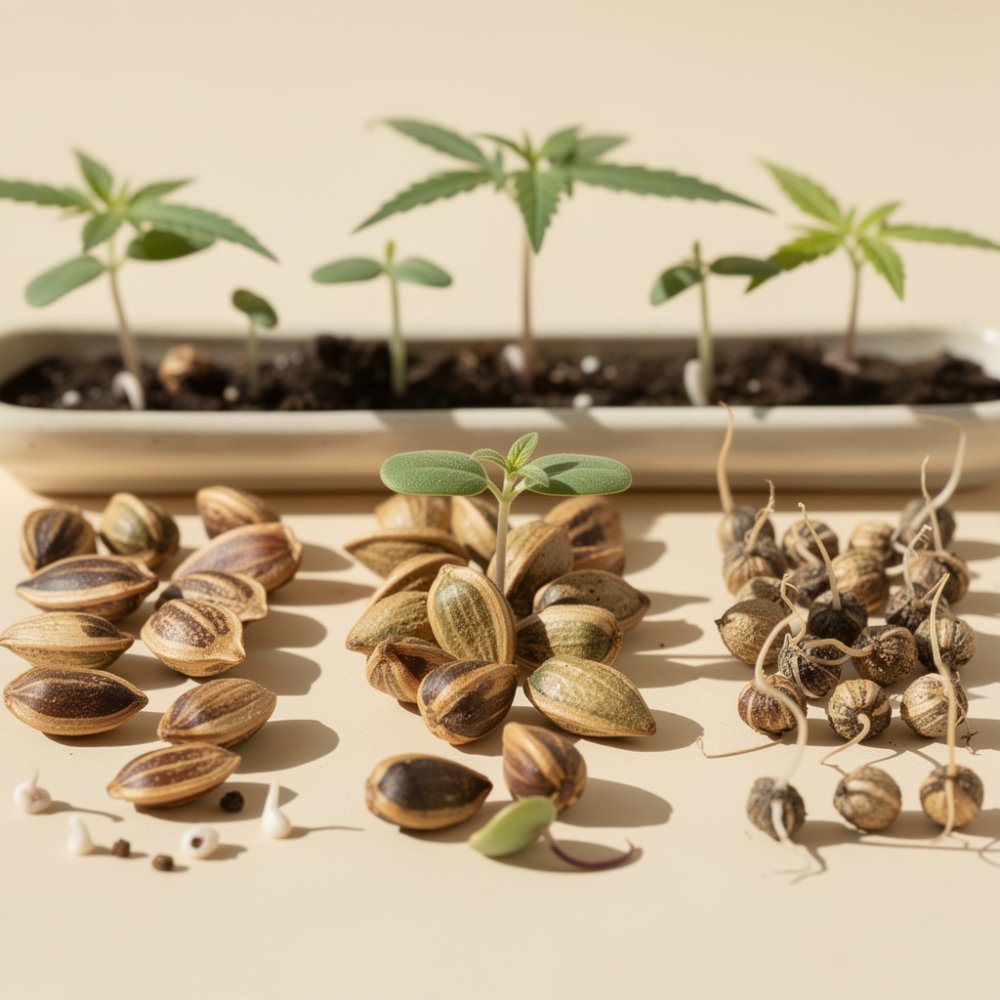
Choosing the right type of cannabis seeds is one of the most fundamental decisions every grower makes. Autoflowering, feminized, and regular seeds differ fundamentally in genetics, plant behavior, care requirements, and final yield. This guide breaks down each type in depth – from genetics through practical advantages and disadvantages to specific recommendations for various growing situations.



Basic Overview of Seed Types
What Are Regular Seeds
Regular seeds are the most natural form of cannabis seeds. They result from natural pollination of a female plant by male pollen and carry genetic information from both parents. Upon germination, they can grow into either male or female plants – roughly in a 50:50 ratio.
Regular seeds are the traditional choice of breeders and experienced growers who want to work with complete genetic diversity and create their own lines. Explore our regular seeds selection.
What Are Feminized Seeds
Feminized seeds are specially bred to produce exclusively female plants (with 99%+ probability). Female plants are the ones that produce resinous flowers rich in cannabinoids – precisely what most growers are after.
Feminized seed production involves stressing a female plant – most commonly by spraying with colloidal silver or gibberellic acid – forcing it to produce male pollen. This "female pollen" then pollinates another female plant, and the resulting seeds carry exclusively female chromosomes (XX).
Feminized seeds are the most popular choice for growers who want maximum yield without the hassle of identifying and removing male plants. Explore our feminized seeds selection.
What Are Autoflowering Seeds
Autoflowering seeds result from crosses with Cannabis ruderalis – a wild cannabis strain originating from central Asia, Siberia, and eastern Europe. Ruderalis evolved in extreme conditions with short growing seasons and irregular light cycles, and thus developed the ability to automatically transition to flowering based on plant age, not day length.
Modern autoflowering strains are the result of sophisticated breeding: ruderalis genetics ensure the autoflowering trait, while an indica or sativa parent contributes potency, aroma profile, and yield. Explore our autoflowering seeds selection.
Genetics Behind Autoflowering: Cannabis Ruderalis
What Is Cannabis Ruderalis
Cannabis ruderalis is the third major species (or subspecies) of the Cannabis genus, alongside Cannabis indica and Cannabis sativa. Key characteristics:
- Origin: Russia, central Asia, central and eastern Europe.
- Size: Small, bushy (30–80 cm).
- Flowering: Automatic, photoperiod-independent – the plant begins flowering after 2–4 weeks of vegetative growth.
- THC content: Naturally low (typically under 3%).
- Hardiness: Extremely resistant to cold, disease, and growing stress.
How Modern Autoflowering Strains Developed
Ruderalis itself is commercially uninteresting for growers – low THC, small yields, unremarkable flavor. The key breakthrough came when breeders began systematically crossing ruderalis with quality indica and sativa strains:
- First generation (F1): Ruderalis × indica/sativa cross. Result: unstable autoflowering trait, low potency.
- Backcross: F1 hybrid is repeatedly crossed back to the quality parent. Potency and yield gradually increase while the autoflowering trait is maintained.
- Stabilization: After 4–6 generations, a stable strain emerges with potency comparable to photoperiodic seeds.
Modern autoflowering strains of 2025/2026 are the result of a decade of intensive breeding and are significantly better than early autoflowers from 2005–2010 – both in terms of potency (20–25%+ THC/CBD) and achievable yields (100–300 g/plant).
Genetics of Photoperiodic Flowering
Photoperiodic seeds – both regular and feminized – respond to the ratio of light and darkness. In nature, they begin flowering as days shorten in late summer. With indoor growing, flowering is triggered by switching to a 12/12 cycle (12 hours light, 12 hours uninterrupted darkness).
This mechanism is controlled by phytochrome – a protein that measures the ratio of red and far-red light. Once the dark period exceeds a critical threshold (approximately 10–12 hours), the plant activates genes responsible for flower formation. Any disruption of the dark phase – even brief – can trigger stress or hermaphroditism in sensitive genetics.
Detailed Comparison Table
| Parameter | Regular | Feminized | Autoflowering |
|---|---|---|---|
| Sex | 50% female / 50% male | 99%+ female | 99%+ female |
| Light regime (indoor) | 18/6 veg → 12/12 flower | 18/6 veg → 12/12 flower | 18/6 or 20/4 full cycle |
| Time from seed to harvest | 4–7 months | 3–5 months | 8–12 weeks |
| Vegetative phase | Flexible (grower determines) | Flexible (grower determines) | Fixed (2–4 weeks) |
| Yield (indoor, per m²) | 400–600 g/m² | 400–600 g/m² | 50–200 g/plant |
| Yield (outdoor) | 200–1000+ g | 200–1000+ g | 50–250 g |
| Maximum height | 100–300+ cm | 100–300+ cm | 40–120 cm |
| Potency (THC/CBD) | High | High | Medium to high |
| Stress resistance | Medium | Medium | High |
| Cloning | Yes | Yes | Technically yes, practically unsuitable |
| Training techniques | All (LST, HST, ScrOG, topping) | All | LST only |
| Seed price | Lowest | Medium | Highest |
| Growing difficulty | High | Medium | Low |
| Suitability for breeding | Ideal | Possible | Possible but difficult |
| Multiple harvests per year (outdoor) | No (1 harvest) | No (1 harvest) | Yes (2–3 harvests) |
Regular Seeds – Detailed Analysis
Advantages of Regular Seeds
-
Genetic diversity and natural robustness. Regular seeds carry complete genetic information from both parents. Because they haven't undergone the stressful feminization process, plants tend to be genetically most stable and overall more robust.
-
Essential for breeding. Creating your own crosses requires male plants as a pollen source. Breeders work almost exclusively with regular seeds to select and combine the best males and females.
-
Reliable mother plants for cloning. Regular females are considered the best mothers for cloning – clones are genetically identical, stable, and without risk of carrying feminization stress.
-
Lower seed cost. Regular seeds are typically 20–40% cheaper than feminized seeds, particularly noticeable with larger purchases.
-
Own seed production. With regular seeds and controlled pollination, you can create your own seed supply without dependence on external seedbanks.
Disadvantages of Regular Seeds
-
Approximately 50% male plants. Males must be identified and removed before pollination, otherwise yield decreases. This means wasted space, light, nutrients, and time.
-
Risk of unwanted pollination. Late male identification can lead to pollination of females, seed production, and significant reduction in harvest quality.
-
Sex is only revealed at pre-flower. Sex identification is usually only possible 4–6 weeks after germination – and requires experience to avoid mistakes.
-
Larger space requirements. To obtain a given number of females, you need to germinate significantly more seeds than the final number of plants you'll harvest.
When to Choose Regular Seeds
- You plan to breed your own strains or stabilize new crosses.
- You want to establish a reliable mother plant for repeated cloning.
- You produce your own seeds for future seasons.
- You're an experienced grower requiring maximum genetic diversity for selection.
- Seed cost savings are a priority when purchasing.
Feminized Seeds – Detailed Analysis
Advantages of Feminized Seeds
-
No male plants. Female probability exceeds 99%, eliminating all work associated with identifying and removing males.
-
Maximum yield per m². Every plant produces flowers – a critical advantage for growers with limited space or strict plant count limits.
-
Simpler growing process. Without needing to sex plants, the grower can focus entirely on optimizing environment, nutrition, and training.
-
Top-tier potency and yields. Premium seedbanks invest the most breeding effort in feminized lines – the result is genetics with the highest available quality.
-
Flexible vegetative phase. Indoors, vegetative growth can be extended arbitrarily, directly influencing plant size and yield.
-
Full compatibility with training techniques. Topping, FIMming, ScrOG, mainlining, supercropping – all advanced methods work without restrictions.
Disadvantages of Feminized Seeds
-
Higher seed cost compared to regular – typically 1.5–2x.
-
Photoperiod dependence. Indoors, you must switch to 12/12 to initiate flowering, extending the total cycle compared to autoflowers.
-
Sensitivity to dark period disruption. Interruption of the night cycle with light – even brief – can trigger hermaphroditism or reveg (return to vegetative phase).
-
Breeding without males requires advanced techniques. Creating new crosses requires reversing female sex using colloidal silver, demanding experience and equipment.
-
Lower phenotypic variability. Growing clones of one phenotype loses the genetic diversity naturally present with regular seeds.
When to Choose Feminized Seeds
- You want to maximize yield from every m² of growing space.
- You grow indoors and want full control over vegetative and flowering phase length.
- You don't want to deal with sex identification.
- You seek the highest harvest quality – potency, terpene profile, and visual flower appeal.
- You have intermediate experience and want to use training techniques.
Autoflowering Seeds – Detailed Analysis
Advantages of Autoflowering Seeds
-
Very fast cycle. From seed to harvest in 8–12 weeks, with the quickest strains completing the entire cycle in 60 days.
-
Automatic flowering without light management concerns. The plant transitions to flowering on its own after 2–4 weeks. Indoors, you can maintain 18/6 or 20/4 throughout the cycle without switching.
-
Compact growth. Most autoflowers reach 40–100 cm – ideal for small grow tents, cabinets, or balconies.
-
Multiple harvests per outdoor season. Outdoors in Europe, you can plant autoflowers in spring, summer, and late summer and realistically harvest 2–3 crops in a single season.
-
Increased hardiness from ruderalis genetics. Autoflowers tolerate lower temperatures, humidity fluctuations, diseases, and growing mistakes better – critical advantages for beginners or guerrilla growing.
-
Accessibility for beginners. Minimal light cycle management requirements and naturally compact habit make autoflowers the easiest entry point into growing.
-
Discretion. Small size aids concealment and reduces visibility – advantageous for balcony or guerrilla growing.
Disadvantages of Autoflowering Seeds
-
Lower total yields. Typically 50–200 g/plant versus 200–600+ g for photoperiodic strains under comparable conditions.
-
Fixed vegetative phase prevents correction. Any stress in the first 2–4 weeks – overfeeding, overwatering, root damage – permanently and irreparably reduces final yield.
-
Limited training options. HST techniques (topping, supercropping, FIMming) are not recommended because the plant lacks sufficient vegetative time to recover. The safe choice is LST only.
-
Cloning is practically unsuitable. A clone shares the biological timer with the mother – a clone from a four-week-old plant will have only days of vegetative growth before automatically flowering, resulting in negligible yield.
-
Higher seed cost. Autoflowering seeds are typically the most expensive of all three categories.
-
Slightly lower maximum potency. Despite significant breeder progress, premium autoflowers may still be 2–5% weaker than their photoperiodic counterparts, though top strains now commonly reach 20–25% THC/CBD.
-
Higher electricity consumption per gram yield. 18–20 hours of daily light throughout the cycle without the ability to shorten the light phase increases operating costs per gram of harvest.
When to Choose Autoflowering Seeds
- You're a beginner wanting a quick, straightforward first grow with minimal technical complications.
- You grow in limited space – balcony, small tent, cabinet.
- You want multiple outdoor harvests in a single season.
- Your climate zone offers only a short summer (northern Europe, high altitudes).
- You prefer discreet growing due to small plant size.
- You can't fully control the light regime – for example, growing near street lighting.
Fast Version Seeds – A Hybrid Approach
Beyond the three main categories, there are also Fast Version seeds – photoperiodic (feminized) strains with a trace of autoflowering genetics that shorten flowering time by 1–2 weeks while still requiring a 12/12 switch to initiate flowering.
Fast Version represents a thoughtful compromise: faster harvest than classic feminized strains while retaining the higher yields and potency typical of photoperiodic genetics. For outdoor growers in central Europe, this can be the difference between a successful harvest and early frost damage. Check out our fast version seeds selection.
If you're still looking for your favorite genetics, it's worth mentioning seed mixes – combinations of various strains ideal for experimentation and discovering new flavors and effects.
Indoor vs. Outdoor – Which Seed Type to Choose
Indoor Growing
| Type | Indoor Suitability | Why |
|---|---|---|
| Feminized | Best | Full vegetative phase control, maximum yield per m², ideal for ScrOG |
| Autoflowering | Very good | Fast turnaround, perpetual harvest, ideal for small spaces |
| Regular | Good (for experienced) | Suitable for breeding and selecting mother plants, requires sex identification |
For a detailed indoor growing guide, see our indoor growing guide.
Outdoor Growing
| Type | Outdoor Suitability | Why |
|---|---|---|
| Autoflowering | Best for short summers | Independent of photoperiod, completes cycle in short season, enables multiple harvests |
| Feminized | Best for long summers | Maximum yields with sufficient season length and stable photoperiod |
| Regular | Good | Natural hardiness, opportunity for natural crossing, lower seed cost |
For a detailed outdoor growing guide, see our outdoor growing guide.
Decision-Making Guide
By Experience Level
| Experience Level | Recommendation |
|---|---|
| Complete beginner | Autoflowering – forgives mistakes, quick results, no light management requirements |
| Beginner with ambitions | Feminized – higher yield, requires basic light cycle management |
| Advanced grower | Feminized – full cycle control, advanced training techniques |
| Expert / Breeder | Regular – genetic diversity, breeding, creating own lines |
By Available Space
| Space | Recommendation |
|---|---|
| Micro grow (PC cabinet, bucket) | Autoflowering – compact growth |
| Small tent (60×60 cm) | Autoflowering or 1–2 feminized |
| Medium tent (120×120 cm) | 4–6 feminized (ScrOG) or 6–9 autoflowers |
| Large tent / room (240+ cm) | Feminized or regular |
| Outdoor garden | Feminized (summer season) + autoflowering (spring and fall) |
| Balcony / terrace | Autoflowering – compact, discreet |
| Guerrilla grow | Autoflowering – fast, inconspicuous, hardy |
By Climate Zone
| Zone | Recommendation |
|---|---|
| Southern Europe (Spain, Italy, Greece) | Feminized sativa – long, hot summer allows maximum yields |
| Central Europe (Czech Republic, Germany, Austria) | Feminized indica/hybrid with shorter flowering + autoflowering |
| Northern Europe (Scandinavia, Baltics) | Autoflowering – short season and insufficient photoperiod eliminate photoperiodic strains |
| Indoor (anywhere) | Feminized – environmental climate is under full grower control |
Myths and Facts
Myth: "Autoflowers Are Weak"
Fact: In 2025/2026, autoflowering strains exist with 20–25% THC or CBD. Through intensive breeding over the past decade, the potency difference compared to photoperiodic genetics has shrunk dramatically.
Myth: "Regular Seeds Are Suitable for Beginners"
Fact: The opposite is true. Regular seeds require the ability to reliably identify and remove male plants in time – without experience, unwanted pollination risks destroying your entire harvest.
Myth: "Feminized Seeds Produce Hermaphrodites"
Fact: Quality feminized seeds from reputable seedbanks have extremely low hermaphrodite rates. In most cases, the cause is stress – dark period disruption, temperature fluctuation, or overfeeding – not the genetics of the seeds themselves.
Myth: "You Can't Train Autoflowers"
Fact: LST (low-stress training) works very well with autoflowers and can significantly increase yield by improving light penetration to lower branches. HST techniques (topping, supercropping) are not recommended – the plant lacks sufficient vegetative time for full recovery.
Myth: "Regular Seeds Have Better Genetics Than Feminized"
Fact: Feminized and autoflowering seeds derive from the same genetic foundation as regular seeds – they simply undergo additional breeding steps. Resulting quality depends on the seedbank and specific strain, not the seed type itself.
Frequently Asked Questions (FAQ)
What's the Main Difference Between Autoflowering and Feminized Seeds?
The key difference lies in the flowering trigger mechanism. Feminized (photoperiodic) seeds require a light cycle change to 12/12 to initiate flowering. Autoflowering seeds transition to flowering automatically after 2–4 weeks from germination, regardless of light period length. Both categories produce almost exclusively female plants.
Can I Grow Autoflowers and Photoperiodic Plants in the Same Space?
With indoor growing, it's problematic. Autoflowers require 18–20 hours of daily light, while photoperiodic flowering plants need a 12-hour dark period. Growing them together outdoors creates no technical barriers.
How Many Seeds Do I Need for My First Grow?
For a start, we recommend 3–5 seeds. From this amount, 3–5 females will grow from feminized and autoflowering seeds. With regular seeds, expect roughly half to be male – so prepare 6–10 seeds for 3–5 females.
Can I Take Clones from an Autoflower?
Technically yes, but the result is usually disappointing. The clone shares the biological timer with the mother plant – a clone taken from a four-week-old plant will have only days of vegetative growth before automatically flowering, with minimal yield.
What Seeds Are Best for Outdoor Cultivation in the Czech Republic?
The Czech Republic is in central Europe (48–51° N), where summer is relatively short and early fall frosts arrive early. For a reliable harvest, we recommend autoflowering strains or feminized indica-dominant hybrids with short flowering times (8–9 weeks). Pure sativa strains require too long a maturation period and in most years won't complete the cycle before the first frosts.
How Do I Identify Plant Sex with Regular Seeds?
Sex reveals itself at pre-flower, typically 4–6 weeks after germination. Females develop white pistils – delicate hairs shaped like a V – near the nodes (branching points). Males develop small ball-shaped pollen sacs arranged in tiny clusters. If unsure, wait a few days – sexual characteristics become clear quickly, making mistakes unlikely.
Sources
- Royal Queen Seeds. "Regular vs. Feminized vs. Autoflowering Cannabis Seeds." royalqueenseeds.com
- ILGM. "Regular, Feminized And Autoflower Marijuana Seeds Explained." ilgm.com
- Herbies. "Autoflower vs Feminized Seeds: What's the Difference?" herbiesheadshop.com