


 English (English)
 Deutsch (German)
 Čeština (Czech)
 Italiano (Italian)
 Hrvatski (Croatian)
 Română (Romanian)
 български език (Bulgarian)
 Magyar (Hungarian)
 Español (Spanish)
 Français (French)
 Nederlands (Dutch)
 Polski (Polish)
 Slovenčina (Slovak)
Pinene -- a terpene with the scent of a pine forest

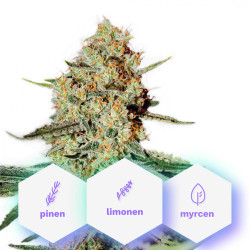
Pinene -- a terpene with the scent of a pine forest
A walk through a pine forest has demonstrably positive effects on the psyche and immune system -- this phenomenon, known in Japan as shinrin-yoku (forest bathing), is largely mediated by pinene itself. This bicyclic monoterpene is among the most widespread terpenes in the entire plant kingdom, and in cannabis it plays a fascinating role: it can suppress the negative effects of THC on memory, bring its own anti-inflammatory benefits, and improve airway passage through bronchodilatory properties.
What is pinene and its two forms
Pinene (C10H16) is a bicyclic monoterpene that exists in two structural isomers differing in the arrangement of the double bond in the bicyclic ring.
Alpha-pinene
The dominant form in cannabis and pine resin. It has a characteristic fresh, sharp coniferous aroma. It is the most abundant terpenoid in nature -- forests around the world produce it daily in quantities of millions of tons, forming a significant part of atmospheric volatile organic compounds.
Beta-pinene
A rarer isomer with a slightly different aromatic profile -- more woody, herbaceous, and less sharp than alpha-pinene. It is found in higher concentrations in basil and dill. In cannabis, it occurs in smaller quantities but contributes to the overall terpene character of the strain.
Both isomers share the same basic pharmacological properties but differ in the intensity of some effects. In the context of cannabis, alpha-pinene is usually referred to unless otherwise specified. The molecular weight of both isomers is 136.23 g/mol, and the boiling point of alpha-pinene is approximately 155 °C.
Aroma and taste profile
Pinene has an unmistakable scent that most people immediately associate with a coniferous forest:
- Pine dominance -- fresh, sharp tone of raw resin
- Coniferous nuances -- spruce, fir character
- Herbal undertones -- rosemary, basil, sage
- Eucalyptus accents -- cooling, camphoraceous finish (especially in beta-pinene)
- Earthy background -- subtle turpentine nuances in deeper tones
In the world of cannabis, pinene is responsible for "sharp," "clean," and "fresh" tones typical of sativa-dominant strains. If you detect forest or conifer notes in cannabis, you are almost certainly dealing with high pinene content.
Where pinene occurs in nature
Pinene is practically ubiquitous in the plant kingdom:
| Plant | Isomer | Content | Note |
|---|---|---|---|
| Pine (Pinus) | Alpha and beta | 40-70% essential oil | Primary natural source |
| Rosemary | Alpha | 15-25% essential oil | Significant aromatic component |
| Basil | Beta | 5-15% essential oil | Herbal pinene |
| Eucalyptus | Alpha | 5-10% essential oil | Complementary terpene |
| Sage | Alpha and beta | 5-15% essential oil | Traditional medicinal herb |
| Parsley | Beta | 3-8% essential oil | Lower content |
| Juniper | Alpha | 10-20% essential oil | Key component of resin |
| Cannabis | Alpha and beta | 1-5% terpenes | Third to fourth most common |
Trees and shrubs produce pinene as a defense mechanism against herbivorous insects -- its sharp aroma repels pests and antimicrobial properties protect damaged tissues from infection. This is precisely why pinene concentration in resin is significantly higher than in leaves or fruits.
Effects and potential health benefits
Anti-inflammatory effects
Pinene exhibits significant anti-inflammatory action with a well-documented mechanism of action. A study published in the American Journal of Chinese Medicine (2015) demonstrated that alpha-pinene inhibits the production of pro-inflammatory mediators (TNF-alpha, IL-6, NO) through suppression of NF-kappaB and MAPK signaling pathways. These pathways play a key role in chronic inflammatory diseases, including arthritis and inflammatory bowel disease.
Further research in Life Sciences (2012) showed that alpha-pinene reduces inflammation in a model of allergic rhinitis in mice, suggesting potential use in allergic airway diseases.
Bronchodilatory effects
One of the most clinically interesting properties of pinene is its ability to widen the bronchi. Studies have demonstrated that alpha-pinene relaxes the smooth muscle of the bronchi, thereby improving airway passage. This mechanism explains why:
- Time in a pine forest subjectively improves breathing in people with mild bronchial obstruction
- Traditional medicine uses pine resin for airway diseases
- Eucalyptus and pine inhalations are folk remedies for colds and upper respiratory inflammation
In the context of cannabis, the bronchodilatory effect of pinene is particularly relevant for those who inhale cannabis -- pinene can partly compensate for the irritant effects of smoke or vapor on the airways.
Effects on memory and cognitive function (THC counterbalance)
The most fascinating aspect of pinene in the context of cannabis is its ability to suppress the negative effect of THC on short-term memory. Ethan Russo in his groundbreaking work (2011) described how pinene inhibits the enzyme acetylcholinesterase (AChE), thereby increasing the availability of acetylcholine -- a key neurotransmitter for memory, concentration, and learning.
THC, conversely, reduces cholinergic transmission, leading to typical short-term memory impairments. Pinene can partly compensate for this effect. This explains why:
- Strains with high pinene content (e.g., Jack Herer) are associated with a "cleaner," more focused high
- Indica strains with low pinene cause more pronounced "brain fog"
- Full spectrum products with preserved terpene profiles may have less pronounced cognitive side effects compared to isolates
Antimicrobial activity
Pinene exhibits broad-spectrum antimicrobial activity relevant from a clinical perspective. A study in Molecules (2012) demonstrated effectiveness against a range of pathogens including:
- Staphylococcus aureus (including antibiotic-resistant MRSA strains)
- Candida albicans
- Aspergillus niger
- Streptococcus pneumoniae
Antioxidant effects
Alpha-pinene is an effective free radical scavenger. A study in the Journal of Food Science showed that pinene neutralizes reactive oxygen species (ROS) and protects cell membranes from oxidative damage -- a mechanism that may contribute to its anti-inflammatory effects.
Cannabis strains rich in pinene
Pinene occurs predominantly in sativa-dominant and hybrid strains:
| Strain | Type | Pinene content | Characteristics |
|---|---|---|---|
| Jack Herer | Sativa-dominant | Very high | Pine-rooted aroma, creative effects |
| Blue Dream | Sativa-dominant | High | Blueberry-pine profile |
| Critical Mass | Indica-dominant | Medium-high | Earthy-coniferous tones |
| OG Kush | Hybrid | Medium | Rooted-pine background |
| Snoop's Dream | Hybrid | High | Fresh, pine aroma |
| Strawberry Cough | Sativa-dominant | Medium | Strawberry-pine nuances |
Pinene-rich strains have a reputation for clear, focused effects -- which directly corresponds to the scientifically substantiated influence of pinene on the cholinergic system and AChE inhibition.
Entourage effect -- synergy of pinene with cannabinoids
Pinene is a key player in the concept of the entourage effect, as described by Russo (2011):
- Pinene + THC: The most important synergy -- pinene suppresses the negative effect of THC on memory through AChE inhibition. The bronchodilatory effect of pinene meanwhile improves cannabinoid absorption during inhalation.
- Pinene + CBD: Both have anti-inflammatory properties but act through different mechanisms. Pinene inhibits NF-kappaB and MAPK, CBD acts through 5-HT1A, TRPV1, and other receptors. The combination can thus provide broader anti-inflammatory coverage than each component alone.
- Pinene + limonene: A combination typical of sativa strains, associated with an energizing, creative, and focused state. Both terpenes have anxiolytic properties and mutually reinforce each other.
- Pinene + beta-caryophyllene: Anti-inflammatory synergy with complementary mechanisms -- pinene via NF-kappaB, BCP via CB2 receptors. Frequent combination in hybrid strains with pronounced anti-inflammatory profile.
Learn more about the interplay of cannabinoids and terpenes in our article on cannabinoids and the entourage effect.
How to use terpene products with pinene
- Vaporization: The boiling point of alpha-pinene is 155 °C. Start at lower temperatures (150-165 °C) for maximum pinene release before heavier terpenes and cannabinoids. At higher temperatures, pinene degrades before reaching the airways.
- Forest bathing (shinrin-yoku): Time in a coniferous forest is the most natural way to benefit from pinene without any preparation. 2-3 hours in a pine forest demonstrably reduce cortisol levels and increase the activity of NK cells in the immune system.
- E-liquids with terpenes: E-liquids with terpenes with a pine or coniferous profile are a rich source of pinene suitable for precise dosing.
- Aromatherapy: Essential oils from pine, rosemary, and eucalyptus are natural sources of pinene usable in a diffuser or during steam inhalation.
- Full spectrum products: Cannabis terpenes in full spectrum oils naturally contain pinene as part of the complex entourage effect.
Comparison of pinene with other major cannabis terpenes
| Property | Pinene | Myrcene | Limonene | BCP | Linalool | Humulene |
|---|---|---|---|---|---|---|
| Aroma | Pine | Earthy, mango | Citrus | Pepper | Lavender | Hops, wood |
| Main effect | Bronchodilatory | Sedative | Anxiolytic | Anti-inflammatory | Sedative | Anorectic |
| Cognitive impact | Improves memory | Neutral/sedative | Uplifting | Neutral | Calming | Neutral |
| Boiling point | 155 °C | 167 °C | 176 °C | 130 °C | 198 °C | 106 °C |
| Prevalence in nature | Highest | High | High | High | Medium | Medium |
FAQ -- Frequently asked questions
Can pinene actually protect memory from THC's effects?
Scientific evidence suggests yes. Pinene inhibits acetylcholinesterase, thereby increasing the availability of acetylcholine -- a key neurotransmitter for memory and learning. THC conversely reduces cholinergic transmission, and pinene can thus partly compensate for its negative effect on short-term memory. It is important to emphasize, however, that this data is largely based on preclinical research and clinical studies in humans remain limited.
Is pinene suitable for people with asthma?
Pinene exhibits bronchodilatory effects that could theoretically be beneficial for people with asthma. A major caveat remains: inhalation of any smoke or concentrated vapor can worsen asthma regardless of pinene content. Aromatherapy or time in a pine forest may be safer alternatives. Always consult your doctor.
Why does the scent of a pine forest improve mood?
The Japanese concept of shinrin-yoku is backed by solid scientific research. Pinene and other terpenes released by trees -- limonene, camphene -- reduce levels of the stress hormone cortisol, lower blood pressure, and increase the activity of natural killer cells (NK cells) in the immune system. A 2010 study published in Environmental Health and Preventive Medicine confirmed these effects in a group of Japanese workers after repeated forest walks.
How do alpha-pinene and beta-pinene differ in their effects?
Both isomers share the same basic pharmacological properties (anti-inflammatory, antimicrobial, bronchodilatory). However, alpha-pinene is more potent in AChE inhibition (memory protection) and demonstrates stronger antimicrobial activity. Beta-pinene has more pronounced antidepressant potential, likely due to different interaction with the serotonergic system. Alpha-pinene dominates in cannabis.
Is pinene safe?
Pinene is generally considered safe. It is a natural component of common diet and air in coniferous forests. The FDA classifies it as GRAS (Generally Recognized As Safe). In concentrated form, it can irritate mucous membranes and skin. At typical cannabis product dosages or during nature exposure, it poses no health risk.
This article is for informational and educational purposes only. It does not constitute medical advice or an encouragement to use any substances. Before using any cannabis products, consult your doctor.
Sources
- Russo, E.B. (2011). Taming THC: potential cannabis synergy and phytocannabinoid-terpenoid entourage effects. British Journal of Pharmacology, 163(7), 1344-1364. pmc.ncbi.nlm.nih.gov/articles/PMC3165946
- Kim, D.S. et al. (2015). Alpha-pinene exhibits anti-inflammatory activity through the suppression of MAPKs and the NF-kappaB pathway. American Journal of Chinese Medicine, 43(4), 731-742. pubmed.ncbi.nlm.nih.gov/26119957
- Li, Q. (2010). Effect of forest bathing trips on human immune function. Environmental Health and Preventive Medicine, 15(1), 9-17. pmc.ncbi.nlm.nih.gov/articles/PMC2793341
- Salehi, B. et al. (2019). Therapeutic Potential of alpha- and beta-Pinene: A Miracle Gift of Nature. Biomolecules, 9(11), 738. pmc.ncbi.nlm.nih.gov/articles/PMC6920849
- Leafly Terpene Guide: Pinene. leafly.com/news/cannabis-101/pinene-terpene
- Cannabis sativa terpenes are cannabimimetic and selectively enhance cannabinoid activity. Scientific Reports, 2021. nature.com/articles/s41598-021-87740-8