


 English (English)
 Deutsch (German)
 Čeština (Czech)
 Italiano (Italian)
 Hrvatski (Croatian)
 Română (Romanian)
 български език (Bulgarian)
 Magyar (Hungarian)
 Español (Spanish)
 Français (French)
 Nederlands (Dutch)
 Polski (Polish)
 Slovenčina (Slovak)
In short: Strawberry Cough (80/20 sativa, 15–20 % THC) is the gentler, sweeter option with a compact 120–150 cm indoor height. Lemon Haze (70/30 sativa, 17–25 % THC) gives higher yields, 450–550 g/m² indoors, but suits growers used to stronger effects. Both finish flowering in 8–10 weeks.


| THC | Strawberry Cough 15–20 %, Lemon Haze 17–25 % |
|---|---|
| Flowering time | Strawberry Cough 8–9 weeks, Lemon Haze 8–10 weeks |
| Indoor yield | Strawberry Cough 400–500 g/m², Lemon Haze 450–550 g/m² |
| Outdoor yield | Strawberry Cough 550–700 g/plant, Lemon Haze 600–800 g/plant |
| Indoor height | Strawberry Cough 120–150 cm, Lemon Haze 140–180 cm |
| Outdoor harvest (Czech conditions) | Strawberry Cough mid-September, Lemon Haze late September |
Strawberry Cough vs Lemon Haze – Detailed Strain Comparison
When deciding which sativa strain to grow, Strawberry Cough and Lemon Haze are among the most sought-after choices. Both offer distinctive aromas, energizing effects, and an interesting terpene profile – but their real difference lies in the details that determine which one better suits your growing style, THC tolerance, and desired effect. In this article, we'll compare them step by step.
Comparison Table
| Property | Strawberry Cough | Lemon Haze |
|---|---|---|
| Genetics | Strawberry Fields x Haze | Lemon Skunk x Silver Haze |
| Type | 80/20 Sativa dominant | 70/30 Sativa dominant |
| THC | 15–20 % | 17–25 % |
| CBD | <1 % | <1 % |
| Flowering Time | 8–9 weeks | 8–10 weeks |
| Indoor Yield | 400–500 g/m² | 450–550 g/m² |
| Outdoor Yield | 550–700 g/plant | 600–800 g/plant |
| Plant Height | 120–150 cm (indoor), 150–200 cm (outdoor) | 140–180 cm (indoor), 180–250 cm (outdoor) |
| Growing Difficulty | Moderately easy | Moderately easy |
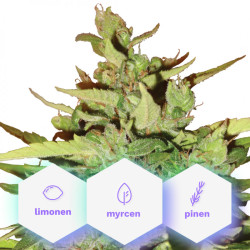
| Dominant Terpenes | Myrcene, limonene, caryophyllene | Limonene, pinene, humulene |
| Flavor | Sweet strawberries, subtle tartness | Lemon, haze, earthy tones |
| Effect | Energy, creativity, euphoria | Energy, focus, sociability |
| Medicinal Use | Depression, fatigue, lack of motivation | Anxiety, stress, depression |
Strawberry Cough – Detailed Profile
Genetics and History
Strawberry Cough is a classic American strain created by crossing Strawberry Fields and Haze. With its 80/20 sativa dominance, it has gained worldwide popularity among both growers and users seeking a pure, energetic effect. The name is no accident – the distinctly irritating smoke that genuinely induces coughing in newcomers is its trademark characteristic.
Its popularity is primarily due to the exceptional flavor that precisely captures ripe strawberries with subtle tartness, and an intense yet approachable effect. In grower circles, it's nicknamed a "show-stopper" – a plant that commands attention both visually and aromatically.
Growing Tips and Recommendations
Strawberry Cough performs well in both indoor growing and outdoor environments. The key is to master these aspects:
- Air and humidity: The strain is susceptible to mold and fungal diseases. Ensure continuous air circulation and maintain relative humidity at 40–50 % during the flowering phase.
- Nutrition: Moderately high nitrogen levels suit it well during the vegetative phase. As flowering begins, reduce nitrogen and boost phosphorus and potassium for resin production.
- Training: It responds well to low-stress training (LST) and gentle topping. Avoid aggressive defoliation or heavy lollipopping – with this strain, it slows recovery and reduces overall growth.
- Organic approaches: Fish emulsion and seaweed extracts demonstrably increase the intensity of the terpene profile, particularly myrcene content, which accounts for the characteristic strawberry aroma.
- Harvest: Target a milky trichome appearance – without significant amber coloration. Harvesting too late shifts the effect toward sedation, causing you to miss the typical sativa energy.
Effect and Medicinal Use
Strawberry Cough's effect is textbook sativa – energetic, creative, and euphoric, without body heaviness. Users most often choose it for:
- Depression and mood swings
- Chronic fatigue and low motivation
- Creative blocks and lack of inspiration
- Social situations where easy communication is valued
It's a strain for an active day, not relaxation before bed. The 15–20 % THC range makes it accessible to less experienced users, while experienced growers will appreciate its subtlety and consistency. In therapeutic contexts, it's most commonly mentioned for treating depression and chronic exhaustion, though clinical studies in this area are still lacking.
Lemon Haze – Detailed Profile
Genetics and History
Lemon Haze was created by crossing Lemon Skunk and Silver Haze – two legendary strains whose combination produced 70/30 sativa dominance with higher THC content (17–25 %). The strain was originally bred in the Netherlands and further refined by California breeders who deepened its citrus terpene profile.
Compared to pure Haze genetics, Lemon Haze is significantly more manageable – shorter flowering time, more resilient to environmental fluctuations, and more stable yields across generations. This makes it recommendable to intermediate growers without major risk of disappointment.
Growing Tips and Recommendations
Lemon Haze is among the more resilient sativa strains and handles minor growing errors well:
- Temperature: It tolerates temperature fluctuations better than Strawberry Cough. The optimal range is 18–26 °C; brief nighttime drops actually promote resin production.
- Nutrition: Requires slightly higher nutrient intake, but overfeeding harms it as much as deficiency. Watch the leaves – light spots or curling are the first signals of imbalance.
- Lighting: Responds excellently to LED full-spectrum and HPS. For maximum yield, we recommend 600W HPS or LED equivalent in the range of 600–700 µmol/m²/s PPFD.
- Training: Ideal candidate for SCROG (Screen of Green) and SOG (Sea of Green) methods. With proper training, it can create a dense bud network with 20 or more crown shoots.
- Harvest: Target 60–70 % amber trichomes for a balanced effect. Earlier harvest preserves greater energy and focus, later harvest shifts the effect toward relaxation.
Effect and Medicinal Use
Lemon Haze offers a sativa effect with a subtle indica undertone that mitigates potential anxiety at higher THC. Users describe:
- Pronounced energy and mental clarity
- Easy sociability and improved communication
- Euphoria without dizziness or paranoia
- Pleasant mental clarity suitable for productive activities
Therapeutically, it's most commonly mentioned for:
- Anxiety and stress
- Depression and mood swings
- ADHD symptoms – due to the combination of focus and euphoria
- Nausea and mild pain
Its higher THC (up to 25 %) places it more in the category for experienced users. In low doses, however, it can effectively relieve anxiety without causing sedation.
Which Strain to Choose?
The choice depends on your specific priorities:
Choose Strawberry Cough if:
- You prefer sweet, fruity aromatic profiles
- You're seeking lower THC with a pure and energetic effect
- You're growing in limited space – the more compact growth habit is an advantage
- You're sensitive to anxiety and prefer a gentler onset
- You lean toward organic growing with an emphasis on terpene quality
Choose Lemon Haze if:
- Higher yields and larger bud mass are a priority
- You have experience with higher-THC sativa strains
- You like citrus, haze terpene profiles
- You need a stronger effect for therapeutic purposes
- You have adequate vertical and horizontal growing space
Frequently Asked Questions (FAQ)
Which strain is suitable for beginners?
Strawberry Cough is slightly more accessible. Lower THC reduces the risk of an unpleasant experience, the more compact height makes space management easier, and the strain tolerates minor nutrition errors better. Lemon Haze is not significantly more demanding – ultimately, it comes down to personal preference for aroma and effect profiles.
How much space do these strains need?
For Strawberry Cough, an indoor box measuring 60 x 60 cm for 1–2 plants is sufficient. Lemon Haze ideally needs 80 x 80 cm for 2–3 plants to develop without excessive light and air competition.
Can they be grown outdoors in the Czech Republic?
Yes, both strains are realistic options for Czech conditions. For Strawberry Cough, expect harvest around mid-September, Lemon Haze more toward late September. The decisive factor is selecting a protected, sunny location – potential autumn rain promotes mold issues, so monitor humidity and plant airflow.
Which is better for outdoor growing?
Lemon Haze has the advantage primarily due to higher yields and resilience to variable weather. Strawberry Cough is more delicate with humidity and requires careful monitoring in the late season.
Conclusion: Both strains represent the pinnacle of the sativa spectrum, each from a different angle. Strawberry Cough excels in flavor refinement, effect accessibility, and aromatic experience. Lemon Haze dominates in yields, potency, and terpene complexity. The ideal solution is to try both and, based on your own experience, determine which better suits your body, environment, and growing style.
Looking for sativa seeds? At Cannapio, we have both these strains in stock in verified quality. Don't hesitate to contact our expert advisors.