


 English (English)
 Deutsch (German)
 Čeština (Czech)
 Italiano (Italian)
 Hrvatski (Croatian)
 Română (Romanian)
 български език (Bulgarian)
 Magyar (Hungarian)
 Español (Spanish)
 Français (French)
 Nederlands (Dutch)
 Polski (Polish)
 Slovenčina (Slovak)
Why choosing lighting is the most important decision when building a grow room
Light is to plants what food is to us. Without proper grow lighting, even the best substrate and premium fertilizers won't save your harvest. Light drives photosynthesis, affects growth speed, bud density, and overall yield. Yet many growers – especially beginners – pay less attention to lighting selection than they should.


This guide will walk you through the entire selection process step by step. Whether you're building your first small tent or expanding an existing setup, you'll find concrete answers to what really matters.
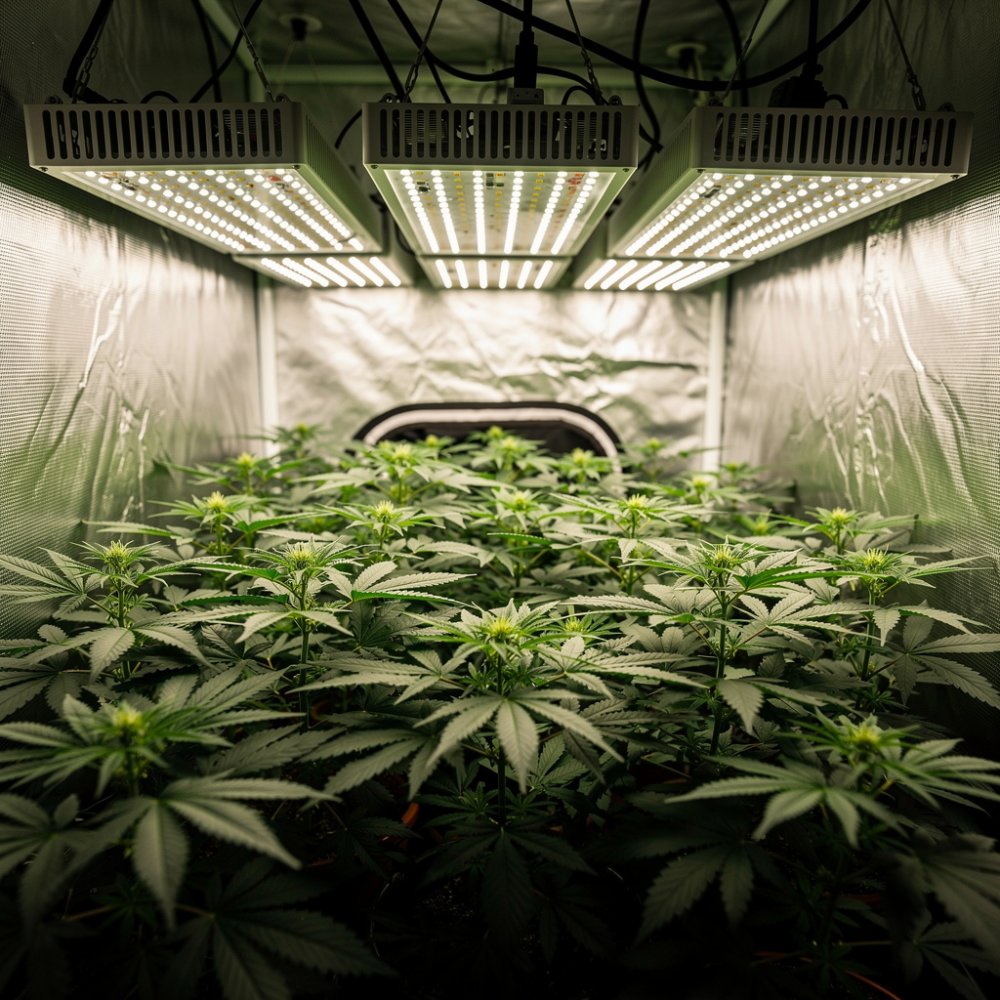
Step 1: Measure your grow tent and determine the area
Before diving into watts, lumens, or PPFD, get the exact dimensions of your tent. The growing area is your starting point for everything else.
Most common tent sizes and their areas:
- 60 x 60 cm – 0.36 m², ideal for 1–2 plants or cloning
- 80 x 80 cm – 0.64 m², compact setup for 2–4 plants
- 100 x 100 cm – 1 m², most popular size for hobby growers
- 120 x 120 cm – 1.44 m², good balance between power and consumption
- 240 x 120 cm – 2.88 m², semi-professional setup
Why is area so crucial? Because all lighting calculations are based on watts per square meter or PPFD (the amount of photons hitting the area per second). Without knowing your area, you can't properly size your lights.
Step 2: Choose your lighting type – LED or HPS?
This is the question that divides growers into two camps. Let's simplify it.
HPS bulbs – proven classics
HPS bulbs (High Pressure Sodium) are a technology proven over decades. They produce intense light with emphasis on the red spectrum, which is crucial for the flowering phase. The advantages are clear: lower purchase price, reliability, and mountains of data from growers worldwide.
On the downside, HPS bulbs generate a lot of heat, require a quality ballast, and need regular replacement (usually after 6–12 months of intensive use). You'll always need a reflector with an HPS bulb to direct light onto your growing area – its shape and reflectivity significantly affect coverage.
LED grow lights – the modern standard
LED grow lights are now the first choice for most hobby growers. Modern full-spectrum LED panels offer excellent energy-to-output ratios. They generate less heat, have longer lifespans (50,000+ hours), and don't require separate ballasts or reflectors as components.
Be cautious of cheap LED lights with inflated specs. Manufacturers sometimes list peak wattage – the maximum draw the light never actually reaches. Always check the actual power consumption and PPFD values at specific hanging heights.
Find a detailed comparison of both technologies in the article LED vs HPS: Complete Comparison of Indoor Growing Lights.
Step 3: Understand key light parameters
For truly informed selection, you need to understand basic terminology. This isn't just theory – these values directly determine your growing results.
PAR and PPFD
PAR (Photosynthetically Active Radiation) refers to the light spectrum plants use for photosynthesis – specifically wavelengths from 400 to 700 nm. However, PAR alone is just a range, not a measurable power value.
PPFD (Photosynthetic Photon Flux Density) is a specific number – it measures how many photons from the PAR range hit 1 m² per second. Measured in µmol/m²/s. PPFD is the most important parameter when choosing lights.
Typical PPFD values for different growing stages:
- Cloning and seedlings: 200–400 µmol/m²/s
- Vegetative phase: 400–600 µmol/m²/s
- Flowering phase: 600–1000 µmol/m²/s
- Intensive growing (with CO2): 1000–1500 µmol/m²/s
Lumens – why they're not enough
Lumens measure total light output as perceived by the human eye. For plants, lumens are misleading – the human eye is most sensitive to green, which plants use least. High-lumen light can be less effective for plants than lower-lumen light with better spectrum. Use lumens only as a rough reference, never as your main selection criterion.
Spectrum
Light spectrum determines plant behavior. Simplified:
- Blue (400–500 nm): promotes compact vegetative growth and leaf development
- Red (620–700 nm): essential for flowering and fruit production
- Full spectrum: mimics sunlight, suitable for the entire life cycle
Modern LED grow light panels offer full spectrum with switchable modes (veg/bloom) or adjustable tuning. This is a major advantage over traditional HPS bulbs, which have fixed spectrum.
Learn more about these parameters in the article PAR, PPFD, and Lumens: What Do Grow Light Parameters Mean.
Step 4: Calculate required wattage
There are two approaches – simpler wattage-based calculations and more precise PPFD-based calculations.
Wattage per plant and per square meter
As a rough guideline:
- HPS bulb: 400–600 W per 1 m² of growing area
- Modern LED grow light: 200–350 W actual consumption per 1 m²
Example: For a 100 x 100 cm tent (1 m²), you need an LED panel with roughly 250–300 W actual consumption, or an HPS bulb rated 400–600 W.
The watts per plant rule is less precise but used: approximately 50–75 W actual LED consumption per plant during flowering. For HPS, count 100–150 W per plant.
PPFD map calculation
A more accurate method. Quality LED manufacturers provide PPFD maps – tables showing PPFD values across different areas of your tent at various hanging heights. This tells you exactly whether the light will cover your tent with desired intensity.
If a manufacturer won't provide or refuses to publish a PPFD map, consider that a red flag.
Step 5: Don't forget the ballast and reflector
If you choose an HPS bulb, the ballast and reflector are mandatory equipment, not accessories.
The ballast regulates electrical current through the bulb. Two main types exist – magnetic and digital. Digital ballasts are quieter, more efficient, and allow power adjustment. Magnetic ballasts are tougher and cheaper but generate more heat and noise. Find detailed analysis in the article Ballast Guide: Digital vs Magnetic.
The reflector directs light from the bulb onto your growing area. Reflector shape (parabolic, straight, wing) and surface reflectivity directly affect coverage uniformity. A cheap reflector with poor reflectivity can waste even an excellent bulb.
Step 6: Consider heat load and ventilation
All lights produce heat. HPS bulbs significantly more than LED, but modern LED panels aren't heat-free either.
Optimal air temperature in your tent is 22–28 °C. If your light pushes temperature above this range, you have a problem – you stress plants, increase mold risk, and reduce yield.
Practical recommendations:
- With a 600 W HPS bulb in a small tent, plan for active cooling or heat extraction from the reflector (cool tube).
- LED grow light in a well-ventilated tent up to 1 m² usually doesn't need extra cooling.
- Always have a thermometer inside the tent, not outside it.
Step 7: Light hanging height
Light hanging height above plants affects both intensity and coverage uniformity. The inverse square law applies – at double the distance, light intensity drops to one quarter.
Typical hanging heights:
- LED grow light (full spectrum, 200–300 W): 40–60 cm above plant tops during flowering
- HPS 400 W: 40–50 cm
- HPS 600 W: 50–70 cm
Always monitor plant response. Signs of too-close light are bleaching or whitening at the tops. Signs of insufficient light are stretching internodes and pale green color.
Practical checklist: How to proceed with selection
- Determine your tent area and size your lighting accordingly.
- Choose your technology – LED for lower operating costs and heat load, HPS for proven results and lower initial investment.
- Focus on PPFD, not just watts or lumens – PPFD is the most accurate indicator of actual plant-usable power.
- Check the spectrum – full-spectrum LED handles the entire life cycle, HPS excels at flowering.
- Don't underestimate ballast and reflector for HPS – they're as important as the bulb itself.
- Plan for heat and design ventilation before you start growing.
Conclusion
Choosing the right lighting for your grow tent isn't rocket science, but it does require some preparation. The key is to base decisions on your tent's actual area, understand the difference between LED grow lights and HPS bulbs, and track the right parameters – especially PPFD and actual power consumption, not marketing numbers.
Investment in quality lighting always pays off – whether through higher yields, lower energy bills, or simply having healthy, vigorous plants from start to finish. If you're uncertain about your choice, don't hesitate to ask for advice – proper lighting is the foundation everything else builds on.