


 English (English)
 Deutsch (German)
 Čeština (Czech)
 Italiano (Italian)
 Hrvatski (Croatian)
 Română (Romanian)
 български език (Bulgarian)
 Magyar (Hungarian)
 Español (Spanish)
 Français (French)
 Nederlands (Dutch)
 Polski (Polish)
 Slovenčina (Slovak)
In short: You can make hemp salve from 60 ml of hemp oil, 20 ml of coconut oil, 15–20 g of beeswax and 300–500 mg of CBD. Melt the wax in a water bath at no more than 70 °C and add the CBD only once the mixture has cooled to 40–45 °C. The whole process takes 30–45 minutes, and the salve keeps for 6–12 months in a cool, dark place.


| Quantities for approx. 100 ml of salve | 60 ml hemp oil, 20 ml coconut oil, 15–20 g wax |
|---|---|
| CBD content | 300–500 mg (oil or isolate) |
| Maximum temperature when melting the wax | up to 70 °C |
| Temperature for adding CBD and essential oils | 40–45 °C |
| Preparation and setting time | 30–45 minutes of preparation, at least 2 hours to set |
| Shelf life and storage | 6–12 months in a cool, dark place |
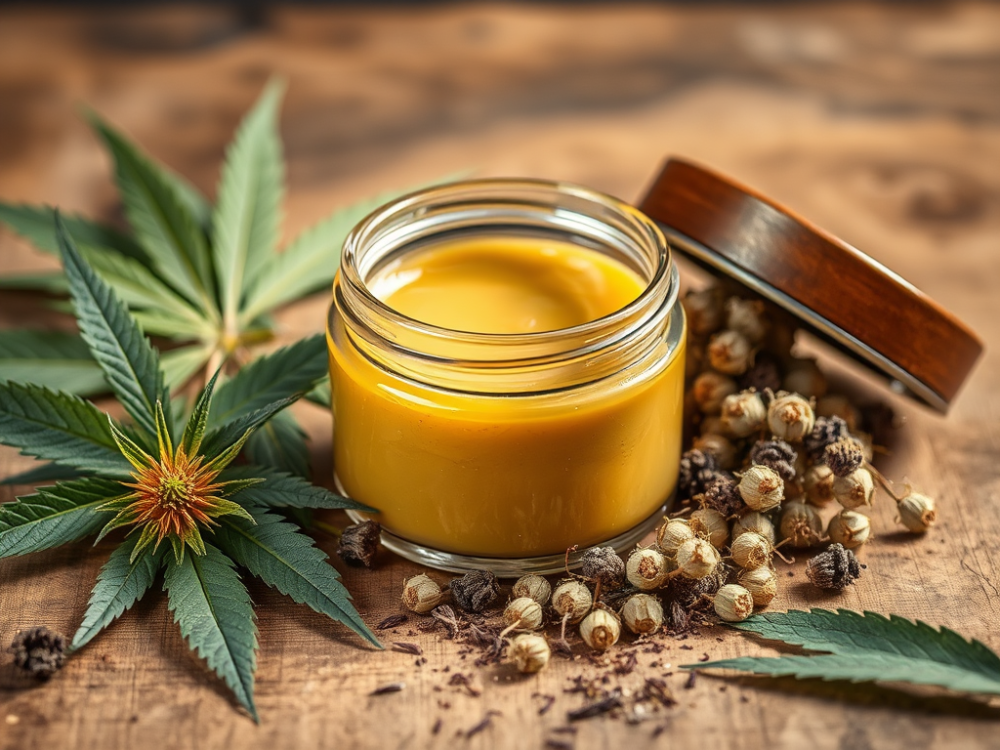
Hemp salve has been enjoying a well-deserved comeback in recent years. Traditional recipes that our grandmothers knew long before hemp started appearing in scientific journals are now being combined with modern knowledge about CBD and other cannabinoids. The result is a natural preparation that you can easily make at home, know exactly what is in it, and adapt to your own needs.
In this article we will show you what hemp salve is made of, when people most often reach for it and, above all, how to prepare it step by step in your own kitchen.
What is hemp salve and how does it differ from ordinary creams?
Hemp salve is a rich, water-free preparation made from vegetable oils or animal fat and enriched with active compounds from hemp. Unlike commercial creams, which contain water, emulsifiers and preservatives, homemade salve is minimalist: fat + extracted cannabinoids + optionally essential oils.
The key difference compared with an ordinary moisturising cream is that the fatty components form an occlusive layer on the skin – it prevents moisture from evaporating and at the same time makes it easier for active compounds to penetrate deeper layers of the skin.
Why add CBD?
CBD (cannabidiol) is a non-intoxicating compound from hemp that binds to receptors of the endocannabinoid system, which are also present in the skin. Research suggests that CBD may support the skin's natural balance, ease the feeling of tension and help calm irritated skin. That is why CBD oils have become a popular ingredient in homemade cosmetics.
When do people use hemp salve?
Although we have to be careful about exaggerated claims, there are many everyday situations in which users like to reach for hemp salve. People's experience and the first scientific studies point mainly to the following areas:
Strained and tired muscles
After physical exertion, sport or long hours at the computer, many people rub hemp salve into tired muscles during a massage. The rich base also works as an excellent massage medium – the salve spreads well and does not run like oil.
- Suitable for athletes and office workers alike
- Can be combined with essential oils (menthol, eucalyptus) for a cooling effect
- Does not leave greasy marks on clothing if you let it absorb for a moment
Dry and cracked skin
Cold-pressed hemp oil is rich in unsaturated fatty acids (omega-3, omega-6) in a ratio very close to the composition of the skin's sebum. That is why hemp salve moisturises very well and creates a protective barrier – ideal for heels, elbows or hands strained by detergents.
Dry and sensitive skin
Sensitive skin tends to be dry and easily irritated. A hemp salve free of fragrance, alcohol and synthetic preservatives is a gentle care option for it. Please note: eczema and other skin problems belong in the hands of a doctor – the salve is a cosmetic and does not replace treatment.
Rough patches and chapped lips
Beeswax (or carnauba wax for a vegan version) forms a protective layer on the skin, so people also use hemp salve on rough and dry areas, sun-dried skin or chapped lips. Do not apply it to open wounds or burns.
What you will need – ingredients and equipment
A good salve depends on quality ingredients. There is no point in saving on the base – the finished product will only be as good as its components.
Ingredients (for approx. 100 ml of salve)
- Cold-pressed hemp oil – 60 ml (the base, carrier of the active compounds)
- Coconut oil – 20 ml (antimicrobial properties, pleasant texture)
- Beeswax or carnauba wax – 15–20 g (determines how firm the salve is)
- CBD oil or CBD isolate – 300–500 mg CBD (the active ingredient; choose a quality CBD oil with a certificate)
- Essential oils (optional) – 10–20 drops: lavender, peppermint, eucalyptus, tea tree
- Vitamin E oil – 5 drops (a natural preservative that extends shelf life)
Equipment
- A small saucepan or a vessel for a water bath
- A glass or stainless steel bowl
- A thermometer (kitchen or infrared)
- A measuring jug and a digital scale
- Sterilised jars or aluminium tins with lids
- A spatula or spoon for stirring
Recipe: how to make hemp salve step by step
The whole process takes about 30–45 minutes and is no more complicated than cooking pudding. The key to success is a low temperature – CBD and the valuable fatty acids must not overheat.
- Prepare a water bath. Pour about 5 cm of water into the saucepan and bring it to a gentle simmer. Place the glass bowl over the saucepan so that it does not touch the water.
- Melt the wax. Put the measured beeswax into the bowl and let it melt slowly. Keep an eye on the temperature – ideally do not exceed 70 °C.
- Add the oils. As soon as the wax has melted, stir in the hemp oil and coconut oil. Stir until smooth.
- Let it cool slightly. Remove the bowl from the water bath and let the mixture cool to about 40–45 °C. At a higher temperature the CBD and essential oils could degrade.
- Add the CBD and essential oils. Stir in the CBD oil (or the measured isolate), vitamin E and your chosen essential oils. Mix thoroughly.
- Fill the containers. While the salve is still liquid, pour it into the prepared sterilised tins. Do not let it set in the bowl – it would be hard to pour.
- Let it set. Leave the tins on a flat surface at room temperature for at least 2 hours until the salve has set completely. Do not close the lids too early – condensation could shorten the shelf life.
Tips for different consistencies
- Softer salve (balm): reduce the amount of wax to 10 g
- Firmer stick (lip balm): increase the wax to 25 g and pour into empty lip balm tubes
- Cooling effect: add 5 extra drops of menthol essential oil
Correct use and dosage
Homemade hemp salve is for external use only – never swallow it or apply it to the eyes or mucous membranes.
- Muscle massage: rub a small amount (the size of a pea) into the strained area with circular movements 2–3× a day.
- Dry skin: apply a thin layer after showering to still slightly damp skin to lock in moisture.
- Sensitive skin: first do a patch test on the inside of your wrist and wait 24 hours to see whether there is any reaction.
- Lips and dry patches: apply a small amount with your finger or a clean spatula, and do not share the tin with others.
Shelf life and storage
A properly made salve keeps for 6 to 12 months when stored in a cool, dark place (or in the fridge). Vitamin E oil, as a natural antioxidant, contributes significantly to a longer shelf life. If the salve starts to smell unpleasant or changes colour, stop using it.
Where to get quality ingredients?
The finished salve is exactly as good as the ingredients that go into it. Unfortunately, there are still many CBD oils on the market with inaccurate concentrations or pesticide contamination. That is why you should always choose products with a certificate from an independent laboratory (CoA – Certificate of Analysis).
In the Cannapio online shop you will find CBD oils and CBD isolates suitable for homemade cosmetics – all products undergo independent laboratory tests and a certificate of composition is available for each of them. For those who want to go even further and grow their own hemp for homemade extracts, we also offer a wide selection of hemp seeds, including high-CBD strains.
What to look out for when choosing CBD for your salve
- Choose a full-spectrum or broad-spectrum CBD oil – it also contains other cannabinoids and terpenes that can work together synergistically (the so-called entourage effect).
- Check the THC content – in the Czech Republic it must be below 1 % for cosmetic use.
- Prefer oils from organic hemp grown without pesticides.
- CBD isolate (pure powder) is more affordable and has neither a green colour nor the characteristic aroma – suitable if you want a neutral salve.
Ready-made hemp salve: what types are there
If you do not want to make salve yourself, you can choose from several types. They differ mainly in what they contain besides hemp oil, and this also determines who can use them and for how long.
| Type of salve | Main ingredients | Uses people mention | Limitations |
|---|---|---|---|
| Pure hemp salve | hemp oil, wax, plant butters | dry skin, hands, heels, elbows, massage | no special limitations, only on intact skin |
| Hemp salve with comfrey | hemp oil, comfrey extract | massage after exertion, rough skin | max. 4–6 weeks a year, not during pregnancy, not on wounds |
| Hemp salve with calendula | hemp oil, calendula extract | sensitive and dry skin | caution if allergic to plants of the daisy family |
| CBD salve | hemp oil, CBD in mg per pack | massage, skin care | higher price, athletes should check anti-doping rules |
| Salve for animals | composition adapted for animals | paw and skin care | use only products expressly intended for animals |
With CBD salves it pays to convert the content per gram: a salve with 250 mg of CBD in 10 ml contains 25 mg per millilitre, and a salve with 750 mg in 30 ml also contains 25 mg per millilitre. A larger pack is therefore not stronger, it just lasts longer. We write in more detail about comfrey salve and its safe use in a separate article, and the recipe for a homemade version is in the guide hemp salve step by step.
What to watch out for
- Salve is not a medicine. Hemp salve is a cosmetic. Joint pain, swelling, eczema or long-term skin problems belong in the hands of a doctor; the salve can only be a complement to care that you agree on with them.
- Only on intact skin. No water-free salve belongs on open wounds, burns or weeping areas, and this applies doubly to comfrey salve.
- Tolerance test. First apply a new salve to the inside of your forearm and wait 24 hours. Reactions are more often caused by essential oils, beeswax or propolis than by hemp oil.
- Essential oils and children. Menthol, eucalyptus and camphor are not used on small children. For children choose a pure, fragrance-free salve and always consult a paediatrician first.
- Animals. An animal will lick off salve made for people, including any essential oils or comfrey. Use only products intended for animals.
- Shelf life. Throw away salve that has changed its smell or colour. Hemp oil goes rancid; it keeps longer in a cool, dark place.
Making your own hemp salve is an enjoyable and useful DIY project that gives you control over what you put on your skin. With the right ingredients from Cannapio and this guide, you can manage your first batch even without any previous experience with homemade cosmetics. Good luck!
Frequently asked questions
Can hemp salve cause a positive THC test?
With correct use (externally, in the recommended amount) and products with a legally permitted THC content, the risk is minimal. Nevertheless, we recommend that athletes subject to anti-doping tests discuss its use with their doctor or an anti-doping officer.
Can I use the salve on children?
For children, always consult a paediatrician first. Essential oils such as eucalyptus or menthol are not recommended at all for children under 3 years, and others only in minimal concentrations.
Is hemp salve the same as marijuana salve?
No. Hemp salve made from CBD oils or industrial hemp does not contain an intoxicating amount of THC and has no psychoactive effects. It is a cosmetic product, not a drug.
What is the difference between hemp salve and CBD salve?
Hemp salve is based on hemp seed oil, which contains practically no CBD. CBD salve also has added cannabidiol, and its amount is stated in mg per pack. Both are cosmetics for external use.
Can I use hemp salve on my face?
On dry patches on the face, yes, as long as the salve does not contain menthol, camphor or eucalyptus and you do not apply it around the eyes. For the whole face, lighter facial oils and creams are more practical; you will find an overview in our article on hemp cosmetics.
Is hemp salve legal?
Yes. It is made from hemp oil or extracts of industrial hemp, which in the Czech Republic may contain no more than 1 % THC. It has no intoxicating effects on the skin.
How often should hemp salve be applied?
Usually 1–3× a day in a thin layer; an amount the size of a hazelnut is enough for the palm of your hand. With comfrey salve, also follow the maximum period of use stated on the packaging.
Recommended products
- Konopný Táta – pure hemp salve 80 ml: a pure salve without comfrey for everyday care of dry skin.
- Konopný Táta – hemp salve with comfrey 80 ml: for massage over shorter periods, with a limit on how long it can be used.
- Hemp salve with calendula for skin 12 ml, Zelená Země: a small pack for sensitive and dry skin.
- Endoca CBD hemp salve 250 mg, 10 ml: a salve with a declared CBD content.
- CBD salve 30 ml, Zelená Země: a more affordable CBD salve in a larger pack.