


 English (English)
 Deutsch (German)
 Čeština (Czech)
 Italiano (Italian)
 Hrvatski (Croatian)
 Română (Romanian)
 български език (Bulgarian)
 Magyar (Hungarian)
 Español (Spanish)
 Français (French)
 Nederlands (Dutch)
 Polski (Polish)
 Slovenčina (Slovak)
In short: A carbon filter traps odor molecules by adsorption onto activated carbon. Size the fan for 60 air exchanges per hour plus a 20–30 % reserve for resistance – a 1.2 × 1.2 × 2 m grow tent therefore needs 200–220 m³/h. The filter, fan and ducting must share the same diameter, and the filter lasts 12–18 months.


| Air exchange | 60× per hour with a filter, min. 30× without a filter |
|---|---|
| Reserve for filter and duct resistance | 20–30 % above the calculated airflow |
| Activated carbon grain size | 4–8 mm, CTC above 60 % |
| Carbon bed depth | 38–46 mm |
| Flange diameters | 100 mm (up to 0.6 × 0.6 m), 125 mm (up to 1 × 1 m), 150 mm (1.2 × 1.2 m and larger) |
| Filter lifespan | 12–18 months at humidity below 70 % RH |
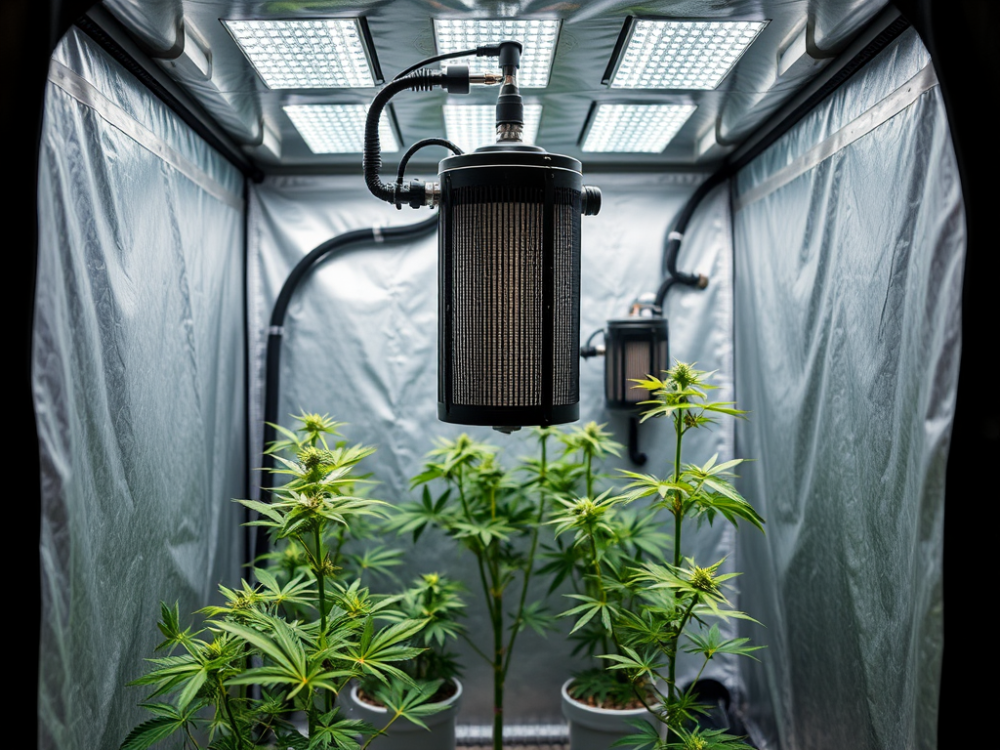
An odor absorber is an absolute must for every cannabis grower. Whether you grow in a small grow tent or a larger room, the characteristic smell of the plants can be very intense – especially during flowering. A properly designed ventilation system with a carbon filter solves this problem reliably while also ensuring an optimal microclimate for your plants. In this guide you will learn everything you need to know: how filters work, how to size them correctly, which brands are worth a look and how to put the whole system together.
How does a carbon odor filter work?
A carbon filter (also called a carbon filter or carbon scrubber) works on the principle of adsorption. Air saturated with aromatic molecules passes through a layer of activated carbon, which captures these molecules on its enormous surface area – a single gram of quality activated carbon can have a surface area of up to 1,500 m². The result is odor-free air that can be safely vented outside.
Activated carbon – the heart of every filter
Not all activated carbon is the same. The key parameters are:
- Grain size – the size of the carbon granules affects both airflow and odor capture efficiency. The optimal range is 4–8 mm.
- RC (Radio Carbon) value – the higher it is, the longer the filter lasts. Look for CTC (Carbon Tetrachloride Activity) values above 60 %.
- Carbon origin – premium filters use coconut-shell or coal-based carbon with high porosity.
- Bed depth – the standard is 38–46 mm; thinner layers are less effective.
Airflow and pressure drop
A denser carbon bed captures odors better but also puts up more resistance to airflow. That is why it is important to pair the filter with a fan that delivers enough performance even at increased resistance (known as static pressure). Always choose a fan whose airflow is equal to or slightly higher than the filter's rated airflow.
Sizing: how to choose the right odor absorber
The most common mistake beginners make is underestimating filter capacity. Remember: an odor absorber should always be somewhat more powerful than the minimum requirement of your space.
Calculating the required airflow
The basic rule is that the air in a grow tent should be exchanged 60× per hour (when using a filter), or at least 30× per hour without a filter. How to calculate it:
- Measure the volume of the space: length × width × height (in meters) = volume in m³.
- Multiply the volume by 60: the result is the minimum fan airflow in m³/h.
- Add a 20–30 % reserve for filter and duct resistance.
Example: Grow tent 1.2 × 1.2 × 2.0 m = 2.88 m³. Minimum airflow: 2.88 × 60 = 173 m³/h. With the reserve, look for a fan rated at 200–220 m³/h.
Filter flange and duct diameter
The filter diameter must exactly match the diameter of the fan and the flexible ducting. The most common sizes:
- 100 mm – grow tents up to 0.6 × 0.6 m, capacity approx. 100–150 m³/h
- 125 mm – grow tents from 0.8 × 0.8 to 1.0 × 1.0 m, capacity approx. 150–350 m³/h
- 150 mm – grow tents 1.2 × 1.2 m and larger, capacity approx. 350–600 m³/h
- 200 mm and more – grow rooms and professional growing facilities
Recommended carbon filter brands
There are many manufacturers on the market. Below are the ones that have earned an excellent reputation among growers thanks to the quality of their carbon, robust construction and long lifespan.
RAM Carbon (RAM Filters)
A British manufacturer using activated carbon of Australian origin. RAM filters are popular for their low pressure drop and long lifespan (12–18 months of intensive use). They feature a polyester-fibre pre-filter that protects the carbon from dust and extends its lifespan.
Phresh Filter
An American premium brand using activated carbon with an exceptionally high CTC value. Phresh filters have a thin perforated aluminum casing, which makes them lighter than the competition. Suitable for growers who prioritize maximum efficiency.
Rhino Pro Carbon Filter
A very popular filter in Europe, made in the United Kingdom. Rhino Pro uses coconut-based activated carbon in a 46 mm bed, which provides excellent adsorption. The filter is available in a wide range of diameters and capacities, so it covers everything from a small grow tent to a large grow room.
Prima Klima and Mountain Air
More affordable alternatives for beginners. The quality is solid for home growing, but the lifespan is usually shorter (6–12 months). We recommend them as a starter solution or for less intensive use.
Fans for grow tent ventilation
A carbon filter only works as well as the fan pulling air through it. Choosing the right fan is therefore just as important as choosing the filter itself.
Inline duct fans
The standard for grow tents is inline duct fans, which connect directly to the filter and flexible ducting. Important parameters:
- Airflow (m³/h) – must match or exceed the filter's capacity.
- Static pressure (Pa) – the higher it is, the better the fan overcomes the resistance of the filter and ducting.
- Noise level (dB) – for discreet operation, look for models up to 35 dB at full power.
- Speed control – the option to connect a speed controller is a big advantage.
Speed controllers and EC motors
Modern fans with an EC (electronically commutated) motor allow smooth speed control without any loss of efficiency. That means less noise, lower energy consumption and a longer lifespan. An alternative is a classic triac controller, which is cheaper but less precise. By linking the controller to a thermostat or hygrostat, you can easily set up automatic operation based on temperature and humidity.
Fresh air intake
Extraction is not enough without a sufficient supply of fresh air from outside. The intake should be passive (openings in the grow tent with a cross-section at least 3× larger than that of the exhaust duct) or active (a second, less powerful fan). Proper negative pressure in the grow tent – recognizable by the walls bending slightly inwards – guarantees that all the air passes through the filter.
Installing the system step by step
Correct installation is the key to maximum efficiency. A poorly assembled system needlessly reduces filter performance and increases noise.
- Place the filter at the top of the grow tent – warm air rises, so the filter will work most efficiently there. Hang it vertically using metal hooks or ratchet straps.
- Connect the filter to the fan – join the flexible aluminum ducting with hose clamps. The air should flow: filter → fan → duct outside.
- Route the exhaust duct along the shortest possible path – every bend increases resistance. Ideally, run the duct directly outside or into an adjacent room.
- Seal all joints – use aluminum tape or silicone sealant. Every leak means uncontrolled escape of odor.
- Check the negative pressure – once the fan is switched on, the walls of the grow tent should bend slightly inwards. If they don't, look for leaks.
- Set the controller – during the calmer phase (vegetative growth), 50–60 % power is enough. During flowering, and especially in the last 2–3 weeks, increase it to 80–100 %.
Common installation mistakes
- Placing the filter outside the grow tent – air can then escape through leaks before it passes through the filter.
- Ducting that is too long or bent – increases noise and pressure resistance and reduces airflow.
- An unchanged pre-filter – a clogged pre-filter significantly reduces airflow and shortens the life of the carbon.
- Underestimating humidity – humid air speeds up the saturation of the activated carbon. Keep humidity below 70 % RH.
Filter lifespan and when to replace it
Activated carbon gradually becomes saturated with captured molecules and stops being effective. The average lifespan of a quality filter in continuous operation is 12–18 months. However, some factors shorten it:
- High air humidity (above 70 % RH)
- High temperature (above 30 °C)
- A clogged or missing pre-filter
- Too little airflow (the air spends too long in the carbon and saturates it locally)
The sign that it's time to replace the filter is odor getting through even with the fan at full power and a clean pre-filter. Some manufacturers (e.g. Phresh) offer the option of regenerating the carbon – the filter is flipped over and excess moisture evaporates. However, this only extends the lifespan temporarily and is not a full restoration.
If you are interested in setting up the whole growing environment, read our article on growing cannabis in a grow tent – you'll also find tips on controlling temperature and humidity there, which directly affect the lifespan of your filter.
Additional methods for masking odor
A carbon filter is the primary and most reliable method, but there are also complementary approaches that can be used alongside it:
Ozone generators
Ozone generators break down aromatic molecules through oxidation. They are very effective, but ozone is harmful to health – never use it in the presence of people or plants. Place an ozone generator exclusively in the exhaust duct after the filter and fan.
Odor neutralizers (gel and spray)
Products such as ONA Gel or similar neutralizers are suitable for masking residual odor around the growing area. Caution – never use them inside the grow tent, as they could affect the terpenes and flavour of the plants.
Houseplants and natural absorbers
Lavender, mint or eucalyptus around the growing area can naturally cover up residual odor, but on their own they are not an adequate substitute for a filter.
To fully equip your grow space, browse our extraction and ventilation category, where you'll find carbon filters, inline fans and accessories neatly in one place. And if you're just starting out, take inspiration from our overview of basic grow equipment for beginners.
Summary: what not to forget
A properly sized and installed odor absorber is an investment that pays for itself many times over – with peace of mind, discreet operation and healthier plants in an optimal microclimate. Here are the key points to remember:
- Choose the filter based on the volume of the space and the required airflow (min. 60 air exchanges per hour).
- The filter, fan and ducting must have the same diameter.
- Invest in quality carbon – premium brands (Rhino Pro, Phresh, RAM) last significantly longer.
- Keep humidity below 70 % RH and replace the pre-filter regularly.
- Seal all joints and check the negative pressure in the grow tent.
- Replace the filter after 12–18 months or at the first signs of odor escaping.
If you have any questions about choosing a specific product, don't hesitate to contact us – at Cannapio.cz we're here to help you put together the optimal system for your exact conditions.