


 English (English)
 Deutsch (German)
 Čeština (Czech)
 Italiano (Italian)
 Hrvatski (Croatian)
 Română (Romanian)
 български език (Bulgarian)
 Magyar (Hungarian)
 Español (Spanish)
 Français (French)
 Nederlands (Dutch)
 Polski (Polish)
 Slovenčina (Slovak)




One of the first questions a grower should think about before actually planting is the question of fertilizer – which one to use and how much of it will be needed. There is a whole range of fertilizers and supplementary products available on the market today, and finding your way around them is often not easy.
That is why, in the following lines, we will get to know most of the products offered on the market and talk about their dosage and the expected consumption.
Composition of fertilizers
All basic fertilizers contain the same components: nitrogen (Nitrogenium), phosphorus (Phosphorus) and potassium (Kalium). These three elements belong to the primary nutrients. Other substances contained in fertilizers include calcium, sulfur and magnesium – the so-called secondary nutrients – and finally the trace elements boron, chlorine, manganese, iron, zinc, copper and molybdenum.
Primary nutrients
1) Nitrogen (N)
Nitrogen compounds are used in the production of fertilizers, since nitrogen itself is a gaseous element. The most common compounds are ammonia, urea, ammonium nitrate ... etc. Bat guano or bird droppings can serve as an organic source of nitrogen, and Chile saltpeter (sodium nitrate) contains it as well. Nitrogen is a significant factor above all for the growth of plants.
- Plants with a sufficient supply of nitrogen compounds can be recognized by their large green leaves and fast growth. However, you must also supply other necessary substances so that the plants do not develop weak stems that break.
- With a nitrogen deficiency we observe slowed growth, and the leaves gradually begin to turn yellow starting from the lower levels and continue upwards. The yellowing is caused by the plant's insufficient ability to produce chlorophyll. And how do we fix it? By adding growth stimulators or bat guano. The increased amount of nitrogen is administered over a period of 4–6 days.
- Unfortunately, an excess of nitrogen also harms the plants. An excess manifests itself in slowed root growth and a darkening of the leaves, which eventually turn completely brown and fall off. And how can this problem be solved? By flushing the growing medium, in such a way that for the following 3 days you water only with pH-adjusted water.
2) Phosphorus (P)
In nature we encounter it only in the form of compounds. It is an important component of DNA molecules and drives the system within them that distributes energy inside the plant. Without phosphorus, not even photosynthesis would take place in plants.
- Phosphorus is needed for plant growth and also influences the final size of the flowers. That is why it must be supplied in larger amounts during the flowering phase. Every bloom stimulator is characterized by a high phosphorus content.
- A deficiency manifests itself, just as with nitrogen, in slowed growth. The color of the leaves changes from green to red or even purple. Here too, the solution is not particularly complicated. A new nutrient solution with a complete fertilizer set must be prepared. This applies to hydroponic growing. Alternatively, phosphorus can be supplied via additives or by spraying (hydroponics and soil substrates). The pH value of the solution should be lowered to 5.5–6.3.
- Overfeeding with phosphorus is rare, because the acidic environment in the growing medium is able to bind phosphates. If it does happen anyway, it manifests itself in a reduced ability to absorb other substances, resulting in a lower yield from the plants and premature ripening. If this problem is identified, proceed exactly as with a nitrogen overdose.
3) Potassium (K)
Its share in the Earth's crust lies in the range of 2–2.4%. In fertilizer production, potassium oxide is most commonly used.
- It plays a major role in the process of photosynthesis and plant respiration. It accumulates in the part of the plant that faces the light. Potassium is also important in carbohydrate metabolism. With a potassium deficiency, the content of reducing sugars rises, which leads to a blockage of citric acid. As a consequence of this disorder, thinner cell walls, weaker tissue and lower carbohydrate reserves are formed. Potassium is needed throughout the plant's entire life cycle. A larger amount is added during the flowering phase to produce bigger flowers.
- Potassium deficiency manifests itself slowly and is only recognized when the leaves turn brown and curl downwards. In addition, black spots can be observed on the leaves. If this is the case, a potassium-containing fertilizer must be added at 1.5 times the usual dose (hydroponics). With soil substrates, this can be solved by mixing potassium oxide with water and watering with it.
- An excess is difficult to detect. It behaves similarly to phosphorus, since it limits the plants' ability to absorb other elements. In case of an excess, the fertilizer dosage is reduced to roughly half for 3–5 days.
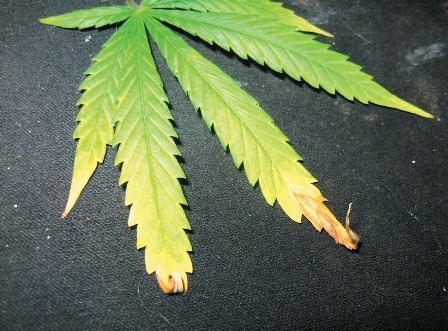
Secondary nutrients
1) Sulfur (S)
It is involved in photosynthesis and enzyme activity and is a component of vitamin B and thiamine.
- The presence of thiamine is important for the oxidation of keto acids.
- A sulfur deficiency can be recognized by the yellowing of young leaves. It also manifests itself in a color change of the stem, which takes on a purple undertone. The solution consists in lowering the pH value to 5.8–6 and increasing the dose of sulfur-containing fertilizers to 1.5 times the usual dose over a period of 3–5 days.
- The opposite problem of a sulfur excess leads to the plant no longer being able to absorb other elements. As a result, the plants do not reach their usual height, and black spots appear on the leaves. It is therefore necessary to adjust the pH value to 6 and flush the growing medium with water for 3 days.
2) Calcium (Ca)
The plant needs calcium throughout its entire life cycle. In nature it occurs only in compounds.
- Calcium influences the permeability of cells and cell membranes. It has a positive effect on detoxification, since it has the ability to bind certain organic acids to itself.
- A calcium deficiency can lead to a disorder of the root system. This deficiency can be recognized by slowed flower formation as well as an unusually dark green leaf color. The remedy is to dissolve 1 teaspoon of calcium hydroxide in 4 liters of water.
3) Magnesium (Mg)
- It is used in chlorophyll formation as well as in neutralizing toxic substances produced by the plants.
- A deficiency can be recognized by irregular yellow spots on the leaves and their curling upwards. A correction is possible by applying magnesium sulfate, dissolving 2 teaspoons in 10 liters of solution, which is used for watering for 5–7 days. A temperature of 24 °C during the day and 18 °C at night also contributes to a faster recovery.
- Overfeeding, just as in the previous cases, leads to a reduced uptake of the remaining elements. It is dealt with in the same way as a nitrogen overdose.
Trace elements
Plants need only a small amount of trace elements. Nevertheless, their deficiency makes itself felt, for example with iron (Fe) through yellowing of the leaves starting from the stem, with zinc (Zn) through loss of the green leaf color, drying out and curling, and with manganese (Mn) the leaves turn yellow from the stem outwards and red spots appear on them. The deficiency is remedied by adding the trace elements.
Chemical fertilizers
They are particularly suitable for indoor growing. They supply the plants with the substances they need, and the dosage is also very simple. Water-soluble liquid fertilizers are recommended for hydroponics. Solid fertilizers are not a good choice for indoor growing, since overfeeding can easily occur and getting rid of it is not easy.
Organic fertilizers
The elements needed for these fertilizers are obtained from natural sources such as humus, peat and various types of droppings. Solid organic fertilizers contain a lower concentration of the required elements, which is why a larger amount must be used compared to liquid fertilizers. In liquid organic fertilizers, the substances are obtained from droppings, bones, Chile saltpeter or coal tar.
Application of fertilizers
Hydroponic fertilizers
Multi-component liquid fertilizers are used here. The fertilizer concentration in the nutrient solution is higher than when growing in soil substrate, since the hydroponic growing medium contains no chemically active substances.
Fertilizers for soil substrates
The soil substrate already contains a certain proportion of nutrients by itself, thanks to humus, peat, etc. It is important to choose fertilizers that are intended directly for the given substrate.
Fertilizers for coco
Special fertilizers have also been developed for this type of growing. For the best possible result, it is therefore advisable to reach for a fertilizer intended for coco substrate.
Foliar fertilizers
This term refers to fertilizers that are applied by spraying. The nutrients are not absorbed through the roots, as with the previous fertilizers, but through the leaves. Spraying is used rather only for supplementary fertilizers and plant protection products.
Stimulators
We count them among the supplementary products and divide them into root, growth and bloom stimulators as well as vitamin solutions and others. If we take the root stimulator as an example, we certainly appreciate its ability to help the plant absorb nutrients already at the base of the roots.
- Hydrogen peroxide – Supplies the roots with a larger amount of oxygen. It is very important to stick to the recommended dosage, otherwise the crop could be destroyed! A proven dosage for the nutrient solution is 5 ml per 10 liters.
- Fish emulsion – Contains a high proportion of potassium and phosphorus and thus contributes to higher final flower yields.
- Phyto-amine – This is a hormone that promotes growth and flowering. When it is used, chlorophyll formation is enhanced, and the plants are enriched with amino acids, vitamins as well as growth and flowering hormones.
The dosage of all the products we have described in today's article depends on the particular manufacturer. That is why, before use, it is always necessary to read the enclosed instructions carefully and stick to the recommended dosages!
With us you will find only high-quality products at excellent prices!