


 English (English)
 Deutsch (German)
 Čeština (Czech)
 Italiano (Italian)
 Hrvatski (Croatian)
 Română (Romanian)
 български език (Bulgarian)
 Magyar (Hungarian)
 Español (Spanish)
 Français (French)
 Nederlands (Dutch)
 Polski (Polish)
 Slovenčina (Slovak)

- Many parents of autistic children are desperate over the lack of effective treatment options
- Medical cannabis often provides the last hope for improving their children's condition
Autism and Cannabis in a Nutshell
- Autism is a group of disorders that affects brain development and causes problems with communication, difficulties with social interaction, and sometimes also tendencies toward self-harm.
- Autism is caused by combinations of genetic mutations and external influences, such as advanced age at conception or complications during pregnancy
- When treating people with autism, doctors focus more on therapy, for example teaching social skills and attempting to modify behavior, rather than on the use of medication
- No official studies dealing with the treatment of autism with cannabis have been carried out so far, yet more and more positive reports keep appearing from doctors and parents
- The lack of official scientific data prevents doctors from approving cannabis as an official medicine for autism
- The large number of active compounds in cannabis makes it difficult to determine the right dose for children, which is why controversy about its use has arisen within the medical community.
Autism and the Cannabis Controversy
Administering medical cannabis to sick children is still a highly controversial topic, so due to the lack of official studies that would confirm its effectiveness for autism, doctors simply do not allow themselves to prescribe cannabis.
The main reason for the acute shortage of official studies is the fact that health institutions are afraid to test cannabis on children because of the many active compounds it contains (cannabinoids), which are perceived as potentially uncontrollable variables.
In the absence of empirical data, however, a wave of anecdotal evidence is rising, showing that cannabis makes autistic children happier and healthier, which has caught the attention of several doctors.
"Anecdotal claims should not be overlooked," says Dr. Daniel Piomelli, one of the world's leading neurologists and researchers studying the endocannabinoid system. Members of the University of California-Irvine are currently not considering prescribing cannabis for the treatment of autism, but they are aware of the growing response. "Anecdotal claims are an indicator for us. They suggest that there is something here that must be either confirmed or ruled out."
That is exactly what Dr. Giovanni Martinez, a clinical psychologist from Puerto Rico, is attempting. Among other things, he founded the SURF4DEM foundation, which introduces children and families affected by autism to the therapeutic properties and effects of surfing.
Martinez is currently exploring the therapeutic possibilities of treating autistic children with CBD extract and reports promising results. He describes one particular case in which a child spoke for the first time after taking hemp oil, which it used twice a day. Furthermore, after just three weeks of treatment, a child who had until then been non-verbal showed significant progress in language skills.
Martinez also reported that: "at first, the child was so frustrated by his inability to communicate that he began acting out and injured himself. Now that he can express himself, he is smiling and enjoying life. Seeing a child initially unable to communicate and then achieving an improved quality of life for himself and his family is amazing."
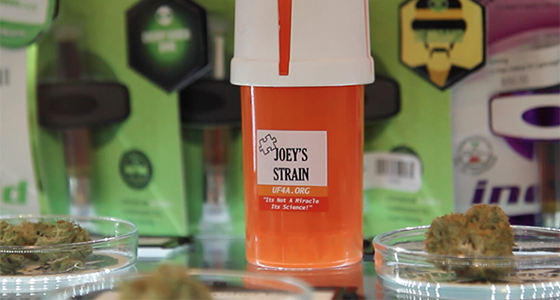
Joey's Strain
Another success story comes from Mieke Hester-Perez, founder of the Unconventional Foundation for Autism and a board member of the company Cannabis Science. Mieke comes from a conservative family whose members have deep roots in the police force, which is unusual, to say the least, for a cannabis advocate. But she is also the mother of Joey, a boy for whom Aaron Justin of Buds and Roses Collective, together with master cannabis breeder Kyle Kushman, bred Joey's strain.
Hester-Perez only turned to cannabis when Joey, who suffered from autism, was diagnosed with Duchenne muscular dystrophy - a rare and aggressive degenerative muscle disorder. According to the doctors, he had only 6 months left to live, during which he was supposed to take a mix of medications with a number of serious side effects. Moreover, at that time he was already taking around 13 different pills a day.
While trying to find less harmful treatment methods that could extend Joey's life, Hester-Perez came across cannabis. Out of curiosity, she began giving her son foods containing medical cannabis. Shortly afterwards, Joey began making eye contact, which is a common problem for children with autism. Cannabis edibles also seemed to stimulate his appetite, and Joey began to gain weight. Now, 6 years after the fatal diagnosis, Joey is a happy, sociable and thriving child.
Despite the good results, Hester-Perez faced criticism from some professionals in the medical and scientific communities. Hester responded as follows: "Until you have walked the path Joey and I have walked, until you have seen what that child was like before he started using cannabis and how much progress he has made since he began, how much his life has improved, you cannot judge."
What Is Autism?
Autism, or autism spectrum disorder (ASD), is a collection of complex brain development disorders. As a "spectrum", ASD affects individuals to varying degrees, but in general a person with autism suffers from three main symptoms:
- Problems with communication
- Problems with social interaction
- Repetitive, mostly self-harming behavioral patterns
While some children with ASD are considered intellectually impaired, others are characterized as "high functioning" - they may excel, for example, in music, mathematics or art. Moreover, some symptoms may improve with increasing age. Other children with autism, however, are unable to communicate and may engage in self-harming behavior.
The Center of Disease Control and Prevention estimates that 1.5%, or 1 in 68 children born in the USA, are diagnosed with ASD. The number of diagnosed children has increased tenfold over the last 40 years, with boys being five times more prone to autism than girls.
What Causes Autism?
Until recently, the answer was "We don't know." Now, however, we know that there is not just one cause. Research tells us that autism can be traced back to early brain development.
Only in the last few years have researchers identified a number of mutations and rare genetic changes, several of which may play a role as a catalyst for autism. In other cases, autism may be caused by a combination of environmental influences and genetic predispositions that affect early brain development.
Groups such as the Organization for Autism Research fund research aimed at detecting autism at a younger age, because the most obvious symptoms come to the surface during the 2nd to 3rd year of life. An earlier diagnosis can therefore mean more effective treatment.
Other risk factors may include:
- The age of the parents at conception
- Illness of the mother during pregnancy
- Problems during pregnancy or birth, for example an insufficient supply of oxygen to the child's brain
None of these influences causes autism on its own, but in combination with a genetic predisposition, the risk increases. According to encouraging evidence, however, women can reduce the risk of their children developing autism by following a diet rich in folic acid and taking prenatal vitamins before and after conception.
Current Autism Treatment Methods
Every autistic child is unique. What works for one child may have an adverse effect on another.
The least controversial form of treatment is behavioral therapy, which includes, for example, social skills training or parent-led sessions under the supervision of a therapist. Studies demonstrate the positive impact of two behavioral interventions applied during a child's early years:
- The Lovaas Model based on applied behavior analysis
- Early Start Denver Model
- Other studied and verified therapies that may be effective are:
- Pivotal Response Therapy
- Floortime
- Verbal Behavioral Therapy
With increasing age, extensively structured therapeutic activities, the development of social skills, the development of motor skills, and speech training become more effective.
Surprisingly, very few medications are approved for autism. In fact, there are only two approved medications for irritability associated with autism, but no medication has yet been approved that could treat the 3 main characteristics of autism - problems with communication, problems with social interaction, and repetitive behavioral patterns.
The 2 approved medications are:
- Risperdal
- Abilify
While these two medications can bring relief by reducing irritability, self-harming behavior and outbursts of aggression, they also carry serious side effects, such as diabetes, severe weight gain, gynecomastia (breast growth in males), musculoskeletal disorders and heart problems.
Other available medications are only experimental with unknown risks, or medications intended for conditions similar to autism, such as ADHD (attention deficit hyperactivity disorder), sleep disorders and depression.
For example:
- SSRIs (antidepressants)
- Stimulants such as Ritalin or Adderal
- Naltrexone, a medication for alcohol or opiate dependence, which reduces repetitive self-harming behavior.
It is important to note that none of these medications have been clinically tested for their risks or positive effects in children with autism. In addition, determining the right medication and the right dose is problematic, to say the least.
Can Cannabis Treat Autism?
More and more parents of autistic children, frustrated by the lack of treatment options, are turning to cannabis. Many of them have heard reports about the effectiveness of cannabis treatment, while others have read about promising results in children with epilepsy. However, clinical studies supporting these claims do not yet exist.
That does not mean, however, that there is no promising research:
- A 2013 study conducted by Dr. Dario Siniscalco found that certain functions of cannabis, more precisely its action on CB2 receptors, may also be useful in treating autism.
- A study published by Dr. Csaba Foldy at the Second University of Naples in cooperation with Stanford University Medical School in 2013 found that changes in endocannabinoid signaling may contribute to the development of autism.
- According to the Autism Research Institute, medical cannabis relieves anxiety, panic disorder, anger, destruction of property and self-harm.
- Dr. Daniele Piomelli and Dr. Olivier Manzoni found that certain compounds in cannabis can improve problematic behavior in children suffering from autism or fragile X syndrome.
Furthermore, the scientific team led by Dr. Piomelli discovered that cannabinoids are not only important for regulating normal social behavior, but may also be involved in the dysfunctional behavior that accompanies certain forms of autism. Piomelli describes the process as follows:
"Endocannabinoids offer hope for normalizing social behavior in children with autism by strengthening social activity and disrupting their destructive behavior."
Is Cannabis Treatment Worth the Risks?
Since scientists are guided by evidence, few of them are willing to recommend cannabis for the treatment of autism. Compared to the treatment of epilepsy, which has been mentioned in records dating as far back as 1843, for most doctors there simply is not enough evidence to allow them to prescribe cannabis as a medicine with peace of mind.
Piomelli warns that dosing can be problematic and most parents may not be well equipped with the knowledge needed to assess and monitor correct dosing. Doing so without the guidance of a qualified professional can have serious consequences.
"Pharmacology is all about dosing. Small doses can be beneficial, while large ones can cause harm. One thing people need to understand is that even though the endocannabinoid system has a protective role, it does not mean that activating this system cannot be dangerous. There is still a risk that the endocannabinoid system will turn against you. For example, even if the intention is to improve social behavior, the exact opposite may occur."
"The fact that it is a plant complicates things further. Most pharmacological medicines contain only a single active compound, but cannabis contains hundreds of them. That can be good on the one hand and bad on the other. Many attribute the effectiveness of cannabis to the so-called entourage effect, that is, the synergy between compounds. While synergy can be quite beneficial, determining the specific process and the compound that is helping us in a given case is still very problematic."
Like most doctors, Piomelli does not recommend cannabis for the treatment of autism, because there is not enough solid evidence. Unlike epilepsy, autism research is at a very early stage. Piomelli admits, however, that in some cases the use of cannabis is understandable.
"I would certainly not judge the decision of parents who are desperate and willing to try it. I am just saying be very, very careful."
Other professionals privately admit that for parents who have already exhausted all options, the potential risks of cannabis treatment are acceptable. According to Bernard Rimland, founder of the Autism Society for Autism and former director of the Autism Research Institute, the risks of medical cannabis are very mild compared to, for example, Risperdal or psychotropic medications, which Dr. Rimland considers the least useful and at the same time the most dangerous.
"Reports from parents and patients suggest that medical cannabis mostly works where all other medications and therapies have failed."
And what about you, our readers? What is your opinion on treating autism with cannabis? Share your views or experiences with us in the comments section!
Sources: wikipedia.org leafly.com miekosblog.com/ cannabisscience.com hightimes.com
Images: ladybud.com offline cleveland.com media-1.lifehack