


 English (English)
 Deutsch (German)
 Čeština (Czech)
 Italiano (Italian)
 Hrvatski (Croatian)
 Română (Romanian)
 български език (Bulgarian)
 Magyar (Hungarian)
 Español (Spanish)
 Français (French)
 Nederlands (Dutch)
 Polski (Polish)
 Slovenčina (Slovak)
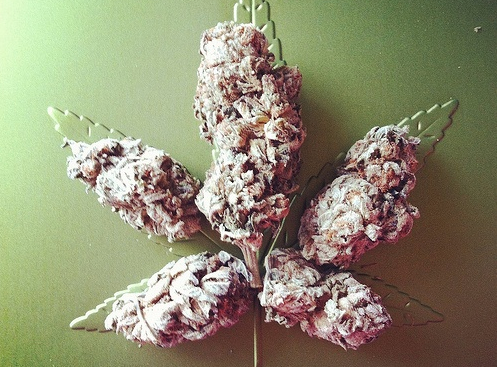



- Besides cannabinoids such as the well-known THC or CBD, medical cannabis also contains a whole range of different terpenes, i.e. aromatic and flavour substances, which, however, besides giving the buds their aroma, also provide various therapeutic properties
Treatment with aromatic substances - terpenes
Beta-caryophyllene is one of the many terpenes that can be found in the mature buds of cannabis. Its easily recognisable flavour contributes, for example, to the typical aroma of pepper. Caryophyllene can also be found in hops, cloves and rosemary. In terms of classification, the caryophyllene molecule falls among legal substances considered safe even when consumed in larger quantities.
Over the last decade, more and more scientists have begun to take notice of caryophyllene, with the biggest wave of interest breaking out at the moment when this terpene was identified as the very first non-cannabinoid substance that directly activates receptors of the endocannabinoid system.
“Medical cannabis strains rich in the terpene caryophyllene could, thanks to its influence on endocannabinoid receptors, possess specific medicinal effects.”

In today's article we will look at how to identify precisely those marijuana varieties that are rich in this specific terpene, and also at some of the typically “spicy” strains. If you are only interested in caryophyllene varieties, you can skip to the second half of the article.
Health effects of the cannabis terpene caryophyllene
CB2 receptors are present across all cells of the immune system of the human body. Their number in the brain increases sharply in the event of physical injury or at the onset of a disease. Their activation gives the body a dampening of the symptoms of inflammation, which in turn leads to a reduction in pain and in the chances of developing brain diseases.
“CB1 and CB2 receptors are the two main receptors of the endocannabinoid system of the human body. CB1 receptors occur mainly in the nervous system. CB2 receptors, which are activated under the action of caryophyllene, occur in other areas, especially in the immune system.” Elysse Feigenblatt
Research into this terpene is still at an early stage, and the available data are therefore understandably very limited. On the one hand, it is easy to assume that the effect of caryophyllene will be similar to that of other substances that activate the same CB2 receptors. After all, activating CB2 receptors with other substances can achieve precisely the dampening of pain, the prevention of stroke, and even a reduction in the amount of plaque deposited in the arteries.
Nevertheless, different activators of the same receptor also have different consequences for the type of resulting bodily mechanisms. It is precisely these differences that may result in a completely different efficacy of strains containing caryophyllene, usable in other types of disease than those that can be treated, for example, with the cannabinoids CBD or THC.
Pain treatment
Study data so far point to cases in which caryophyllene was able to help patients against various kinds of pain. In one of the studies, scientists directly observed groups of mice that had been injected with caryophyllene.
“Compared with mice that were given only the control substance, the mice under the influence of caryophyllene behaved in an evidently pain-free manner.”

Another very interesting result was the direct proportionality of the dose of caryophyllene to the efficacy of commonly administered morphine. Today we already know that people who use opiates for pain on a daily basis are able to reduce the necessary doses with the help of medical cannabis. The effectiveness of cannabis and its ability to improve the efficacy of opiates in the body may therefore be linked precisely to the terpene caryophyllene.
Inflammation and brain ageing
There are numerous inflammatory diseases that can affect our digestive tract. One such condition is, for example, colitis, which commonly causes intestinal pain, cramps in the abdominal area, and even an increased chance of developing cancer. The scientists therefore decided to group mice artificially infected with colitis and begin administering caryophyllene to them. In the end it turned out that in this case too the terpene was considerably effective, and the symptoms of inflammation in the mice decreased considerably during the therapy.
The activation of CB2 receptors therefore definitely plays a significant role in reducing pain, but an equally important function appears to be the ability to protect the brain and body from the negative effects of ageing and disease. For example, inflammation of the brain is the root of neurodegenerative diseases such as Alzheimer's. Moreover, during further experiments on mouse subjects it was observed that mice under the influence of caryophyllene had a noticeably lower occurrence of brain plaques, a typical manifestation of Alzheimer's disease.
The future of research into cannabis terpenes and caryophyllene
For now, the biggest question remains whether caryophyllene occurs in the mature buds of cannabis in a sufficiently high quantity at all to have a sufficient medicinal effect in the body. All the studies we have talked about here used highly concentrated extracts of caryophyllene in their research. But are these doses drastically higher than those we take into the body when smoking or vaporising cannabis? Unfortunately, we do not yet know the answer to this question.
Future research into medical cannabis and the terpenes it contains should therefore focus on dosages that are common for a typical marijuana user. Nevertheless, once the optimal effective dose of caryophyllene has been found, it will be possible to include extracts of this terpene directly in the diet or in edibles enriched with substances from cannabis.

Will I find more caryophyllene in indica or sativa?
Laboratory results so far have gathered data collected from more than a thousand different cannabis genetics, and it appears that there is not such a big difference between indica, sativa or hybrids as far as the content of caryophyllene is concerned. The vast majority of varieties that contained caryophyllene carried it in a percentage amount of 0.5%. Whether a given variety is a sativa or an indica therefore cannot be considered a reliable indicator.
Medical cannabis varieties with the highest content of caryophyllene
As there are still not enough detailed data today on the average quantities of substances occurring in individual genetics, it should be borne in mind that the terpene caryophyllene is probably contained in many more varieties than is currently known. Nevertheless, the following three genetics are considered relatively reliable in terms of their caryophyllene content:
White Widow
White Widow, also known as the famous Bílá Vdova (White Widow), is undoubtedly one of the most frequently mentioned and also one of the most popular medical cannabis varieties worldwide. The origin of this legend lies in a combination of ancient landrace genetics originating from the region of Brazil and the mountains of Kerala. For breeding this immortal genetic, which has now spread all over the world, we have the founder of the Green House Seeds, Shantibaba.
Seeds of White Widow are available in many different versions, but the most popular variants of recent times are:
-
White Widow XXL Auto
Cookies
In the last few years, the Cookies variety has become a phenomenon on the cannabis scene. This genetic has made its way from California to the rest of the world and is now available in several variations. According to users' experience, it is the terpene spectrum that lifts this variety above average and leaves an indelible mark in the memory of patients and recreational users alike.
Cookies varieties are currently available in the following variations:
However, the Cookies genetic is also widely used by the seed banks Royal Queen Seeds and the Californian Barney’s Farm as part of their new releases, which include in particular.
Blueberry
Blueberry is a well-known cannabis legend, which we will soon discuss in the next instalment of Legendary Strains. This variety is most frequently mentioned precisely in debates on terpenes and especially flavonoids - the mature buds of Blueberry are characterised by a typically purple hue when the right growing conditions are met.
The currently most popular Blueberry varieties include:
Source: leafly.com