


 English (English)
 Deutsch (German)
 Čeština (Czech)
 Italiano (Italian)
 Hrvatski (Croatian)
 Română (Romanian)
 български език (Bulgarian)
 Magyar (Hungarian)
 Español (Spanish)
 Français (French)
 Nederlands (Dutch)
 Polski (Polish)
 Slovenčina (Slovak)



Legal status of cannabis in the European Union (as of 25 September 2026)
- The EU has no single cannabis law: it sets a common framework for hemp farming, trade and drug trafficking, while recreational use is regulated by each Member State.
- CBD lawfully produced in one Member State may in principle be sold in another; a national ban is allowed only if it is suitable to protect public health and does not go beyond what is necessary. The Court held that such CBD is not a narcotic drug under the 1961 Single Convention (Articles 34 and 36 TFEU, Case C-663/18 Kanavape, paras 76 and 96).
- Industrial hemp qualifies for CAP direct payments only if the THC content of the variety does not exceed 0.3 % (Art. 4(4) Regulation (EU) 2021/2115); THC control methods are set by the Commission (Art. 60(4)(a) Regulation (EU) 2021/2116).
- Member States may restrict how hemp is grown, for example ban indoor hydroponic cultivation, if the restriction is suitable and proportionate for protecting public health (Case C-793/22 Biohemp Concept, 4 October 2024).
- Member States must make intentional unlawful cultivation of cannabis plants and drug trafficking a criminal offence (Art. 2(1)(b) Framework Decision 2004/757/JHA, as quoted in Case C-271/23).
- Rules on recreational cannabis differ widely: Germany allows adults to possess up to 25 g in public, 50 g at home and three plants (§ 3 and § 9 KCanG), while in Czechia personal use becomes a criminal offence only above 5 plants, 200 g at home or 50 g elsewhere, and plants with up to 1 % THC are excluded (§ 285 Czech Criminal Code).
“Články 34 a 36 SFEU musí být vykládány v tom smyslu, že brání vnitrostátní právní úpravě, která zakazuje uvádět na trh CBD, který je legálně vyprodukován v jiném členském státě, v případě, že je extrahován z celé rostliny cannabis sativa, a nikoli pouze z jejích vláken a semen, ledaže je tato právní úprava s to zaručit naplnění cíle ochrany veřejného zdraví a nepřekračuje meze toho, co je k dosažení tohoto cíle nezbytné.”
[Translation: “Articles 34 and 36 TFEU must be interpreted as precluding national legislation which prohibits the marketing of CBD lawfully produced in another Member State when it is extracted from the Cannabis sativa plant in its entirety and not solely from its fibre and seeds, unless that legislation is appropriate for securing the attainment of the objective of protecting public health and does not go beyond what is necessary for that purpose.”]
This overview is based on legislation and case law in the legal database Europaius. It is not legal advice.
Legal status: In the Czech Republic, HHC (hexahydrocannabinol) is a psychotropic substance listed in Annex 4 of Government Regulation nařízení vlády č. 463/2013 Sb. Producing, selling, offering or possessing it without authorisation is unlawful. Related substances such as HHCP, HHCH (HHC-C6), HHC-C8 and HHCB are listed psychoactive substances under nařízení vlády č. 11/2025 Sb. and may be handled only for research. HHC is also banned in Germany, France, Poland, Slovakia, the Netherlands, Bulgaria and Romania, HHC derivatives are banned in Italy, and in a number of other EU countries HHC is also a controlled substance. This article is for information only.
HHC: What It Is
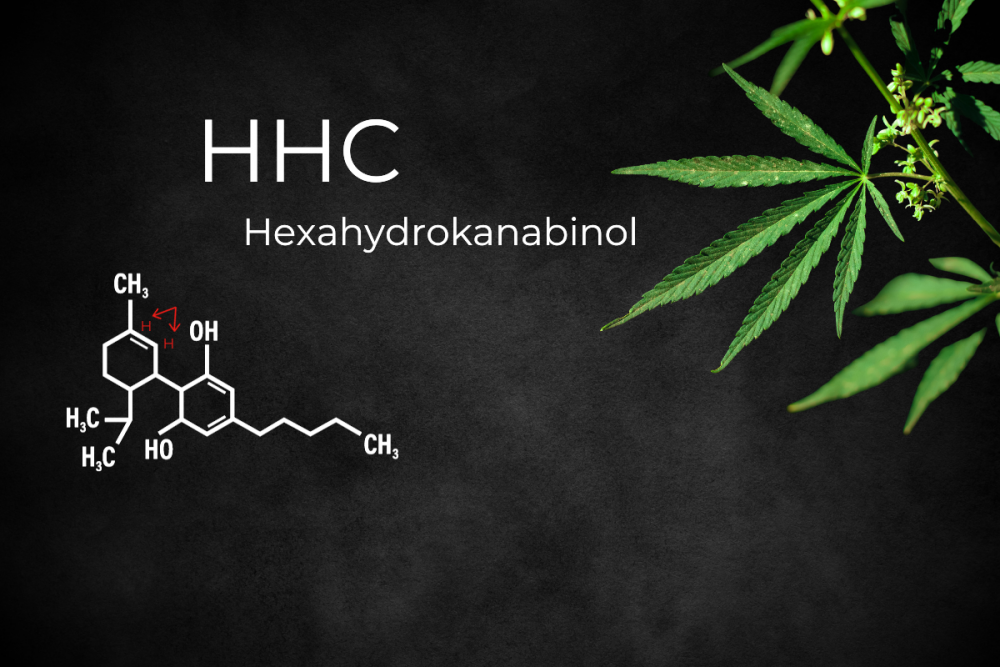
HHC (hexahydrocannabinol) is a semi-synthetic cannabinoid. It occurs in the cannabis plant only in trace amounts, so the HHC in products was made by chemically converting other cannabinoids, usually CBD extracted from hemp. It is closely related to THC and has psychoactive effects.
HHC is not a plant variety or a genetic trait. No cannabis variety produces it in meaningful amounts, so there are no “HHC genetics” or “HHC seeds”, and HHC is not a collector's item.
Chemical Composition
HHC is formed by hydrogenation: hydrogen atoms are added to the double bond of the THC molecule, which makes it more resistant to oxidation. The process produces two stereoisomers, 9R-HHC and 9S-HHC. HHC was first prepared in the 1940s by the American chemist Roger Adams by hydrogenating THC.
HHC itself has no characteristic aroma. The terpene profiles described for “HHC flowers” came from the hemp material to which HHC had been added.
Research, Effects and Risks
HHC has not been approved as a medicine, and its effects and safety have not been sufficiently studied. Its effects on the body are similar to those of THC.
- Psychoactive effects: HHC can alter perception, attention and reaction time. Do not drive after using it.
- Unknown composition: HHC products were made by chemical conversion without pharmaceutical control; their actual content and possible production residues were not verified.
- Drug tests: using HHC can lead to a positive test for THC.
- Reported side effects: drowsiness, dry mouth, anxiety, dizziness or a rapid heartbeat.
Legal Status
HHC is not a “grey area” product, nor a legal alternative to cannabis. In the Czech Republic it is a psychotropic substance under nařízení vlády č. 463/2013 Sb., and handling the related substances listed in nařízení vlády č. 11/2025 Sb. outside research is prohibited (Section 33j of Act No. 167/1998 Coll.). This also applies to products made from industrial hemp.
Forms in Which HHC Was Sold
Before it was banned, HHC was sold mainly as vape cartridges, as hashish with added HHC and as hemp flowers to which HHC had been applied. In the Czech Republic and in the countries listed above, all these products are now illegal.