


 English (English)
 Deutsch (German)
 Čeština (Czech)
 Italiano (Italian)
 Hrvatski (Croatian)
 Română (Romanian)
 български език (Bulgarian)
 Magyar (Hungarian)
 Español (Spanish)
 Français (French)
 Nederlands (Dutch)
 Polski (Polish)
 Slovenčina (Slovak)
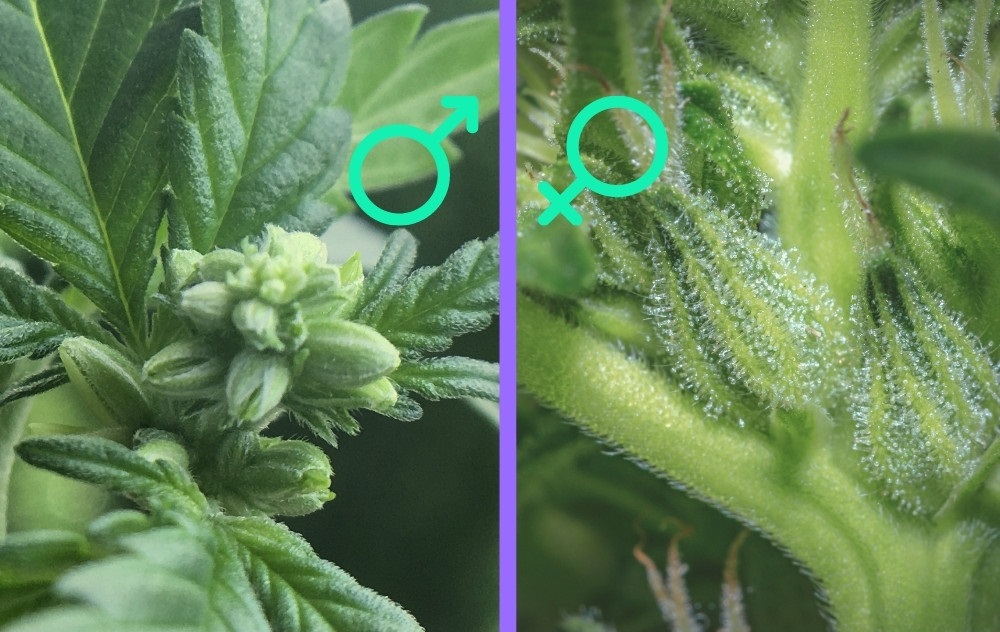


Male or female cannabis – how to recognize the gender and why it matters so much? Correctly identifying the sex of a cannabis plant is crucial for quality cultivation, yield, and active ingredient content. In this article, we will explain how to recognize cannabis gender in different growth stages and why it is important to distinguish male and female plants as early as possible.
Determining the genetic sex of cannabis seeds is a fundamental aspect for any serious collector of genetic material. Understanding the morphological and chromosomal differences between male and female plants forms the basis of a well-organised collection and an accurate assessment of the available genetic profiles.
The Genetic Fundamentals of Sex Determination in Cannabis
The cannabis chromosome system follows the XY pattern for male specimens and XX for female ones, similar to humans. This chromosomal configuration determines not only the sex of the plant but also the distinct characteristics of each phenotype, including terpene profiles and cannabinoid structure.
Male genetic material is characterised by pollen production and the development of specific floral structures, while female genetics determine the formation of complex flowers, rich in resinous glands and with developed aromatic profiles. These differences are reflected in the chemical composition and aromatic potential of each genetic line.
Feminised Seeds - the Revolution in Genetics Collecting
Genetic feminisation techniques have radically transformed the field of cannabis seed collecting. By manipulating chromosomal expression, reputable breeders can offer feminised seeds with a success rate of almost 99% for obtaining female specimens.
The feminisation process involves the use of substances that inhibit ethylene production, forcing female plants to produce pollen with exclusively female chromosomes. The result is genetic material that retains all the desired characteristics of the mother line, eliminating the risk of unwanted pollination in seed collections.
Distinctive Morphological Characteristics
Identifying sex based on morphological characteristics is an essential skill for correctly assessing collected genetic material. Each sex displays distinctive traits that manifest at different stages of development.
The Male Genetic Profile
Male specimens are characterised by rapid growth in height and a less dense structure. The branching system is usually sparser, with longer internodes, reflecting the evolutionary adaptation for efficient pollen dispersal.
- Early flowering - 1-4 weeks ahead of female specimens
- Clustered floral structures with five distinct sepals
- Pendant anthers that release pollen at maturity
- Plant architecture oriented vertically for optimal pollen dispersal
From a collector's perspective, male specimens are valuable for hybridisation programmes and for preserving genetic diversity. Pollen can be collected and stored under controlled conditions for future use in developing new genetic lines.
Characteristics of Female Genetics
Female plants show a completely different profile, optimised for producing complex floral structures rich in active compounds. Distinctive stigmas - white, cream or reddish hairs - emerging from specialised bracts, are the most obvious indicator of female sex.
- Pronounced lateral development with dense branching
- Flowers with glandular trichomes producing aromatic resins
- Formation of "colas" - dense clusters of flowers up to 60 cm long
- Complex terpene profiles with distinctive aromatic notes
For collectors, female specimens are the main source of information about the cannabinoid and terpene profiles of a particular genetic line. Analysing the chemical composition of these specimens provides essential data for accurately cataloguing a collection.
The Timeline of Identification and Assessment Methods
The process of identifying sex in cannabis genetic material follows a precise timeline, and each stage offers specific clues for experienced collectors.
Early Vegetative Stage
At this stage, sexual differentiation is minimally detectable, but attentive observers can identify certain growth tendencies. Male specimens tend to show more pronounced internode elongation, while female ones develop a more compact, more branched structure.
Pre-flowering - the Crucial Moment
This stage, also known as "pre-flowering", is the first moment when sex can be determined with certainty. In autoflowering varieties, this process can begin 3-4 weeks earlier than in photoperiod varieties.
Careful examination of the leaf axils reveals the first sexual structures:
- Male: Small globular structures on short stalks
- Female: Elongated structures without stalks, from which the stigmas will emerge
Advanced Identification Techniques
Professional collectors use sophisticated methods for early sex determination, including chromosomal analysis and molecular genetic testing. These techniques allow sex to be identified as early as the seedling stage, offering significant advantages in managing large collections.
Using magnifying glasses with 10-20x magnification makes it easier to observe fine morphological details, while macro photography techniques allow precise documentation of distinctive characteristics for archiving in collection catalogues.
Implications for Responsible Collecting
A deep understanding of sexual dimorphism in cannabis goes beyond simple identification, influencing strategies for collecting and preserving genetic material. Each sex contributes uniquely to the genetic diversity and aromatic potential of a collection.
Responsible management of a collection involves the rigorous separation of male and female specimens to avoid unwanted fertilisation, which would compromise the purity of the collected genetic lines. Meticulous documentation of each specimen's characteristics helps build a valuable database for further research.
In conclusion, mastering sex identification in cannabis seeds is a fundamental skill for any serious collector, providing the basis for understanding genetic complexity and for appreciating the remarkable diversity of this fascinating species.