


 English (English)
 Deutsch (German)
 Čeština (Czech)
 Italiano (Italian)
 Hrvatski (Croatian)
 Română (Romanian)
 български език (Bulgarian)
 Magyar (Hungarian)
 Español (Spanish)
 Français (French)
 Nederlands (Dutch)
 Polski (Polish)
 Slovenčina (Slovak)
Cannabis Microdosing – Small Doses, Big Effects
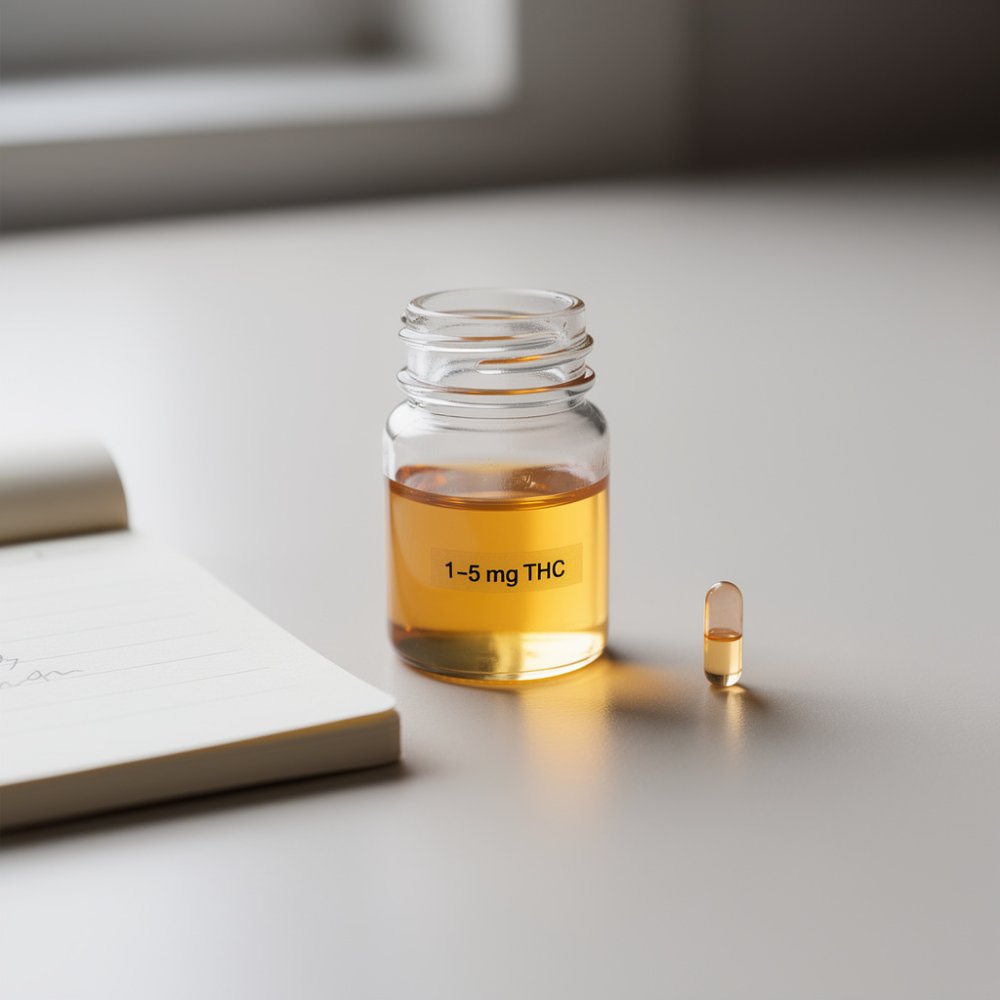
In cannabis medicine and wellness, a principle that seems to run counter to intuition has gained ground in recent years: less can be more. Microdosing cannabis is the practice of deliberately consuming very low doses of cannabinoids – typically 1–5 mg THC or 2–10 mg CBD – with the aim of achieving therapeutic effects without the adverse effects associated with higher doses.


This philosophy challenges the established belief that a stronger dose automatically brings better results. The pioneer of cannabis microdosing is American physician Dustin Sulak, who since 2009 has developed a systematic protocol now used by thousands of patients. The following guide summarizes the science behind microdosing, the practical procedure, and why this approach is relevant even for CBD product users.
What is Cannabis Microdosing
Definition
Cannabis microdosing means the deliberate consumption of sub-therapeutic or threshold doses of cannabinoids – that is, doses at the edge of perceptibility or just below it. The goal is not to achieve a pronounced psychoactive effect (with THC) or high plasma concentration (with CBD), but to maintain a stable, low level of cannabinoids in the body throughout the day.
Typical microdoses compared to standard dosing:
| Cannabinoid | Microdose | Standard Dose (for comparison) |
|---|---|---|
| THC | 1–5 mg | 10–30 mg |
| CBD | 2–10 mg | 25–100 mg |
| CBD:THC (1:1) | 1–2.5 mg each | 5–15 mg each |
Why Microdosing Works: Biphasic Response
The logic of microdosing is based on the pharmacological principle of biphasic response: a range of substances exhibit different – sometimes directly opposite – effects at low and high doses.
With cannabis, this phenomenon is particularly pronounced:
- Low THC dose (1–5 mg): mild anxiety reduction, mood improvement, gentle analgesic effect.
- High THC dose (20+ mg): risk of increased anxiety, paranoia, cognitive slowing, sedation.
As Sulak himself formulates it: "When you increase the dose, sometimes you get decreased benefits and sometimes the exact opposite of what you're looking for – while a little cannabis might help reduce anxiety, too much might actually trigger it."
This principle is analogous to the hormetic effect described in other areas of biology: a mild stimulus strengthens the system, while excessive stimulation weakens it.
Sulak's Protocol: Sensitization and Finding the Optimal Dose
Who is Dustin Sulak
Dustin Sulak, DO (Doctor of Osteopathic Medicine), is a physician from Maine, USA, who has specialized in cannabis medicine since 2009. As the founder of Healer.com, he developed an approach named the Cannabis Sensitization Protocol – a systematic framework for finding the minimal effective dose of cannabis.
Key Discovery: The Efficacy Threshold
Sulak identified that most users have a specific threshold dose that acts as a tipping point:
- Below the threshold: as the dose increases, therapeutic benefits gradually rise, adverse effects remain minimal.
- Above the threshold: tolerance builds, benefits decrease, and adverse effects appear – short-term memory impairment, impaired coordination, excessive appetite.
The goal of microdosing is to identify this threshold and deliberately move just below it or at its level.
Practical Procedure of Sulak's Protocol
Phase 1: 48-Hour Abstinence (Optional, but Recommended)
If you already use cannabis, Sulak recommends starting the protocol with 48 hours of abstinence from all cannabinoids. This pause helps "reset" the endocannabinoid system and increase its sensitivity.
- During abstinence, carefully observe your natural state – mood, sleep quality, pain intensity, anxiety level.
- These baseline values are essential reference points for later comparison with the effects of microdoses.
Phase 2: Finding the Minimal Effective Dose
- Day 1–3: Start with 1 mg THC (optionally 1 mg THC + 1 mg CBD in a 1:1 ratio).
- Before each dose, subjectively assess your state: anxiety, pain, mood, energy on a scale of 1–10.
- 30–60 minutes after the dose, re-evaluate the same parameters.
-
If you notice no apparent effect, that's fine – maintain this dose for 3 days.
-
Day 4 onwards: Increase the dose by 1 mg and repeat the same.
-
Continue increasing gradually until you notice a threshold effect – a subtle but distinct change in symptoms, mood, or perception.
-
After finding the threshold dose, maintain it for at least 4 days and monitor consistency of effect.
-
Optimal dose corresponds to the threshold level or slight above – the lowest dose at which the therapeutic effect is clear but does not cause adverse manifestations.
Phase 3: Maintenance Phase
- Dose 1–3 times daily according to individual need and desired duration of effect.
- If you notice the effect weakening, do not increase the dose – instead, take a 48-hour break and perform a receptor sensitivity reset.
- Regularly reassess your needs: as your condition improves, it's often possible to gradually reduce the dose.
Scientific Mechanism: Why Sensitization Works
Sulak's protocol has a solid pharmacological foundation in the knowledge of the endocannabinoid system:
- Low THC doses can increase CB1 receptor density – the body responds to mild stimulation by increasing the number of available receptors.
- Increased sensitivity of existing receptors – a receptor responds more intensely to the same cannabinoid concentration.
- Support for endogenous cannabinoid production – low doses can stimulate the formation of anandamide and 2-arachidonylglycerol (2-AG).
- Opposite effect of high THC doses – excessive stimulation leads to CB1 receptor downregulation, reduced sensitivity, and tolerance building.
THC Microdosing: For Whom and for What Conditions
Indications with Documented or Promising Results
| Condition | Typical Microdose | Note |
|---|---|---|
| Chronic pain | 2–5 mg THC | Analgesic effect without sedation or cognitive impairment |
| Anxiety | 1–2.5 mg THC | Higher doses paradoxically intensify anxiety |
| Depression | 1–2.5 mg THC | Gentle mood modulation without euphoria |
| Insomnia | 2–5 mg THC (evening) | CBN may be an alternative or complement |
| PTSD | 1–5 mg THC | Promising clinical experience, limited controlled studies so far |
| Focus | 1–2 mg THC | Highly individual; may distract sensitive individuals |
| Creative work | 1–2.5 mg THC | Mainly anecdotal evidence, but consistently mentioned |
Why Choose Microdosing over Standard Dosing
- Minimal psychoactive effects – 1–2.5 mg THC does not produce a perceptible "high" in the vast majority of adults.
- Preservation of cognitive function – no impairment of short-term memory, attention, or fine motor skills.
- Building sensitivity instead of tolerance – with proper microdosing, receptor sensitivity increases rather than decreases.
- Lower incidence of adverse effects – less dry mouth, less red eyes, less fatigue.
- Compatibility with everyday life – work, sports, and social activities remain fully preserved.
- Economic advantage – significantly lower product consumption with comparable or better effect.
CBD Microdosing
Why Microdose Even Non-Intoxicating CBD
While with THC the primary goal is to stay below the intoxication threshold, CBD microdosing pursues different therapeutic objectives:
- Stable plasma levels – instead of one large daily dose, you maintain even, low CBD concentration throughout the day, leading to more consistent effect.
- Limiting adverse effects – higher CBD doses can cause drowsiness, gastrointestinal discomfort, or clinically significant drug interactions in sensitive individuals. Low doses substantially reduce these risks.
- Regulatory context – the EFSA position on 2 mg CBD safe daily intake in practice favors a microdosing approach for common wellness use.
- Precise individual calibration – CBD responses vary significantly between individuals; microdosing allows finding the optimum without unnecessary waste.
Practical Procedure for CBD Microdosing
| Step | Procedure |
|---|---|
| Starting dose | 2–5 mg CBD, 2× daily (morning and evening) |
| Observation phase | Track effects on sleep, mood, pain, and anxiety for 3–5 days |
| Dose adjustment | Increase by 2–5 mg if no effect is noticed; decrease if drowsiness or nausea occurs |
| Optimal dose | Lowest dose with objectively observable benefit |
| Maintenance phase | Stable dose given 2–3 times daily at the same time |
A quality CBD oil with a precise dropper is ideal for microdosing – one drop of most tinctures contains 1–5 mg CBD depending on product concentration, allowing truly fine-tuned dosing.
Combined CBD + THC Microdosing
The combination of CBD and THC in a 1:1 ratio is considered one of the most effective microdosing strategies:
- CBD modulates and dampens potentially anxiety-inducing effects of THC, reducing paranoia risk.
- THC complements CBD's analgesic and mood-improving properties.
- Recommended combined microdose: 1–2.5 mg CBD + 1–2.5 mg THC.
This synergistic effect is often referred to as part of the broader entourage effect principle, where individual cannabis components mutually strengthen and modulate each other's effects.
Routes of Administration and Their Suitability for Microdosing
Sublingual Administration (Oils, Tinctures)
Unequivocally the most recommended form for systematic microdosing.
Advantages:
- Precise dosing by drops with the possibility of very fine titration.
- Relatively fast onset (15–30 minutes) due to absorption through the mucosa.
- Medium duration (4–6 hours) – suitable for 2–3 daily doses.
- Easy reproducibility: each dose is identical.
Procedure:
1. From the label or Certificate of Analysis (COA), determine the exact CBD/THC content per drop.
2. Apply the required amount under the tongue and hold for 60–90 seconds for maximum absorption.
3. Swallow the remainder.
Oral Administration (Capsules, Gummies, Edibles)
Advantages:
- Discreet form suitable for work or travel.
- Longer and more even duration (6–8 hours).
Disadvantages:
- Slower onset (30–90 minutes) makes immediate effect assessment difficult.
- First-pass liver metabolism causes unpredictable bioavailability that may vary even in the same individual depending on food and other factors.
- Fixed capsule content limits flexibility in fine-tuning.
Vaporization (Dried Herb, Concentrates)
Advantages:
- Fastest onset (1–5 minutes) allows immediate assessment and precise titration.
- Suitable for situations requiring rapid symptom adjustment.
Disadvantages:
- Short duration (1–3 hours) requires more frequent dosing.
- Dose depends on breath depth, duration, and number of inhalations – less reproducible.
- Even without combustion, inhalation carries potential respiratory risks, though significantly lower than smoking.
For targeted, systematic microdosing, sublingual administration remains the most reliable choice. CBD oil or CBD capsules with clearly stated active substance content per dose form the foundation of any well-adjusted microdosing protocol.
Keeping a Journal: The Foundation of Successful Microdosing
Without systematic recording, objective assessment of effect is practically impossible – subjective memory is unreliable when evaluating subtle changes. However, the journal need not be complex; a consistent structure is sufficient.
What to Record
| Parameter | Example Entry |
|---|---|
| Date and time | Mar 1, 2026, 8:00 AM |
| Product | CBD oil 10%, full spectrum |
| Dose | 3 drops = 4.5 mg CBD |
| Route of administration | Sublingual |
| State before dose | Anxiety 6/10, back pain 4/10, energy 5/10 |
| State 1 hour after | Anxiety 3/10, pain 3/10, energy 6/10 |
| State 4 hours after | Anxiety 4/10, pain 4/10, energy 5/10 |
| Adverse effects | None |
| Notes | Better focus at work, taken on empty stomach |
How to Evaluate the Journal
After 1–2 weeks of regular recording, look for repeating patterns:
- Which dose brings the best benefit-to-risk ratio?
- What time of administration correlates with best results?
- Does efficacy differ on an empty stomach versus after food?
- Is the effect stable, or does it come and go?
This information is invaluable when deciding whether to adjust the protocol.
Safety Principles of Microdosing
For THC Microdosing
- Legal context: THC is subject to legal restrictions. In the Czech Republic, THC microdosing is legal exclusively within prescribed medical cannabis. This article is educational and not a guide to breaking the law.
- Vehicle operation: Even a microdose of THC can affect reaction time. In the Czech Republic, drivers face zero tolerance for any THC concentration – microdosing and driving are incompatible.
- Drug interactions: THC and CBD are metabolized by the CYP450 system and can affect levels of many medications. Details in the article CBD and Medications – Interactions.
- Psychiatric contraindications: Individuals with a history of psychosis, schizophrenia, or bipolar disorder should not use THC in any dose without psychiatric supervision.
- Pregnancy and breastfeeding: THC is categorically contraindicated in pregnancy and breastfeeding regardless of dose.
For CBD Microdosing
- Product quality and transparency: Low-quality CBD products may contain undeclared THC, pesticides, or heavy metal contamination. Always request a COA (Certificate of Analysis) from an accredited laboratory.
- Drug interactions: Even low CBD doses can inhibit cytochrome P450 enzymes (particularly CYP3A4 and CYP2D6) and thus alter the metabolism of concurrently used medications. Consult a physician before starting microdosing with any medication. A detailed overview of specific interactions can be found in the article CBD and Medications – Interactions You Must Know.
- Interindividual variability: The same CBD dose can have significantly different effects in different people depending on body weight, metabolism, gut microbiota, and genetic factors. This is why a systematic approach with a journal is key.
Microdosing and Minor Cannabinoids
The principle of microdosing logically extends to minor cannabinoids, whose pharmacological profiles differ from THC and CBD and offer targeted possibilities.
CBG
A clinical study from 2024 demonstrated anxiolytic effects at a 20 mg CBG dose. Microdosing (5–10 mg) could provide gentle stress support without psychoactive effects. CBG oil is an available and well-titratable option.
CBN
CBN in a dose of 5–10 mg given 30–60 minutes before sleep can support sleep onset and overall sleep quality. This is a lower dose than used in clinical studies, but the microdosing principle calls for starting conservatively and increasing only to sufficient effect.
THCV
THCV exhibits interesting dose-dependent pharmacology: at microdoses (below 5 mg), it acts as a CB1 receptor antagonist and suppresses appetite without psychoactive effect. Above approximately 10 mg, behavior changes – THCV becomes a partial CB1 agonist and may exhibit mild psychoactive properties. THCV microdosing is therefore particularly sensitive to dose precision.
Most Common Microdosing Errors
| Error | Why It's Problematic | How to Correct It |
|---|---|---|
| Too-rapid dose increases | You skip the optimal threshold and end up above it | Increase by maximum 1 mg THC or 2–5 mg CBD every 3–5 days |
| Not keeping a journal | Without records, objective assessment of subtle changes is impossible | Record every dose and subjective state before and after administration |
| Inconsistent dosing times | Fluctuating plasma levels lead to unpredictable effect | Dose every day at the same time |
| Choosing an imprecise product | Without knowing content per drop, you cannot reproduce the dose | Choose products with accurate droppers, stated content, and COA |
| Increasing dose when expectations unmet | You overlook subtle but real effects | Be patient; microdose effect is deliberately gentle and develops gradually |
| Combining with alcohol | Alcohol unpredictably amplifies THC effects and increases adverse reaction risk | Avoid alcohol throughout the active protocol |
When Microdosing Is Not Appropriate
Microdosing is not a universal therapeutic strategy. It is unsuitable for:
- Acute intense pain – requires higher analgesic doses or conventional pharmacotherapy.
- Acute epileptic seizures – registered cannabidiol preparation Epidiolex is given in pharmaceutical doses (5–20 mg/kg/day), not microdoses.
- Severe psychiatric disorders – treatment requires expert supervision, standardized procedures, and proven therapeutic doses.
- Situations requiring rapid and strong effect – microdosing is a long-term preventive and supportive strategy, not an acute intervention.
Frequently Asked Questions (FAQ)
Will I Get "High" from a THC Microdose?
With properly adjusted microdose (1–2.5 mg THC), the vast majority of adults will not experience a classic "high". The effect is deliberately subtle – mild tension relief, gentle mood improvement, reduced pain perception. If you feel clearly intoxicated, the dose is set too high and needs to be reduced.
How Long Before Microdosing Starts Working?
The effect of a single THC microdose is noticeable within 15–60 minutes depending on the route of administration. With systematic CBD microdosing, it may take 1–2 weeks of regular use before cumulative effects fully manifest and plasma levels stabilize.
Can I Microdose CBD While Taking Medication?
CBD interacts with the cytochrome P450 system even at low doses and can affect the metabolism of many medications – including anticoagulants, antiepileptics, or immunosuppressants. Before starting microdosing with any medication, consult a physician. An overview of specific interactions is found in the article CBD and Medications – Interactions You Must Know.
Is Microdosing Legal in the Czech Republic?
Microdosing CBD from cannabis with THC content below the legal limit is legal in the Czech Republic. THC microdosing is legal only within medical cannabis prescribed by a doctor, which has been available in the Czech Republic since 2013. The law does not permit recreational or non-medical THC use.
What Is the Practical Difference Between CBD Microdosing and Standard Dosing?
CBD microdosing (2–10 mg, 2–3 times daily) aims to maintain a stable low level in the body and seeks the minimal dose with measurable effect. Standard dosing (25–100+ mg/day) seeks higher plasma concentrations, typically for more pronounced or faster therapeutic effect. Microdosing is gentler on the liver, carries lower risk of drug interactions, and is more economical – suitable especially for preventive and wellness use.
Can I Microdose Cannabis Long-Term?
For CBD, long-term safety and tolerability of low doses are well-supported by available data. For THC, the situation is more nuanced: while microdosing substantially reduces the risk of tolerance and adverse effects, long-term effects of very low THC doses have not been sufficiently studied. Sulak's protocol therefore recommends regular 48-hour breaks every few weeks as a preventive measure to maintain receptor sensitivity.
Conclusion
Cannabis microdosing is an approach that returns control and awareness to the user. Instead of blindly increasing doses, it offers a systematic way to identify the minimal effective dose – the point where therapeutic benefits are maximized and adverse effects remain below the threshold of perception.
Sulak's key observation captures it perfectly: there is a threshold, below which health benefits increase with increasing dose, and above which they begin to decrease while adverse effects grow. Microdosing is the discipline of remaining consciously on the right side of this threshold.
For CBD users, microdosing is particularly relevant in the context of tightening regulation – the EFSA position on 2 mg CBD safe daily intake de facto supports the microdosing approach. A quality CBD oil with a precise dropper and transparent COA is the most reliable tool for systematic microdosing.
Whether you decide to microdose THC, CBD, or minor cannabinoids – the key is patience, consistency, and an honest journal. The subtle signals from your body are worth tracking: in microdosing, they are precisely what makes the difference.