


 English (English)
 Deutsch (German)
 Čeština (Czech)
 Italiano (Italian)
 Hrvatski (Croatian)
 Română (Romanian)
 български език (Bulgarian)
 Magyar (Hungarian)
 Español (Spanish)
 Français (French)
 Nederlands (Dutch)
 Polski (Polish)
 Slovenčina (Slovak)
Garden Seeds – Cannabis as a Garden Plant
Cannabis sativa L. ranks among the oldest cultivated crops in the world and simultaneously among the most versatile garden plants. Forget the stereotypes – cannabis in the garden is far from just about flower production. It's a fast-growing, visually striking plant that actively improves soil, naturally repels pests, attracts pollinators, and functions as an excellent companion for vegetables, herbs, and fruit trees. This article will show you how to meaningfully incorporate cannabis into your garden – as both a functional and decorative element.

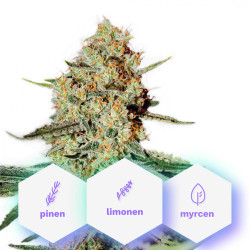

Why Grow Cannabis in the Garden
Aesthetic Value
Cannabis is a visually attractive plant with a range of decorative properties:
- Height: Depending on the variety, 0.5 to 3 meters – from compact dwarfs suitable for containers to majestic flower bed dominants.
- Leaves: Iconic palmate compound leaf with 5 to 9 leaflets – instantly recognizable shape with striking decorative potential.
- Colors: Various shades of green, in some varieties purple or red transitions, striking autumn coloration.
- Flowers: Dense, aromatic pistillate plant inflorescences or airy staminate plant panicles.
- Rapid growth: A seedling grows into a full plant within 3 to 4 months – daily growth is clearly visible in healthy plants.
Functional Benefits
| Benefit | Description |
|---|---|
| Soil Improvement | Deep taproot (up to 2 m) mechanically aerates and loosens compacted soil |
| Green Manure | After incorporation into soil, adds organic matter and releases nutrients |
| Pest Repulsion | Terpenes naturally repel aphids, codling moths, whiteflies, and slugs |
| Pollinator Attraction | Male plants produce pollen, female plants attract bees and butterflies |
| Shading | Tall varieties provide natural shade for more sensitive or drought-prone plants |
| Phytoremediation | Cannabis absorbs heavy metals and pesticides from contaminated soil |
Suitable Varieties for the Garden
Technical (Industrial) Varieties
For garden cultivation in the Czech Republic, certified technical cannabis varieties with THC content below the legal limit are ideal. Select seeds exclusively from registered varieties listed in the EU catalog – this ensures the legality of cultivation and predictable plant characteristics. A detailed overview of varieties can be found in the article on technical cannabis.
| Variety | Height | Type | CBD Content | Suitable for |
|---|---|---|---|---|
| Finola | 100–160 cm | Monoecious | 3–4 % | Compact flower beds, seeds, CBD |
| Futura 75 | 200–350 cm | Monoecious | 4–5 % | Windbreak, flower bed background, CBD |
| Fedora 17 | 150–200 cm | Monoecious | 3–5 % | Versatile use |
| USO 31 | 80–120 cm | Monoecious | Low | Most compact, containers |
| Tiborszállási | 200–300 cm | Dioecious | 2–3 % | Fiber, striking solitary plant |
| Carmagnola | 250–400 cm | Dioecious | 3–4 % | Garden dominant, fiber |
| Bialobrzeskie | 200–300 cm | Monoecious | 1–2 % | Fiber, biomass, green manure |
CBD Varieties
CBD varieties legal in the Czech Republic offer a more attractive aromatic profile than industrial varieties and are suitable for growers who also want to utilize the CBD content of harvested flowers:
- Denser, more resinous flowers with a pronounced terpene profile.
- Lower height range of 80 to 150 cm – manageable even on smaller gardens.
- Higher care requirements and longer harvest window than industrial varieties.
Explore the selection of garden seeds on Cannapio.cz or technical cannabis seeds.
Companion Planting – Cannabis as a Garden Companion
Companion planting is a centuries-old agricultural practice in which plants are deliberately combined to support each other. Cannabis, thanks to its terpene profile and root structure, ranks among the most effective companion plants available.
Cannabis Helps Other Plants
| Plant | How Cannabis Helps | Note |
|---|---|---|
| Tomatoes | Repels aphids and whiteflies, provides shade for sensitive leaves on hot days | A classic and proven combination |
| Cabbage, broccoli, kale | Repels cabbage moths and caterpillars | Terpenes don't appeal to brassica pests |
| Potatoes | Repels Colorado potato beetle | Traditional use in organic farming |
| Carrots | Deep cannabis roots loosen soil, facilitating root vegetable growth | Cannabis roots penetrate significantly deeper |
| Beans, peas | Legumes fix nitrogen, cannabis efficiently utilizes it | Mutually beneficial nutrient exchange |
| Corn | Similar nutrient requirements, mutual shading and support | Resembles traditional milpa combination principle |
| Herbs (basil, mint) | Mutual reinforcement of pest repulsion | Ideal for aromatic gardens |
What Benefits Cannabis
Cannabis itself benefits from proximity to well-chosen plants:
- White clover – fixes nitrogen in soil, functions as living mulch and protects soil from drying out.
- Basil – repels thrips and aphids, which most commonly attack cannabis.
- Marigold or tagetes – functions as trap crop, attracting pests that prefer these plants over cannabis.
- Nettle – in extract or compost tea form stimulates production of essential oils and terpenes.
- Caraway and coriander – attract parasitoid wasps and ladybugs as natural aphid predators.
More on protecting cannabis from pests and diseases can be found in our specialized article.
How Cannabis Improves Soil
Deep Root System
Cannabis develops a taproot penetrating to depths of 1.5 to 2 meters. This characteristic provides several specific benefits:
- Aeration: Roots mechanically disrupt compacted layers that would otherwise impede water and air penetration.
- Deep Nutrient Uptake: Nutrients from deeper layers become available to shallower-rooted crops after root decomposition.
- Improved Drainage: Channels left by decomposed roots permanently improve water drainage and reduce waterlogging risk.
Green Manure
After harvest or instead of it, entire cannabis plants can be incorporated into soil as green manure:
- Cut plants into smaller pieces, ideally 10 to 20 cm in length.
- Work the material into the top 15 to 20 cm of soil with a spade or tiller.
- Allow 4 to 6 weeks for decomposition – moist soil accelerates the process.
- Result: Soil enriched with organic matter, improved microbial activity and structural stability for the next season.
Phytoremediation
Cannabis has a proven ability to absorb heavy metals and organic toxins from contaminated soil – a process called phytoremediation. It has been utilized, for example, in soil remediation around Chernobyl and Fukushima. In home garden practice this means:
- Gradual cleaning of soil after years of intensive chemical fertilization or treatment.
- Absorption of pesticide and herbicide residues from previous seasons.
- Critical Warning: Cannabis cultivated on provably contaminated soil should never be consumed – toxins accumulate directly in plant tissues.
Pest Repulsion
The ability to naturally repel pests is among the most valuable properties of cannabis as a garden plant. It functions as a passive protective element without any chemical inputs.
How It Works
Cannabis produces dozens of terpenes and essential oils that serve as natural repellents:
- Myrcene – repels insects, proven antimicrobial effects.
- Limonene – particularly effective against aphids and ants.
- Pinene – antimicrobial properties, repels some beetle species.
- Linalool – repellent effect against mosquitoes and moths.
What Cannabis Helps Against
| Pest | Effectiveness | Mechanism |
|---|---|---|
| Colorado potato beetle | High | Terpene repulsion |
| Aphids | Medium to high | Terpenes and physical leaf barrier |
| Whiteflies | Medium | Aromatic repulsion |
| Slugs and snails | Medium | Rough leaves and terpenes |
| Caterpillars (cabbage white) | Medium | Aromatic repulsion |
| Mosquitoes | Low to medium | Linalool and citronellol |
| Moles and rodents | Low | Effect rather anecdotal, scientifically unsubstantiated |
Cannabis is not a universal insecticide and doesn't function in isolation. It can itself be attacked by spider mites, thrips, or fungus gnats – see more on cannabis pests and diseases.
Practical Guide – How to Grow Cannabis in the Garden
When to Sow
| Method | Timing | Note |
|---|---|---|
| Direct outdoor seeding | Late April – early May | Soil temperature must consistently exceed 10 °C |
| Pre-cultivation in containers | April (indoors) | Transplant outdoors after last frost (May 13–15) |
| Late summer seeding | June | Smaller plants with shorter vegetation period |
Soil Preparation
Cannabis is relatively undemanding in terms of conditions, but for full utilization of its potential, soil preparation is worthwhile:
- Loosen soil to a depth of at least 30 cm – the taproot needs free space.
- Add compost or mature farmyard manure at 5 to 10 l/m².
- Check pH: Ideal range is 6.0 to 7.0. Test kits are available at any garden center.
- Ensure drainage: Cannabis dislikes standing water or permanently waterlogged soil – on heavy clay soils add sand or coarse agroperlite.
For detailed information on nutrients and fertilization, see the article on cannabis fertilization.
Seeding Step by Step
- Prepare rows or holes with spacing corresponding to your chosen variety (see table below).
- Seeding depth: 1.5 to 2.5 cm – deeper seeding slows germination.
- Water gently, ideally with a sprayer, so seeds aren't washed away.
- Germination: Under optimal soil temperature occurs within 5 to 10 days.
- Thinning: After germination, keep the strongest seedlings at desired spacing, remove or transplant others.
Recommended Seeding Density:
| Purpose | Spacing | Plants/m² |
|---|---|---|
| Ornamental (dwarf varieties) | 30–40 cm | 6–9 |
| Ornamental (tall varieties) | 60–100 cm | 1–3 |
| Companion planting | 50–80 cm | 2–4 |
| Green manure | 10–20 cm | 25–50 |
| CBD flowers | 60–100 cm | 1–2 |
Care During Season
- Watering: Regular watering is crucial especially in the first 4 weeks after seeding and during dry spells. Mature plants, thanks to deep roots, tolerate short-term drought well – still monitor leaf condition.
- Fertilization: On well-prepared garden soil with sufficient compost, additional fertilization is unnecessary. On poor soils, add compost tea or balanced organic fertilizer twice per season – once at the beginning of vegetation and once mid-summer.
- Weeding: Cannabis grows rapidly and after 4 to 6 weeks suppresses weeds through shading. Manual weeding is essential in the initial phase, then typically not needed.
- Trimming and Shaping: Ornamental plants can be shaped by removing apical tips (topping), promoting bushy growth and denser branching.
- Harvest: Timing depends on cultivation purpose – harvest CBD flowers at trichome maturity (September to October), seeds at natural ripeness (August to September), material for green manure anytime during the season. More detailed information is provided in the article on outdoor cannabis cultivation.
Legislation in the Czech Republic – What You Can Legally Do
Knowledge of current laws is absolutely essential for any home cannabis grower. The current situation is detailed in our article on cannabis legalization in the Czech Republic 2026; below is a brief summary of the most important points.
Technical Cannabis (THC Under 1%)
| Area | Requirements |
|---|---|
| Up to 100 m² | No permit or notification needed. Certified seeds from the EU catalog suffice. |
| Over 100 m² | Notification obligation to the relevant customs office within 15 days of seeding. |
Cannabis with Higher THC (From 2026)
New Czech legislation effective from 2026 allows cannabis cultivation for personal use:
- Up to 3 plants per person without THC content restrictions.
- Plants must not be accessible to minors.
- Direct visibility from public spaces should be prevented.
What You Should Have Ready
- Proof of purchase of certified seeds – keep receipts or proof of purchase as evidence of legal origin.
- Knowledge of variety and its declared THC content.
- Consideration for neighbors – cannabis in full flower has an intense and pervasive smell that may bother neighbors.
Photography and Documentation
Cannabis is a photogenic plant that offers attractive shots at every vegetation stage.
Best Times for Photography
- Morning golden hour (first 30 minutes after sunrise) – warm light and dew drops on leaves.
- Evening golden hour (30 minutes before sunset) – dramatic shadows and warm color tones.
- Macro photography at midday – sufficient light for capturing trichome or leaf vein details.
What to Photograph
- Plant development from seed to harvest as a visual journal or time-lapse project.
- Characteristic leaf shape backlit against the sky.
- Trichome detail on ripe flowers with macro lens or smartphone attachment.
- Cannabis in garden context – among vegetables, herbs, and ornamental plants.
- Color transformations through the season from fresh green through purple tints to autumn yellow.
- Pollinators – bees, bumblebees, and butterflies visiting flowering plants.
Sharing on Social Media
From 2026, cannabis cultivation in the Czech Republic is legal within set limits, yet be cautious:
- Social media platforms apply their own rules, which may be stricter than actual legislation.
- Instagram and Facebook may hide cannabis-related content or limit its reach.
- Focus sharing on aesthetics, botany, and gardening rather than consumption or psychoactive effects.
Frequently Asked Questions (FAQ)
Can I legally grow cannabis in my garden?
Yes. Technical cannabis with THC below 1% can be grown without a permit on an area up to 100 m² – certified seeds from the EU catalog are sufficient. From 2026, you can additionally grow up to 3 plants of any cannabis for personal use regardless of THC content. Always keep proof of seed purchase.
Will cannabis smell in my garden?
Technical varieties have a mild, herbal scent – most neighbors won't notice it. CBD and THC varieties in full flower can emit very intense and pervasive odor. If growing in a densely populated area or near neighbors, choose technical varieties with lower terpene profiles.
Does cannabis in the garden attract pests?
Quite the opposite. Cannabis, thanks to its terpene profile, repels many common garden pests. It can be attacked by spider mites or thrips, which are pests found on most garden plants anyway. A diversified garden with cannabis tends to have fewer overall pest problems.
What variety should a beginner choose?
Finola is an ideal choice – compact height of 100 to 160 cm, good disease resistance, rapid maturation, and minimal care requirements. For more striking decorative effect with greater height, try Futura 75 or Carmagnola, which reach over 2 meters.
Can cannabis survive winter?
No, Cannabis sativa is an annual plant. It's seeded in spring and dies after the first frosts. Perennial Cannabis species exist in nature, but are not commonly available for home garden cultivation.
Can pollen from my cannabis pollinate my neighbor's plants?
Cannabis pollen is wind-dispersed and can travel several kilometers. Male or monoecious varieties can therefore theoretically pollinate female plants in the area. For companion planting and ornamental purposes this is a negligible factor, but if you want to prevent pollination – for example when growing CBD varieties for quality flower – opt for feminized seeds.
How does cannabis work as green manure?
After harvest or anytime during the season, cut the plants, chop them into shorter pieces, and work them into the top 15 to 20 cm of soil. Over 4 to 6 weeks the material decomposes and enriches soil with organic matter, nitrogen, and trace elements. Alternatively, compost the cannabis and use the resulting compost in the next season.
Conclusion
Cannabis in the garden is not a passing fad – it's a return to a thousand-year tradition of cultivating one of the most versatile cultural plants. Whether you grow it for its aesthetic appeal, to protect vegetables from pests, for soil regeneration, or for harvesting CBD flowers, cannabis will repay you with minimal requirements and maximum benefits. The key is choosing the right variety, basic soil care, and knowing current legislation.
Explore the selection of garden seeds on Cannapio.cz and technical cannabis seeds and give cannabis on your garden the space it deserves.
Sources: Cannapio.cz, GrowMarket.cz, Zelená Země, Magazín Konopí, NKZ.cz, Royal Queen Seeds, Project CBD, Uroda.cz, KONOPEX Market