


 English (English)
 Deutsch (German)
 Čeština (Czech)
 Italiano (Italian)
 Hrvatski (Croatian)
 Română (Romanian)
 български език (Bulgarian)
 Magyar (Hungarian)
 Español (Spanish)
 Français (French)
 Nederlands (Dutch)
 Polski (Polish)
 Slovenčina (Slovak)
Linalool -- lavender terpene for calm and relaxation


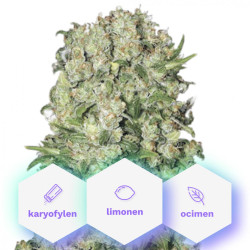
The scent of lavender has accompanied humanity for thousands of years. Ancient Romans added it to their baths (hence the Latin lavare -- to wash), medieval apothecaries used it against headaches and insomnia, and modern aromatherapy considers it one of the most effective natural anxiolytics. Behind this scent stands linalool -- a monoterpene alcohol that also ranks among the most interesting terpenes in cannabis. In the context of the entourage effect, it contributes to the calming and anticonvulsant properties of cannabis products in a way that deserves a closer look.
What is linalool and its chemical nature
Linalool (C10H18O) is an acyclic monoterpene alcohol -- unlike most cannabis terpenes, it contains a hydroxyl group (-OH), which gives it specific chemical properties and higher water solubility. It exists in two enantiomers:
- R-(-)-linalool (linalol): Predominates in lavender and cannabis. Floral, sweet, lavender aroma.
- S-(+)-linalool (coriandrol): Predominates in coriander and basil. Sweet-spicy, more citrusy aroma.
In cannabis, the R-form predominantly occurs, which is responsible for characteristic floral, lavender tones. The boiling point of linalool is approximately 198°C -- it is one of the most "resistant" terpenes during vaporization, as it is released only at higher temperatures, which is important when selecting the correct vaporizer setting.
The molecular weight of linalool is 154.25 g/mol. The presence of the hydroxyl group distinguishes it from purely hydrocarbonic terpenes such as myrcene or pinene and contributes to its higher biological activity and ability to interact with various receptor systems.
Aroma and flavor profile
Linalool has one of the most complex and pleasant aromatic profiles among terpenes:
- Floral dominance -- delicate, sweet lavender scent
- Sweet nuances -- honey, nectarine undertone
- Spicy accents -- subtle nutmeg and coriander tones
- Citrus finish -- light lemon sweetness in the aftertaste
- Woody undertone -- subtle, warm wood in the background
In the world of cannabis, linalool is responsible for "floral" and "lavender" aromatic notes that distinguish some strains from strictly earthy or citrusy profiles. Experienced users describe it as a terpene whose presence can be sensed even before the first draw.
Where linalool occurs in nature
Linalool is a remarkably widespread terpene -- it is found in more than 200 plant species:
| Plant | Linalool Content | Traditional Use |
|---|---|---|
| Lavender (Lavandula) | 25-45% essential oil | Aromatherapy, insomnia, anxiety |
| Coriander (Coriandrum sativum) | 60-70% essential oil of seeds | Culinary spice, digestion |
| Sweet basil (Ocimum basilicum) | 40-55% essential oil (some cultivars) | Culinary, traditional medicine |
| Birch leaf | 5-15% essential oil | Folk medicine |
| Nutmeg | 3-8% essential oil | Spice, sedatives |
| Rosemary | 1-5% essential oil | Culinary, aromatherapy |
| Citrus fruits | 1-5% floral essential oil | Perfumery |
Interesting fact: humans consume approximately 2 mg of linalool daily from common foods. This amount is classified by both FDA and EFSA as completely safe, which attests to its long history of safe use.
Effects and potential health benefits
Anxiolytic effects (anxiety reduction)
The anxiolytic effect of linalool is its best-documented property. A landmark study published in Frontiers in Behavioral Neuroscience (2018) showed that inhalation of linalool activates anxiolytic pathways in mice through the olfactory system -- not through direct absorption into the bloodstream. This has important practical consequences: simply smelling lavender can have a measurable anxiolytic effect without systemic absorption.
Mechanisms of linalool's anxiolytic action include:
- Modulation of the GABAergic system: Linalool enhances the effect of GABA (the main inhibitory neurotransmitter) on GABA-A receptors. This mechanism is fundamentally similar to the action of benzodiazepines (Valium, Xanax), but linalool acts with significantly lower intensity and without risk of dependence.
- Modulation of the glutamate system: Linalool inhibits glutamate release (the main excitatory neurotransmitter), thereby reducing neuronal excitability and contributing to nervous system calming.
- Serotonergic modulation: Linalool interacts with 5-HT receptors, which contributes to mood regulation and emotional stability.
Clinical studies in humans confirm these findings. A meta-analysis published in Phytomedicine (2019) including 17 clinical studies found that lavender aromatherapy significantly reduces anxiety in various populations -- including preoperative patients, chronic pain patients, and those with generalized anxiety disorder.
Sedative effects and sleep support
Linalool is among the main terpenes responsible for the sedative effects of certain cannabis strains. A study in the Journal of Agricultural and Food Chemistry (2009) showed that inhalation of linalool significantly prolonged sleep duration in mice and reduced their motor activity.
The sedative effect of linalool is potentiated in combination with myrcene -- both terpenes act on the GABAergic system from slightly different angles, which may explain the highly sedative profiles of indica-dominant strains rich in both terpenes. If you are looking for a strain specifically for nighttime use, it is precisely the combination of linalool and myrcene that is a signal to pay attention to.
Anticonvulsant effects
Linalool exhibits anticonvulsant (anti-seizure) properties, which are particularly relevant in the context of cannabis. A study in Epilepsy & Behavior (2010) showed that linalool reduces the frequency and severity of seizures in animal models of epilepsy through:
- Blocking glutamate NMDA receptors
- Enhancing GABAergic inhibition
- Modulating voltage-gated sodium channels
These mechanisms are complementary to the anticonvulsant action of CBD, suggesting that a terpene profile rich in linalool may increase the efficacy of CBD in epileptic conditions -- a practical example of the entourage effect in a clinical context.
Analgesic effects
Linalool exhibits its own pain-relieving effects through several mechanisms:
- Activation of opioid receptors (weak but measurable effect)
- Inhibition of cholinergic transmission at the neuromuscular junction level
- Reduction of the inflammatory component of pain
This combination of mechanisms makes linalool an interesting complement to anti-inflammatory terpenes such as beta-caryophyllene.
Neuroprotective potential
Recent research suggests neuroprotective properties of linalool. A study in Neuropharmacology (2016) showed that linalool reduces neuroinflammation and markers of Alzheimer's disease (beta-amyloid plaques) in transgenic mice. Notably, linalool restored cognitive and emotional deficits to levels comparable to control animals without disease -- a result that opens new questions about the potential of terpenes in neurodegenerative diseases.
Cannabis strains rich in linalool
Linalool is not as abundant in cannabis as myrcene or limonene, but some strains contain it in significant amounts:
| Strain | Type | Linalool Content | Characteristics |
|---|---|---|---|
| Amnesia Haze | Sativa-dominant | High | Citrus-floral aroma, creative |
| Lavender | Indica-dominant | Very high | Pronounced lavender aroma, relaxing |
| LA Confidential | Indica | High | Blueberry-floral tones, strong sedation |
| Zkittlez | Indica-dominant | Moderately high | Sweet, fruity-floral aroma |
| Do-Si-Dos | Indica-dominant | Moderate | Sweet, floral with depth |
| Kosher Kush | Indica | Moderate | Earthy-floral nuances |
In general, strains rich in linalool have a reputation for deeper relaxation, better sleep, and stronger anxiolytic effects. When selecting a strain or product, we recommend verifying the laboratory analysis of the terpene profile -- declared aroma is not always a guarantee of actual linalool content.
Entourage effect -- synergy of linalool with cannabinoids
Linalool plays a specific and valuable role in the entourage effect:
- Linalool + CBD: Both exhibit anxiolytic and anticonvulsant properties, but work through different mechanisms. CBD via 5-HT1A, TRPV1, and allosteric modulation of GABA-A; linalool directly enhances GABAergic inhibition and blocks glutamate NMDA receptors. This complementarity may lead to more effective overall action at lower doses of both substances.
- Linalool + THC: Linalool may mitigate the anxiogenic effects of higher THC doses through its anxiolytic action while deepening the relaxing and sedative components.
- Linalool + myrcene: "Sedative duo" -- both act on the GABA system and together are responsible for the strongest relaxing profiles of indica strains.
- Linalool + limonene: An interesting balanced combination -- linalool calms, limonene lifts mood. The result is a state of relaxation without pronounced drowsiness, suitable for daytime use.
- Linalool + beta-caryophyllene: Anti-inflammatory and analgesic synergy from different mechanisms, potentially interesting for users seeking pain relief.
Learn more about interactions between terpenes and cannabinoids in our article on cannabinoids and the entourage effect.
How to use terpene products with linalool
- Aromatherapy: The best-studied way to use linalool is through inhalation. Lavender essential oil in a diffuser can demonstrably reduce anxiety and improve sleep quality -- 30-60 minutes before bedtime in a closed room is sufficient.
- Vaporization: Linalool has a higher boiling point (198°C) than most cannabis terpenes. To achieve its full release, set your vaporizer to 190-210°C. At lower temperatures, pinene, limonene, and BCP are released preferentially.
- E-liquids: E-liquids with terpenes with floral or relaxing profiles typically contain linalool as one of the key components.
- Before bedtime: A combination of cannabis terpenes rich in linalool with CBD can support natural sleep without morning "cloudiness."
- Bath: Lavender oil in a bath is a traditional and scientifically supported way to utilize linalool's relaxing effects -- absorption through the skin during bathing is measurable and occurs more efficiently at water temperatures around 37-38°C.
Comparison of linalool with other major cannabis terpenes
| Property | Linalool | Myrcene | Limonene | BCP | Pinene | Humulene |
|---|---|---|---|---|---|---|
| Aroma | Lavender | Earthy, mango | Citrusy | Pepper | Pine | Hops, wood |
| Main effect | Anxiolytic | Sedative | Uplifting | Anti-inflammatory | Bronchodilator | Appetite suppressant |
| GABA modulation | Strong | Moderate | Weak | None | Weak | Weak |
| Boiling point | 198°C | 167°C | 176°C | 130°C | 155°C | 106°C |
| Type | Monoterp. alcohol | Monoterpene | Monoterpene | Sesquiterpene | Monoterpene | Sesquiterpene |
FAQ -- Frequently Asked Questions
Is linalool the same as lavender oil?
Not entirely. Lavender essential oil is a complex mixture of dozens of compounds, of which linalool typically comprises 25-45%. Other significant components are linalyl acetate, lavandulol, camphor, and 1,8-cineol. Pure linalool is an isolated single-component substance. Some studies suggest that the entire lavender oil may be more effective than linalool alone due to the synergy of all present components -- a principle analogous to the entourage effect in cannabis.
Can linalool replace anxiety medications?
Linalool exhibits demonstrable anxiolytic effects, but their intensity is orders of magnitude lower than pharmaceutical anxiolytics (benzodiazepines, SSRIs). It may be useful as a supplement for mild situational anxiety, but should never replace prescribed treatment without consulting a doctor. If you suffer from clinical anxiety disorder, consult a specialist.
Why is linalool less common in cannabis than myrcene?
Linalool biosynthesis in cannabis requires a specific enzyme (linalool synthase), which is not equally active in all strains. Selection of strains focused on high THC or CBD content in recent decades has negatively affected terpene diversity, including linalool content. However, strains deliberately bred for aromatic profile -- such as Lavender -- can contain linalool in significantly higher amounts.
Is linalool safe for long-term use?
Linalool is classified by the FDA as GRAS (generally recognized as safe) and has a long history of safe use in food and cosmetics. In some cases, oxidized linalool (after prolonged air exposure) may cause contact dermatitis in sensitive individuals -- we therefore recommend storing products with terpenes in closed containers away from direct light. With normal use of cannabis products or aromatherapy, linalool is considered safe.
How does linalool affect sleep?
Linalool promotes sleep by enhancing GABAergic inhibition, reducing neurological excitability, and alleviating anxiety that disrupts sleep. Studies show that inhalation of linalool prolongs sleep duration and improves its quality. Combined with myrcene and CBD, it may provide comprehensive support for the natural sleep cycle without the risk of dependence associated with classic pharmacological hypnotics.
This article is for informational and educational purposes only. It does not constitute medical advice or encourage the use of any substances. Before using any cannabis products, consult your doctor.
Sources
- Russo, E.B. (2011). Taming THC: potential cannabis synergy and phytocannabinoid-terpenoid entourage effects. British Journal of Pharmacology, 163(7), 1344-1364. pmc.ncbi.nlm.nih.gov/articles/PMC3165946
- Harada, H. et al. (2018). Linalool Odor-Induced Anxiolytic Effects in Mice. Frontiers in Behavioral Neuroscience, 12, 241. pmc.ncbi.nlm.nih.gov/articles/PMC6206409
- Koulivand, P.H. et al. (2013). Lavender and the Nervous System. Evidence-Based Complementary and Alternative Medicine. pmc.ncbi.nlm.nih.gov/articles/PMC3612440
- Elisabetsky, E. et al. (1999). Effects of Linalool on Glutamatergic System in the Rat Cerebral Cortex. Neurochemical Research, 24(9), 1191-1196.
- Sabogal-Guaqueta, A.M. et al. (2016). Linalool reverses neuropathological and behavioral impairments in old triple transgenic Alzheimer's mice. Neuropharmacology, 102, 111-120. pubmed.ncbi.nlm.nih.gov/26549854
- Leafly Terpene Guide: Linalool. leafly.com/news/cannabis-101/linalool-terpene
- Cannabis sativa terpenes are cannabimimetic and selectively enhance cannabinoid activity. Scientific Reports, 2021. nature.com/articles/s41598-021-87740-8
- Malcolm, B.J. & Tallian, K. (2017). Essential oil of lavender in anxiety disorders: Ready for prime time? Mental Health Clinician, 7(4), 147-155. pmc.ncbi.nlm.nih.gov/articles/PMC6007527