


 English (English)
 Deutsch (German)
 Čeština (Czech)
 Italiano (Italian)
 Hrvatski (Croatian)
 Română (Romanian)
 български език (Bulgarian)
 Magyar (Hungarian)
 Español (Spanish)
 Français (French)
 Nederlands (Dutch)
 Polski (Polish)
 Slovenčina (Slovak)
Quality grinder is among the most important, yet frequently underestimated accessories. Evenly ground material burns more consistently, vaporizes more efficiently, and the resulting experience is noticeably more enjoyable. The difference between a cheap plastic model and a precision metal grinder becomes apparent upon first use – in grinding consistency, the amount of kief retained, and the overall durability of the tool.



This guide will walk you through everything essential – from simple two-piece grinders to four-piece models with kief catchers – so you can choose exactly what suits your needs.
Grinder Anatomy – How Many Pieces Do You Need
2-Piece Grinder
The most basic design: a lid with teeth and a bottom chamber with teeth. Ground herb remains in the same chamber where grinding takes place.
Advantages: Simple construction, low price, compact size, easy maintenance.
Disadvantages: No sieve or kief collector, ground material is harder to pour out of the chamber.
Suitable for: Occasional users, light travel, complete beginners.
3-Piece Grinder
Compared to a two-piece, a middle chamber with holes is added – ground material falls through and separates from the teeth, making it easier to handle.
Advantages: Cleaner separation of herb from the grinding chamber, more convenient material dispensing.
Disadvantages: Kief sieve is still missing, price is slightly higher than two-piece models.
Suitable for: Regular users who don't need kief collection.
4-Piece Grinder (Recommended)
The gold standard for anyone who uses a grinder regularly. Contains a lid with teeth, a grinding chamber with holes, a collection chamber with a mesh bottom, and a bottom chamber for kief – fine trichome dust with high concentrations of active compounds.
| Part | Function |
|---|---|
| 1. Lid | Upper set of teeth, magnet for secure holding |
| 2. Grinding chamber | Lower set of teeth, holes for material to fall through |
| 3. Collection chamber | Ground herb accumulates on the mesh |
| 4. Kief catcher | Fine trichomes fall through the mesh and settle here |
Advantages: Complete solution in one tool, regular kief collection, clean and evenly ground material.
Disadvantages: Higher purchase price, more parts to clean, slightly larger dimensions than simpler variants.
Suitable for: All regular users. If you're buying one grinder to keep in stock, go for a four-piece – the investment pays for itself quickly.
5-Piece Grinder
A variant with two sieves of different fineness allows you to sort kief by trichome size and separate less pure fraction from the highest quality one.
Suitable for: Experienced users and enthusiasts who want maximum control over kief quality and purity.
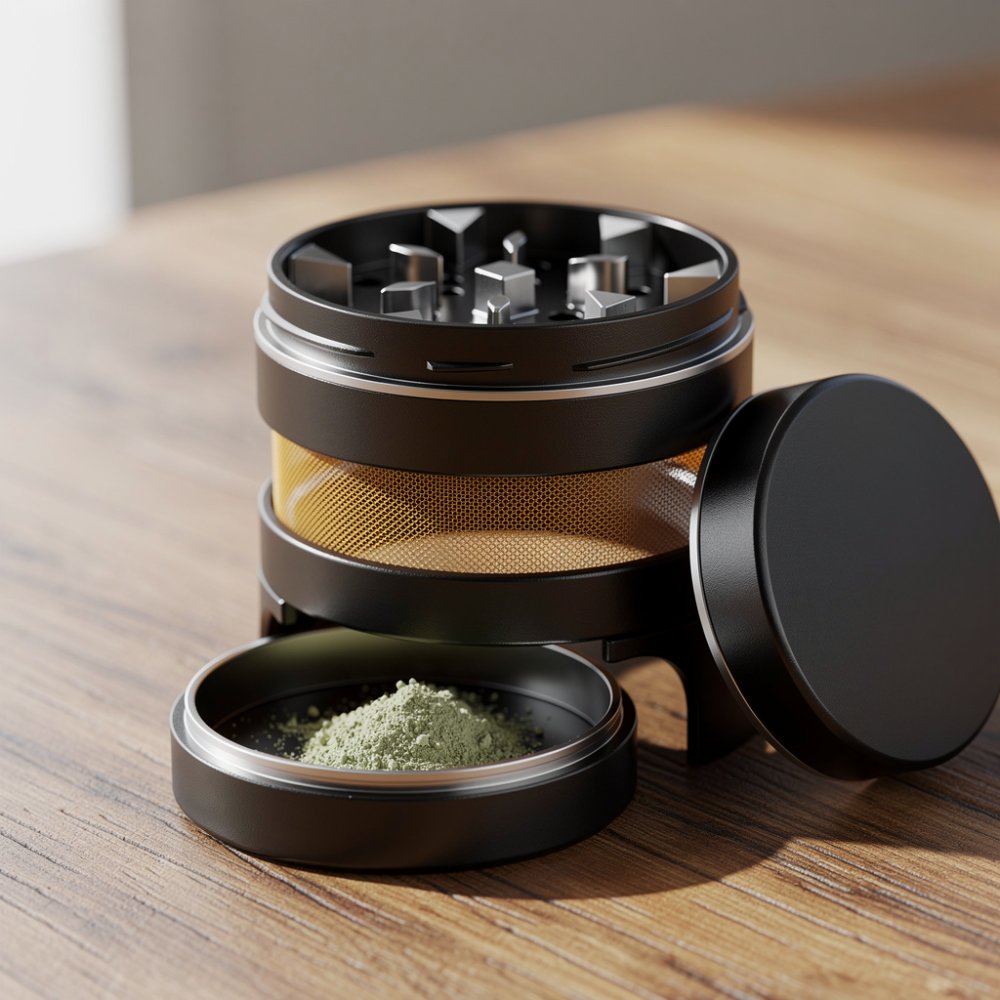
Materials – What Should a Grinder Be Made Of
| Material | Durability | Flavor Neutrality | Price | Lifespan |
|---|---|---|---|---|
| Aluminum (anodized) | High | Excellent | Medium | 5–10+ years |
| Zinc (alloy) | Medium | Good | Lower | 3–5 years |
| Titanium | Very high | Excellent | High | 10+ years |
| Stainless steel | High | Excellent | Medium–high | 10+ years |
| Wood | Low | Poor (absorbs resin) | Medium | 1–3 years |
| Plastic/acrylic | Low | Poor | Lowest | Months |
Aluminum – Best Price-to-Performance Ratio
Anodized aircraft-grade aluminum – typically alloys 6061-T6 or 7075 – is the first choice material for most quality grinders. The anodizing process creates a hard oxide layer on the surface that prevents metal particles from being released into the material, resists corrosion, and facilitates cleaning.
Watch out for: Cheap grinders from unknown manufacturers are often insufficiently anodized or not anodized at all – fine metal particles can then be released into the herb during grinding. Always choose verified manufacturers with transparently listed material specifications.
Titanium – Premium Choice for the Demanding
Titanium is lighter than steel, harder than aluminum, and biologically completely inert. Titanium teeth won't dull even after years of intensive daily use and don't affect the material in any way. Premium titanium model prices start at approximately 1,500–2,000 CZK.
Wood and Plastic – Why to Avoid Them
Wooden grinders have undeniable aesthetic value, but their porous surface gradually absorbs resin, is difficult to clean, and under certain conditions can be a breeding ground for mold. Plastic models dull quickly, their teeth break material unevenly, and there's a risk of microplastic release – especially with cheaper acrylic.
Teeth – Design That Makes a Difference
The shape and arrangement of teeth affects the resulting grind quality more than any other design element.
Tooth Shapes
- Diamond (rhombus) – the most efficient variant, cuts from both sides, minimizes jamming of sticky material
- Sharp pointed – suitable for fresh, moist herb with higher resin content
- Straight angular – rather grinds than cuts, results tend to be less uniform
- Slanted or spiral – naturally guide material toward holes, rotation is smoother
Number of Teeth
A higher number of teeth doesn't automatically guarantee better results. What matters is their arrangement – teeth should mesh with each other without dead spots, but also leave enough space for smooth material movement.
Optimal guideline: 20–30 teeth for a 50 mm diameter grinder. With larger diameters, the number increases proportionally.
Size – What Diameter to Choose
| Diameter | Typical Portion | Suitability |
|---|---|---|
| 40 mm | 0.2–0.5 g | Travel, maximum discretion |
| 50 mm | 0.5–1.0 g | Most versatile size for daily use |
| 63 mm | 1.0–2.0 g | Home use, group sessions |
| 75 mm+ | 2.0+ g | Large quantities, collector pieces |
Recommendation: For most users, a 50–63 mm diameter works best. Smaller grinders are more portable, but processing larger amounts of herb in them tends to be tedious and laborious.
Kief – The Hidden Bonus of a 4-Piece Grinder
Kief (also "keef" or "trichome dust") is a fine golden substance composed mainly of trichomes – glands on the surface of cannabis flowers that contain the highest concentration of cannabinoids and terpenes. You collect it automatically with every grind without having to do anything extra.
How to collect kief effectively:
- Keep the mesh clean – clogged holes will stop trichomes from falling into the bottom chamber
- Put your grinder in the freezer for 15 minutes before grinding – trichomes will harden and separate from the material more easily
- Add a clean coin to the collection chamber – its movement when rotating mechanically releases trichomes through the mesh
- Be patient – filling a kief catcher typically takes weeks to months
What to do with kief:
- Sprinkle it on a joint or filled vaporizer chamber to boost effects
- Add to cannabis butter when cooking
- Press into homemade hash using parchment paper and gentle heat
- Vaporize pure kief – effects are noticeably stronger than regular herb, start cautiously
Cleaning Your Grinder – Step by Step
Regular maintenance ensures smooth rotation, sharp teeth, and a clear mesh. Neglected cleaning directly impacts grinding quality and the amount of kief collected.
Quick Clean (After Every 5th–10th Use)
- Disassemble grinder into all parts
- Use a soft brush – for example a toothbrush or flat painting brush – to remove material residue from the teeth and chambers
- Poke clogged holes in the grinding chamber with a toothpick or pin
- Clean the mesh with a brush from both sides – always move from center to edge to avoid deforming the mesh
Deep Clean (Approximately Once a Month)
- Place the entire grinder in the freezer for 30 minutes – resin will harden and separate from the surface much more easily
- Tap each part against a hard surface over clean paper – collect loose debris and kief without losing them
- Soak metal parts in isopropyl alcohol (minimum 90%) for 20–30 minutes
- Clean with a brush, pay extra attention to the mesh and threads
- Rinse thoroughly with warm water
- Let all parts air dry completely before reassembling
Warning: Don't soak wooden and plastic grinders in alcohol – this will damage the surface and cause harmful substances to be released from plastics.
Frequently Asked Questions (FAQ)
How finely should I grind herb for a vaporizer?
For vaporizers, medium consistency is ideal – neither too fine (clogs the chamber and blocks air flow) nor too coarse (vaporization is then uneven and less efficient). For conventional methods like joints or pipes, slightly finer grinding is preferred.
Can I use a kitchen herb grinder?
Technically it's possible, but not recommended. Kitchen grinders process material too finely and unevenly, lack a kief catcher, and cleaning resin from them is usually very difficult.
How do I know if a grinder is quality?
Reliable indicators are: smooth rotation without grinding or play, strong magnet holding the lid, sharp teeth with no visible burrs or jagged edges, evenly drilled holes in the grinding chamber, quality anodizing that doesn't peel even with scratching, and a precise thread that fits well.
How much does a good grinder cost?
A solid aluminum 4-piece grinder from a verified manufacturer can be found from approximately 400 CZK. Premium models range from 800–2,000 CZK, titanium and designer pieces can exceed 3,000 CZK. Investing in a quality grinder pays off – with proper maintenance, it lasts years of daily use without problems.
Browse our selection of grinders and choose the perfect one.
Sources
- Leafly (2025). The Complete Guide to Cannabis Grinders.
- Vaporpedia – Grinder Materials and Safety FAQ.