


 English (English)
 Deutsch (German)
 Čeština (Czech)
 Hrvatski (Croatian)
 Română (Romanian)
 български език (Bulgarian)
 Magyar (Hungarian)
 Español (Spanish)
 Français (French)
 Italiano (Italian)
 Nederlands (Dutch)
 Polski (Polish)
 Slovenčina (Slovak)
Bongs and Water Pipes – Selection Guide
Bong belongs among the oldest methods of consuming herbs – a fundamentally simple water filtration system that cools and partially purifies smoke before it reaches the lungs. However, modern glass models with multi-level percolators are as far removed from a bamboo tube with water as a smartphone is from a telegraph. Today's bongs represent a combination of functional engineering and glassmaking art.
Whether you're looking for your first bong or considering an upgrade to a more sophisticated model, this guide will walk you through everything essential – from filtration physics through materials and shapes to percolator selection and proper care.
How a Bong Works – Principles of Filtration and Cooling
Basic Principle
Every bong consists of several key components:
- Bowl – where ground herb is placed
- Chillum/downstem – a tube leading from the bowl into the water
- Water chamber (base) – a water-filled reservoir where filtration occurs
- Tube – the vertical part where smoke accumulates
- Mouthpiece – the upper opening for inhalation
- Kickhole/carburetor – a hole for regulating draw (not on all models)
When you inhale, negative pressure pulls smoke from the bowl through the chillum into the water. The smoke disperses into bubbles that bubble through the water surface – during this process it cools significantly and some water-soluble impurities are captured.
What Filtration Actually Removes
| Component | Filtered by Water? | Note |
|---|---|---|
| Solid particles (ash, tar) | Partially | Larger particles are captured |
| Water-soluble toxins | Yes | Acrolein, formaldehyde (partially) |
| Smoke temperature | Yes | Significant cooling |
| THC/CBD | Minimally | Cannabinoids are hydrophobic |
| Terpenes | Minimally | Most passes through |
A study by Gieringer et al. (2004) found that water filtration reduces the ratio of tar to cannabinoids – so the relative effectiveness of active substance intake improves, even though filtration doesn't remove all harmful combustion products. For the purest form of inhalation, consider vaporizers, where combustion doesn't occur at all.
Materials – Glass, Acrylic, Silicone and More
Glass Bongs
Borosilicate glass – the same material as Pyrex laboratory glass – is the gold standard in the bong category. It's heat-resistant, chemically inert, and unlike plastics, it doesn't affect flavor even with long-term use.
Advantages:
- Cleanest flavor – glass doesn't absorb odors or resin
- Transparency – you immediately see water level, smoke density, and contamination degree
- Enormous variety of shapes, sizes, and percolators
- Easy to clean (isopropyl alcohol and coarse salt)
Disadvantages:
- Fragility – a single drop on a hard floor usually means the end
- Higher purchase price compared to acrylic or silicone
- Thick-walled models can be heavier
Recommendation: Invest in borosilicate glass with a thickness of at least 3.5 mm, ideally 5–7 mm. Cheap thin glass costing a few hundred won't survive even the first careless move off a shelf.
Acrylic Bongs
Acrylic (plexiglass) is the cheapest and mechanically very durable alternative.
Advantages: Practically unbreakable, lightweight, affordable price.
Disadvantages: Gradually absorbs odors and resin, affects flavor, difficult to clean thoroughly, practically no percolator options.
Suitable for: Festivals, travel, absolute beginners who want to try the principle without a major investment.
Silicone Bongs
Food-grade silicone combines mechanical durability with acceptable inhalation quality. Compared to acrylic, it's a noticeable step forward.
Advantages: Unbreakable, foldable (ideal for a backpack), dishwasher safe, affordable price.
Disadvantages: Slight flavor impact, limited percolator options. The bowl should always be glass or metal – a silicone bowl in direct contact with flame is not suitable.
Suitable for: Travel, outdoor activities, users with extensive experience breaking glass.
Ceramic Bongs
Ceramics offer the greatest aesthetic variety – from traditional Oriental shapes to striking artistic pieces.
Advantages: Distinctive design, neutral flavor impact, natural thermal insulation.
Disadvantages: Fragility (although somewhat lower than glass), opacity (you can't see water or smoke), cleaning can be more difficult for shapewise complex pieces.
Metal Bongs
Most commonly made from anodized aluminum or stainless steel.
Advantages: Practically indestructible, compact and portable.
Disadvantages: Metallic flavor develops over time, the material heats up, opaque, hygienic maintenance is more demanding.
Types of Bongs – Shapes and Their Effect on Experience
Beaker
The classic shape with a wide conical base that resembles a laboratory beaker. The most stable geometry thanks to a low center of gravity and large base – much more resistant to accidental tipping over than a straight tube. Large water volume ensures more pronounced filtration and cooling.
Ideal for: Beginners, daily home use, users preferring a stable and reliable base.
Straight Tube
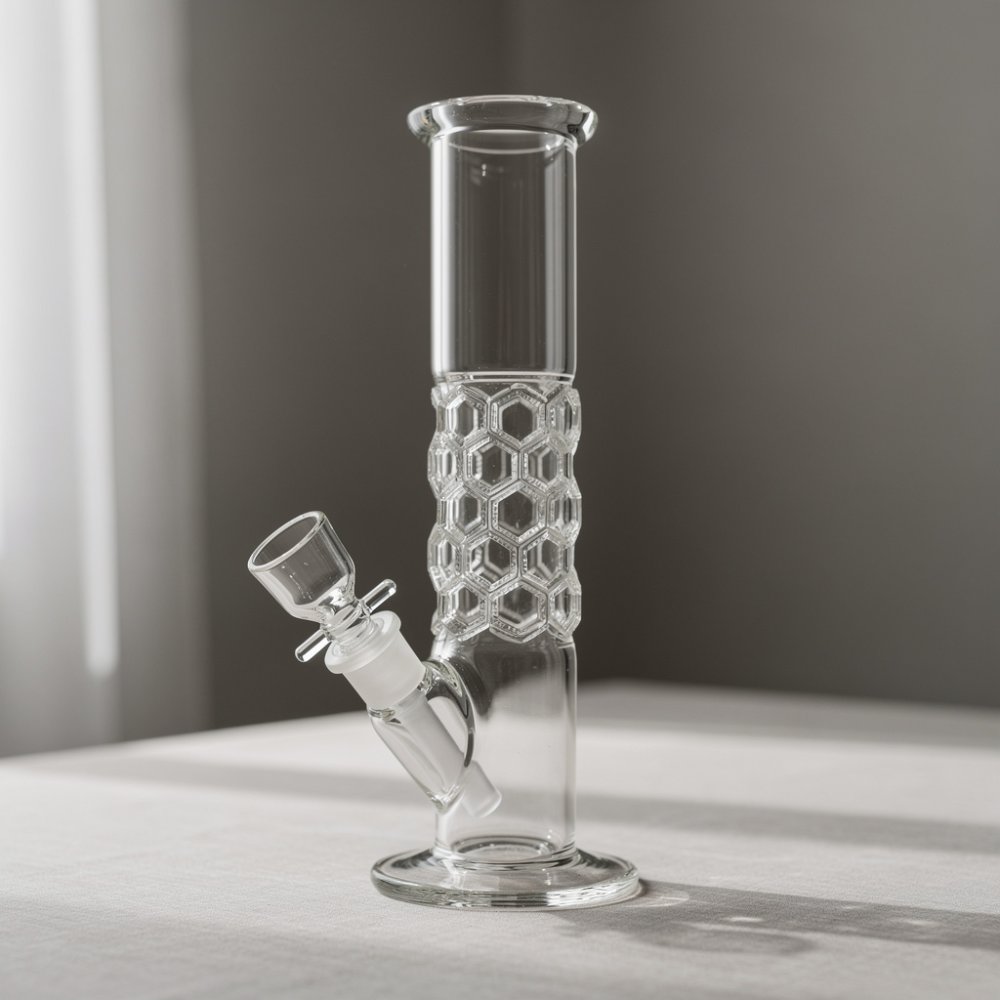
A simple cylindrical shape with a smaller water volume. The draw is more direct and faster, the bong is easier to clean due to internal space accessibility. Less stable than a beaker.
Ideal for: Users preferring a more aggressive and direct draw.
Recycler
A sophisticated two-chamber design connected by a tube system where smoke and water circulate in a closed loop. Water continuously "recycles" through both chambers, allowing this type to achieve exceptionally smooth and cold filtration. Visually, recyclers are among the most attractive bongs on the market.
Ideal for: Advanced users, concentrate consumers, those who prioritize maximally smooth smoke.
Bubbler
A compact hybrid between a traditional pipe and a bong – in size comparable to a large pipe, but contains a water chamber for filtration. Portable and discreet, yet offers significantly smoother smoke than a dry pipe.
Ideal for: Portable use with the advantage of water filtration.
Gravity Bong
Uses gravity and water pressure to fill the chamber with very dense smoke. A small amount of herb produces a strong, compact draw – effects arrive quickly and distinctly.
Ideal for: Experienced users, social gatherings, users seeking maximum material efficiency.
Percolators – Filtration at the Next Level
A percolator is an additional filtering element inside the bong whose purpose is to break smoke into the smallest possible bubbles. A greater number of smaller bubbles means a larger contact surface with water, and thus better filtration and cooling. This is one of the most important parameters when choosing a glass bong.
Types of Percolators
| Type | Description | Filtration | Draw |
|---|---|---|---|
| Diffused downstem | Holes at the end of the chillum | Basic | Light |
| Tree perc | Little branches with holes | Good | Medium |
| Honeycomb | Flat disk with dozens of holes | Excellent | Light |
| Showerhead | Sprinkler with holes around the perimeter | Very good | Medium |
| Turbine | Angled cuts in the disk create a vortex | Good + visual effect | Medium |
| Matrix | Cylinder with holes on sides and bottom | Excellent | Light |
| Inline | Horizontal tube with holes | Good | Direct |
| Swiss perc | Disk with holes reminiscent of cheese | Very good | Light |
| Faberge egg | Egg-shaped with dense holes | Excellent | Very light |
Multiple percolators in one bong mean smoother smoke, but come with trade-offs:
- Higher resistance requires stronger draw to push smoke through
- Cleaning is significantly more demanding
- Resin accumulates in more places
- Some terpenes and cannabinoids are lost in water contact
For most users, a bong with one quality percolator is optimal. Two or more percolators will be appreciated mainly by those who prefer absolutely smooth and cool smoke and don't mind spending more time on cleaning.
Size Guide
| Height | Water Volume | Characteristic | Suitability |
|---|---|---|---|
| 15–20 cm | Small | Compact, quick draw, easily portable | Travel, shorter sessions |
| 25–35 cm | Medium | Versatile, good filtration, stable | Daily home use |
| 35–45 cm | Large | Excellent filtration, smooth and cool smoke | Home sessions, groups |
| 45+ cm | Very large | Maximum cooling and filtration | Collector pieces, parties |
Practical tip: A larger bong doesn't automatically guarantee a better experience. A well-made medium-sized bong (25–35 cm) with a honeycomb percolator will outperform a giant model without a percolator in both flavor and smoke purity.
Dab Rigs – Specialized Vessels for Concentrates
A dab rig is a type of bong designed exclusively for vaporizing concentrates – waxes, shatter, rosin, or live resin. It differs from a classic bong in several key parameters:
- Smaller volume – concentrates are aromatically pronounced and don't require extensive filtration; a smaller chamber preserves the terpene profile
- Nail/banger instead of bowl – a quartz banger is now the standard due to thermal stability and neutral flavor impact; titanium and ceramic nails are alternatives
- Recycling design – very common in dab rigs, minimizes loss of active substances
- Lower water temperature – some users use ice-cold water or ice directly for maximum vapor cooling
Dabbing temperatures and their effect on experience:
- Low temp (315–400 °C) – maximum flavor and terpene profile preservation, less vapor volume
- Medium temp (400–500 °C) – balanced flavor and volume ratio
- High temp (500–600 °C) – dense vapor with pronounced effect, some flavor is lost
For beginners in dabbing, electronic nails (e-nails) with precise digital temperature control are ideal. No need for a torch and no uncertainty about the correct temperature of a heated banger.
Cleaning Your Bong – Why and How
A dirty bong is not only a source of unpleasant flavor but also a potential health hazard. Stagnant water with resin creates ideal conditions for bacterial and mold growth.
Routine Maintenance (After Each Use)
- Change the water immediately – never leave stagnant water overnight
- Quick rinse with warm water extends intervals between deep cleaning
Deep Cleaning (Weekly with Regular Use)
- Empty water and rinse with warm water
- Pour in a mixture of isopropyl alcohol (91% and higher) and coarse non-iodized salt
- Cover all openings – with fingers, silicone plugs, or plastic wrap with a rubber band
- Shake thoroughly for 2–3 minutes; salt acts as a mechanical abrasive and together with alcohol breaks down resin
- For heavy contamination, let the solution sit for 15–30 minutes
- Rinse thoroughly with warm water, at least three times in succession
- Allow to dry completely in the air
For complex percolators: Pour in the cleaning solution and let sit for 1–2 hours. Gently shake and repeat if necessary. Bamboo or silicone bottle brushes help with more accessible chambers.
Alternative approaches: Specialized commercial cleaning solutions (Formula 420, Randy's Black Label) or a citric acid solution in hot water are gentler on delicate glass constructions and less irritating to work with.
How to Choose – Quick Guide
| Your Situation | Recommendation |
|---|---|
| Complete beginner | Beaker bong, borosilicate glass 5 mm, 25–30 cm, diffused downstem |
| Regular home user | Beaker or straight tube, honeycomb perc, 30–40 cm |
| Traveler | Silicone bong or glass bubbler |
| Flavor and terpene lover | Small recycler with glass percolator |
| Concentrate dabbing | Dab rig 20–25 cm with quartz banger |
| Gift | See our gift packages for cannabis enthusiasts guide |
Browse our selection of bongs and pipes and choose a model that suits your habits and preferences.
Frequently Asked Questions (FAQ)
Is a bong healthier than a joint?
Water filtration removes some harmful substances and significantly cools the smoke, thereby reducing irritation to the respiratory tract. However, it's not a safe alternative – combustion still occurs with the production of harmful pyrolytic compounds. For the healthiest inhalation method, consider a vaporizer, where burning doesn't occur at all.
What water should I use?
Cold tap water or filtered water. Some users add ice cubes to an ice catcher (if the bong has this feature) for more pronounced cooling. Avoid hot water – it reduces filtration efficiency. Sparkling water, juices, or other liquids are not suitable.
How often should I change the water?
Ideally after each session. If you use the bong daily, change the water at least once a day. Stagnant water enriched with resin is a breeding ground for bacteria and unpleasantly affects flavor.
Can I use a bong for CBD flowers?
Yes, a bong works exactly the same for CBD flowers as for any other herbal material. Water filtration cools the smoke and makes inhalation more pleasant. Keep in mind that some cannabinoids and terpenes will always be captured in the water – especially with CBD flowers with a delicate aromatic profile, this can be noticeable.
Sources
- Gieringer, D. et al. (2004). Cannabis Vaporizer Combines Efficient Delivery of THC with Effective Suppression of Pyrolytic Compounds. Journal of Cannabis Therapeutics, 4(1), 7–27.
- Bloor, R.N. et al. (2008). Can cannabis smoking equipment contribute to an understanding of waterpipe use? Ethnicity & Health, 13(1), 1–16.