


 English (English)
 Deutsch (German)
 Čeština (Czech)
 Italiano (Italian)
 Hrvatski (Croatian)
 Română (Romanian)
 български език (Bulgarian)
 Magyar (Hungarian)
 Español (Spanish)
 Français (French)
 Nederlands (Dutch)
 Polski (Polish)
 Slovenčina (Slovak)
In short: A filter tip keeps the joint in shape, stops the filling from getting into your mouth and lets you smoke it right to the end. Paper tips are the cheapest, glass and metal tips cool the smoke and are reusable, acrylic tips are light and drop-resistant. The most common diameter is 6–8 mm; you roll a paper filter from a strip 5–7 mm wide and 3–4 cm long.



| Most common tip diameter | 6–8 mm |
|---|---|
| Strip for a paper filter | width 5–7 mm, length 3–4 cm |
| Accordion folds | 2–3 folds in a “W” or “M” shape |
| Cleaning glass and metal | isopropyl alcohol min. 70 %, 15–30 minutes |
| Cleaning acrylic | warm water with washing-up liquid, no strong solvents |
| Cleaning frequency | with daily use at least 1× a week |
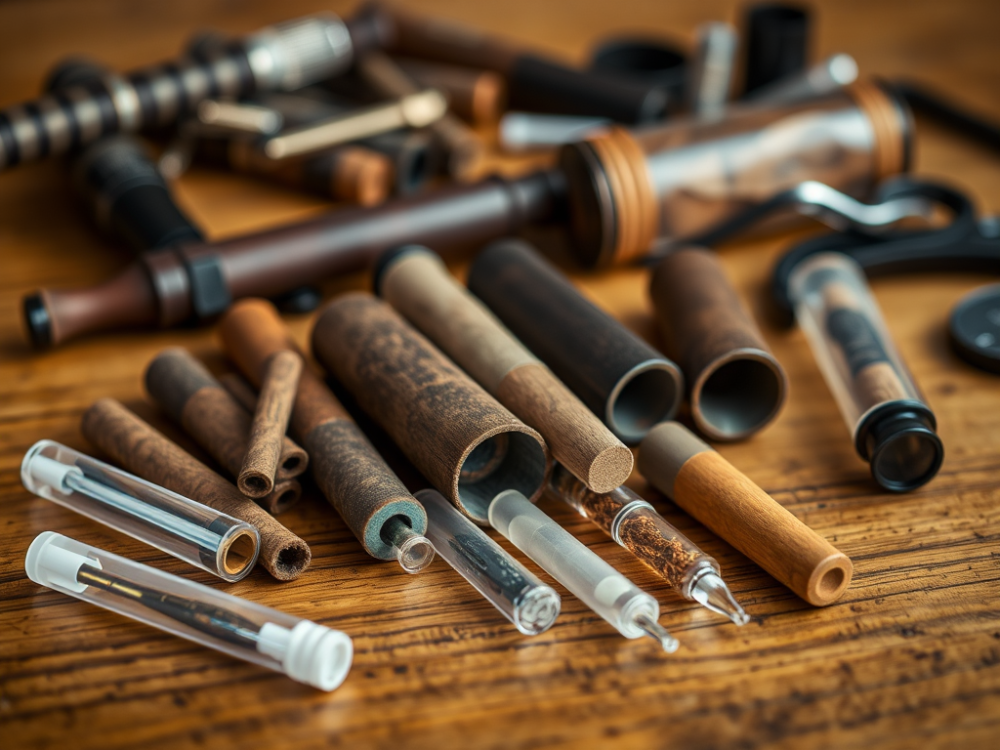
Filter tips – a small, inconspicuous component without which it is hard to roll a quality joint. Yet many smokers don't pay them enough attention and settle for whatever comes to hand first. In fact, choosing the right filter or tip can make a big difference to how pleasant (and safe) the whole experience is. In this guide we look at the different types of tips, explain their pros and cons and show you how to use them properly.
What are filter tips and why use them?
Before we get to the specific types, let's clarify the basics. Filter tips (also called crutches, roaches or filters) are small inserts placed at the end of a joint – the end you put to your mouth. Their main job is to create a firm, stable end that doesn't get squashed, doesn't clog and doesn't stick to your lips.
Why should you use them at all? There are several reasons:
- Firmness and shape – the joint keeps its round cross-section and is comfortable to hold.
- Hygiene – saliva doesn't soak into the filling and, conversely, the filling doesn't end up in your mouth.
- Cooler smoke – glass and metal tips in particular cool the smoke a little before you inhale.
- Less waste – with a filter you can smoke the joint much further down without burning your fingers.
- Looks – it simply looks better and more professional.
If you'd like to know how a joint, a spliff and a blunt actually differ, we recommend reading our article Blunt, joint and spliff: what are the differences? – it explains the basic terms clearly.
Paper tips – a classic that never goes out of style
Paper tips are by far the most widespread type of filter. They come either as pre-perforated, pre-folded cards (so-called tips) or as loose strips of thicker paper from which you roll the filter yourself.
Advantages of paper tips
- Availability – you can buy them in practically any newsagent or tobacco shop.
- Low price – a pack of dozens of tips costs pennies.
- Natural material – they don't affect taste or aroma.
- Easy to handle – even a complete beginner can manage them.
Disadvantages of paper tips
- They don't cool the smoke much.
- They get soggy from saliva and can lose their shape.
- If rolled incorrectly, they can clog.
How to roll a paper tip properly
- Take a strip of paper (approx. 5–7 mm wide, 3–4 cm long).
- At one end, make 2–3 small accordion folds in a "W" or "M" shape.
- Wrap the rest of the strip around the folds to form a cylinder.
- Insert it into the end of the rolling paper just before you close the joint.
- Make sure the filter is neither too loose nor too tight – the smoke should pass through freely.
Paper tips are a great choice for everyday use, especially if you value simplicity and easy preparation.
Glass tips – a premium experience for the discerning
Glass tips have become increasingly popular in recent years, and for good reason. They are small tubes made of borosilicate glass (the same material as laboratory glassware or Pyrex) that go into the end of the joint instead of a paper filter.
Advantages of glass tips
- Cooler smoke – glass draws away heat, so the smoke feels noticeably smoother when you inhale.
- Clean taste – glass is completely chemically inert and has no effect on the aroma or flavour profile.
- Reusable – just clean it with alcohol and the filter is as good as new.
- Elegant look – glass tips come in a variety of designs, colours and patterns.
- Hygiene – glass doesn't soak up anything and doesn't absorb saliva or odours.
Disadvantages of glass tips
- Higher purchase price compared with paper tips.
- Fragility – they can crack if dropped on a hard floor.
- They need regular cleaning.
Glass tips are the ideal choice if you care about quality and don't want to compromise. They are especially popular with those who experiment with premium strains and want to enjoy their full terpene profile to the last.
Metal tips – durability comes first
Metal tips, most often made of stainless steel or aluminium, are synonymous with durability. You won't find them in every shop, but if you're looking for a filter that will last for years, they're worth a look.
Advantages of metal tips
- Practically indestructible – they don't break and don't deform.
- Reusable – just like glass tips, they are easy to clean.
- Compact – they fit into any wallet or case.
- They heat up quickly and distribute heat evenly.
Disadvantages of metal tips
- Metal can get very hot with prolonged use – be careful not to burn your lips.
- Cheaper aluminium versions can affect the taste at high temperatures.
- They are not suitable for people who are sensitive to a metallic aftertaste.
If you travel, go to festivals or simply need a filter that will survive a fall onto concrete, a metal tip is the right choice. For everyday use at home, however, glass or paper alternatives are more comfortable.
Acrylic tips – a colourful, lightweight alternative
Acrylic tips are a kind of compromise between glass and metal. They are made from clear or coloured plastic (acrylic) and offer good value for money.
Advantages of acrylic tips
- Drop-resistant – unlike glass, they don't break.
- Lightweight – they weigh next to nothing.
- Available in various colours and sizes.
- Affordable.
Disadvantages of acrylic tips
- Plastic can slightly affect the taste at higher temperatures.
- They are not as easy to recycle as glass or metal.
- Over time they can become discoloured or scratched.
Tip: If you opt for an acrylic filter, choose products from trusted brands – cheap plastic tips from unknown sources may be made of materials that are not intended for contact with heat.
How to choose the right tip
The choice of filter depends mainly on your priorities and how you enjoy your joint. Here is a quick overview to help you decide:
- Beginners and occasional smokers – paper tips are the simplest choice. They're cheap, easy to get and you'll be able to use them right away.
- Lovers of taste and aroma – glass tips don't affect the flavour and cool the smoke slightly at the same time. Ideal for premium strains.
- Active lifestyle and travel – metal tips can take anything. Throw them in your pocket and you don't have to worry about a thing.
- Looking for a colourful design at a reasonable price? – acrylic tips offer good looks without a big investment.
The size of the tip matters too. The most common diameter is 6–8 mm, which matches the standard width of a joint. There are also wider versions for those who prefer a larger cross-section and an easier draw.
If you'd like to know how to get the most out of every joint without unnecessary waste, take a look at our article 5 tricks to save money on "marijuana" – several of its tips relate directly to proper rolling and using a filter.
Caring for reusable tips
Glass, metal and acrylic tips are an investment that pays off – but only if you look after them properly. A dirty filter restricts the draw, spoils the taste and is simply unhygienic.
How to clean glass and metal tips
- Soak the tip in isopropyl alcohol (at least 70%) for 15–30 minutes.
- Use a small brush or cotton bud to remove deposits from the inside.
- Rinse thoroughly with warm water.
- Let it dry completely before using it again – leftover moisture can affect the draw.
How to clean acrylic tips
- Acrylic is sensitive to strong solvents – instead of isopropyl alcohol, use warm water with a little washing-up liquid.
- Gently scrub with a brush.
- Rinse and leave to dry.
How often to clean depends on how intensively you use it – with regular daily use, we recommend cleaning the tip at least once a week.
Tips and joint rolling – a few final pointers
Even the best filter won't help if the joint itself isn't rolled well. Here are the most common mistakes people make:
- Joint packed too tightly – a poor draw makes smoking difficult. The filling should be evenly distributed and only lightly compressed.
- Filter inserted too loosely – it slips inside and ruins the shape. Always roll the paper firmly around the tip.
- Wrong filter length – a filter that is too short doesn't give enough support, while one that is too long takes up an unnecessarily large part of the paper.
- Uneven sealing – make sure the gummed edge of the paper is stuck down well along its entire length.
And if you're interested in smoking from a slightly different angle – for example, how different consumption methods compare – check out our article Dabbing: what is it and how is it made?, where we look at one of the alternative methods.
Summary: which type of tip is right for you?
Let's sum everything up. Each type of tip has its place and its audience:
- Paper tips – the simplest and most accessible, ideal for beginners and everyday use.
- Glass tips – the premium choice for flavour lovers, reusable and elegant.
- Metal tips – maximum durability, great for travelling, last for years.
- Acrylic tips – light, colourful, drop-resistant and affordable.
At Cannapio.cz you'll find a wide range of filter tips and all the accessories you need for rolling – whether you're after classic paper tips in a bulk pack or a premium glass tip to go with your favourite CBD flowers. Remember: the right filter is a small detail, but it takes the whole experience up a level.
If you're interested in more tips from the world of cannabis, read our popular article Chronic as well – it tells you about one of the most popular and best-known strains in the world.
You might also be interested in: How to roll the perfect joint – a step-by-step guide