


 English (English)
 Deutsch (German)
 Čeština (Czech)
 Italiano (Italian)
 Hrvatski (Croatian)
 Română (Romanian)
 български език (Bulgarian)
 Magyar (Hungarian)
 Español (Spanish)
 Français (French)
 Nederlands (Dutch)
 Polski (Polish)
 Slovenčina (Slovak)
Why Plant Protection is Critical for Every Grower
Whether you're growing indoors under artificial lighting or outdoors in your garden, pests and fungi are a reality you won't avoid. The question isn't if you'll encounter them, but when – and how well you'll be prepared. Experienced growers know that the best battle against pests is one that never happens. Prevention is always cheaper, less stressful, and more effective than dealing with a full-blown infestation.

This article serves as your comprehensive guide to plant protection. We'll cover the fundamentals, specific threats, preventive measures, and intervention methods when problems arise. We'll focus especially on plant and environmentally-friendly approaches – biological control, neem oil, and integrated pest management (IPM).
Most Common Pests and How to Identify Them
The first step in effective protection is knowing what to look for. Different pests attack plants in different ways and require different approaches. Here are the most common ones growers encounter:
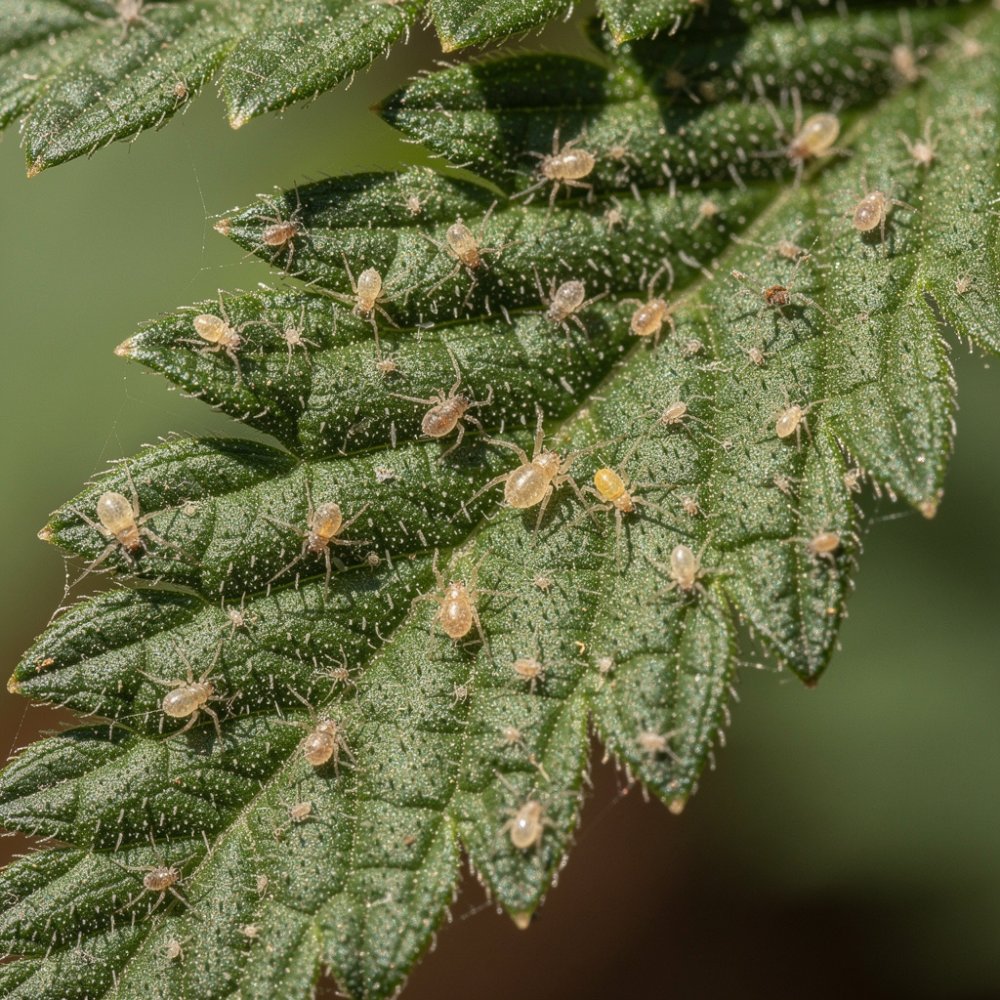
Spider Mites (Tetranychus urticae)
Spider mites are tiny arachnids that suck sap from leaves. Typical symptoms include fine stippling on leaves, gradual yellowing, and visible webbing on the underside of leaves in advanced stages. They love dry, warm environments – making them especially problematic in indoor grows with low humidity. Their populations can double in just three to four days, so quick action is crucial.
Aphids
Aphids are small, soft-bodied insects that cluster on young shoots and leaf undersides. They feed on sap, excrete honeydew (a sticky substance where black mold grows), and transmit viral diseases. They reproduce asexually and extremely rapidly. An aphid colony can completely deform young shoots within a week.
Thrips
Thrips are tiny insects whose larvae and adults cause characteristic silvery or bronze spotting on leaves. They're particularly sneaky because they spread easily on clothing and tools, and can survive in soil as pupae. They also transmit dangerous viruses like TSWV (tomato spotted wilt virus).
Sciaridae – Fungus Gnats
Fungus gnats are small flies whose larvae live in soil, feeding on organic matter and plant roots. The adults themselves cause minimal damage, but their presence signals overwatered soil, and larvae can severely damage the root system of young seedlings.
Mealybugs
Mealybugs are covered in white waxy coating that resembles cotton tufts. They hide in leaf axils and on stems. They're resistant to many sprays precisely because of this protective wax layer, and their colonies spread slowly but persistently.
Fungi: The Silent Threat in Every Grow
Fungi are equally serious threats as animal pests, and in many ways even more treacherous – they spread through the air and can ruin an entire crop within days.
Botrytis (Gray Mold)
Botrytis cinerea is probably the most feared fungal disease among growers. It attacks dense, humid parts of plants – flowers, stems, leaves. It appears as gray-brown spots that spread quickly, covering affected areas in gray mold. Once developed, the infection spreads via airborne spores and can destroy an entire crop bed within 48 hours.
Powdery Mildew
Powdery mildew shows as a characteristic white, flour-like coating on leaves. Unlike botrytis, it thrives in lower humidity and temperature fluctuations. Infected leaves gradually yellow and die. While powdery mildew doesn't directly kill plants, it significantly reduces their vigor and yields.
Fusarium and Pythium – Root Rots
These fungal pathogens attack the root system, causing seedling damping-off or wilting in mature plants. Fusarium spreads through soil and is very resistant – its spores survive in substrate for years. Pythium is an oomycete (water mold) that thrives in waterlogged, poorly aerated soil.
Prevention: The Foundation of Successful Growing
Prevention in plant protection isn't a one-time action but a system of daily habits and proper growing environment setup. An experienced grower knows that a healthy, strong plant is naturally more resistant to infestation – and that proper conditions are the first line of defense.
Growing Space Hygiene
Cleanliness is fundamental. Regularly remove dead leaves and plant material – they're ideal breeding grounds for fungi and pests. Disinfect tools before each use, especially when transplanting or pruning. Always quarantine new plants for at least one to two weeks before moving them in with others.
Proper Environmental Conditions
Many pest and fungal problems stem from poor growing conditions. Key parameters to monitor:
- Humidity: Too high humidity (above 70%) promotes botrytis and powdery mildew. Too low (below 40%) creates ideal conditions for spider mites. The optimal range is 50-65% depending on growth stage.
- Temperature: Maintain stable temperatures without major fluctuations. Sudden changes weaken plants and condense moisture on leaves, promoting fungal growth.
- Air circulation: Good air movement mechanically hinders spore and pest settlement, strengthens stems, and reduces surface leaf moisture. A fan is absolutely essential in indoor grows.
- Watering: Overwatered soil is a breeding ground for fungus gnats and root rots. Allow substrate to partially dry between waterings.
Choosing Resistant Varieties and Healthy Seeds
Start right – from the beginning. Select varieties with natural disease resistance and buy seeds and seedlings only from trusted sources. A healthy start significantly reduces the risk of problems throughout the entire growing cycle.
Neem Oil: The Grower's Natural Weapon
Neem oil is an extract from the seeds of the Azadirachta indica tree and is among the most universal and popular natural pesticides. It contains azadirachtin, an active compound that disrupts the insect's hormonal system – preventing molting, reproduction, and feeding. Neem oil is effective against a wide range of pests including spider mites, aphids, thrips, and mealybugs, while also providing preventive action against some fungal diseases.
How to use neem oil correctly:
- Prepare an emulsion by mixing neem oil with warm water and a few drops of neutral soap as an emulsifier (approximately 5 ml oil per liter of water).
- Apply thoroughly to the entire plant surface, especially undersides of leaves where pests typically hide.
- Spray in the evening or under reduced light intensity – neem oil can cause leaf burn under strong direct light.
- Repeat application every 5-7 days for 2-3 weeks to interrupt the pest lifecycle.
- Neem oil can be used preventively – regular sprays at 2-week intervals significantly reduce infestation risk.
Important note: Don't use neem oil in late flowering stages, as it may affect taste and aroma of the harvest. Always test on a small plant section before full application.
Biological Control: Nature as Your Ally
Biological control uses living organisms – predators, parasitoids, or microorganisms – to suppress pest populations. It's an approach that works with natural processes rather than against them, and is completely safe for plants, growers, and the environment.
Predators and Parasitoids
For every major pest, there are one or more natural enemies that can be intentionally introduced into your growing space:
- Phytoseiulus persimilis – predatory mite, specialized spider mite predator. Extremely effective at temperatures 20-28°C and humidity above 60%.
- Amblyseius cucumeris – predatory mite effective against thrips and spider mites. Tolerates a wider range of conditions than Phytoseiulus.
- Aphidius colemani – parasitic wasp that lays eggs in aphids. Larvae develop inside the aphid and kill it.
- Steinernema feltiae – entomopathogenic nematode effective against fungus gnat larvae in soil. Applied through irrigation.
- Beauveria bassiana – entomopathogenic fungus that attacks and kills a wide spectrum of insect pests. Available as a spray.
Biological control requires patience and proper timing – predators should be introduced early, ideally preventively or at the first signs of infestation, not after a full-blown problem develops. Learn more about comparing biological and chemical control in the article Biological Control vs Chemical: What Works Better Indoors.
IPM: Integrated Pest Management as a System
IPM (Integrated Pest Management) isn't a specific method but a philosophy and decision-making system. It combines all available tools – prevention, monitoring, biological control, physical methods, and targeted chemical interventions – to achieve effective protection with minimal impact on plant health, grower safety, and the environment.
The Four Pillars of IPM
- Prevention and monitoring: Regular plant inspections, environmental monitoring, hygienic measures. The goal is to catch problems in their infancy, before they escalate.
- Threshold of economic injury: IPM doesn't aim for zero pest presence but an acceptable level. A small aphid population causing no visible damage may not warrant intervention.
- Selection of intervention method: When intervention is necessary, proceed from least invasive methods (mechanical removal, biological control, neem oil) to more intensive ones. Chemical pesticides are a last resort, not the first choice.
- Evaluation of results: Monitor effectiveness after each intervention and adapt your strategy. IPM is an iterative process – you learn from each season.
Practical IPM Implementation in Indoor Growing
In a closed growing environment, you have a major advantage – you can control and regulate the environment much more precisely than outdoors. The foundation of IPM indoors is:
- Regular visual monitoring – inspect plants at least twice weekly from all angles, including leaf undersides.
- Use yellow or blue sticky traps as monitoring tools – they catch flying insects and give you an early warning signal.
- Keep records of pest occurrence, applied measures, and results. Over time, you'll gain valuable information specific to your growing conditions.
- Plan preventive applications of biological control or neem oil as part of your standard growing protocol, not as a crisis response.
When to Turn to Chemical Protection
Chemical pesticides have a place in plant protection – but only as a last resort when other methods fail or for acute, severe infestations. If you decide on chemical intervention, always follow these principles:
- Use only products registered for your crop and pest.
- Strictly follow recommended dosages – higher doses don't mean better results, but higher risk of plant damage and pest resistance.
- Rotate active ingredients to prevent resistant pest populations.
- Observe pre-harvest safety intervals.
- Always use protective equipment – gloves, respirator, safety glasses.
Summary: Key Principles of Plant Protection
Plant protection from pests and fungi is a complex discipline, but its fundamental principles are surprisingly simple. If you take away only three things from this article, let them be these:
- Prevention is always more effective than treatment. Investment in proper environment, hygiene, and regular monitoring pays for itself many times over through healthy plants and good yields.
- Natural methods – neem oil and biological control – are entirely sufficient for most situations and are gentler on plants, growers, and the environment than chemical pesticides.
- IPM is a system, not a product. A combination of preventive measures, regular monitoring, and targeted intervention when the damage threshold is exceeded is the most effective approach available to you.
Whether you're a beginner setting up your first grow room or an experienced grower looking to optimize your system – the principles outlined in this article will help you keep plants healthy, strong, and productive throughout the season.