


 English (English)
 Deutsch (German)
 Čeština (Czech)
 Italiano (Italian)
 Hrvatski (Croatian)
 Română (Romanian)
 български език (Bulgarian)
 Magyar (Hungarian)
 Español (Spanish)
 Français (French)
 Nederlands (Dutch)
 Polski (Polish)
 Slovenčina (Slovak)
Why Your Choice of Protection Method Matters
Every grower eventually encounters unwelcome guests – whether it's pests like spider mites, aphids, or thrips, or fungi like gray mold (Botrytis) and powdery mildew. In an indoor environment, the situation is unique: a closed ecosystem without natural predators, combined with high humidity and heat, creates ideal conditions for rapid pest proliferation.
The question isn't just how to act, but rather with what. Biological protection and chemical protection are two different approaches with distinct logic, different risks, and varying results. This article will help you understand the differences and choose the right strategy for your grow.
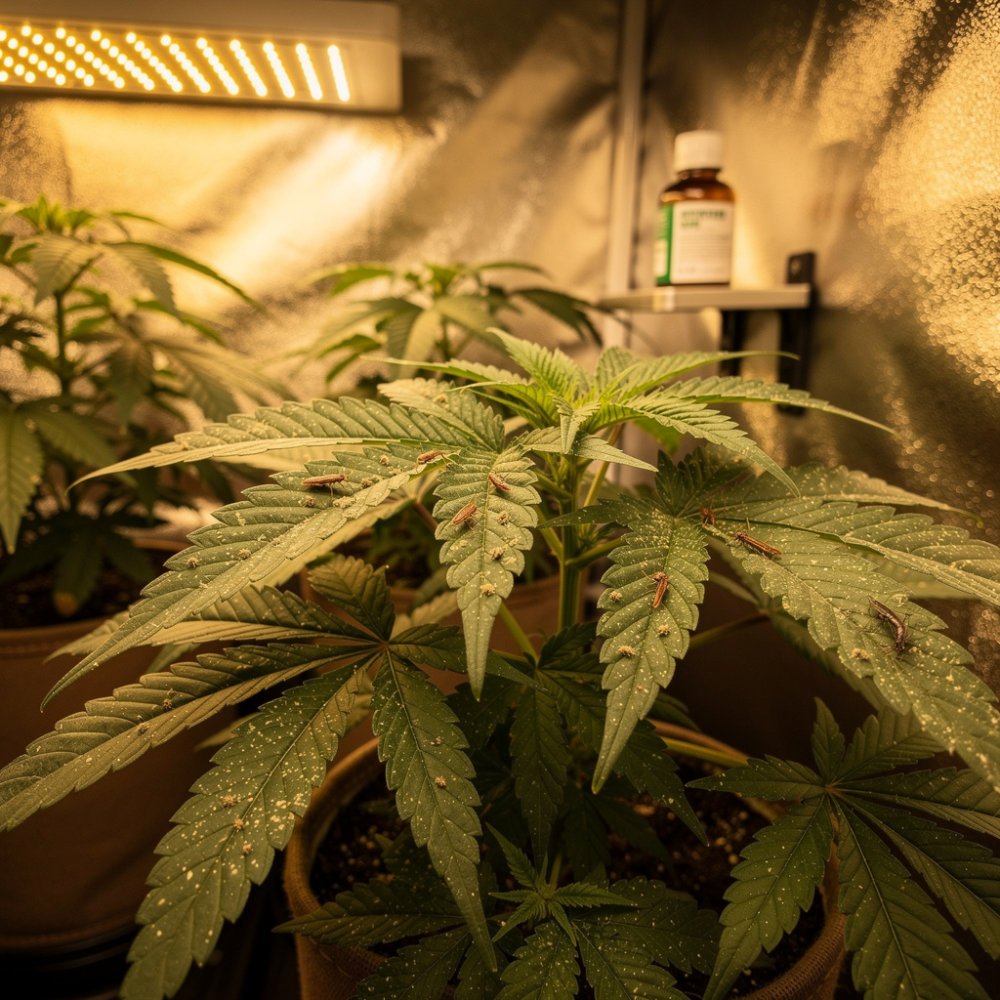
Biological Plant Protection – What It Actually Is
Biological protection leverages nature's own mechanisms: living organisms, microorganisms, or naturally derived substances to control pests and diseases. This includes predatory insects, beneficial fungi, bacteria, and plant extracts like neem oil.
Most Common Biological Methods in Indoor Growing
- Predatory mite Phytoseiulus persimilis – specializes exclusively in spider mites and is highly effective in warm, humid environments
- Amblyseius cucumeris – predator of thrips and mites, suitable even as preventive deployment
- Steinernema feltiae – nematodes against fungus gnat larvae in the substrate
- Bacillus thuringiensis (Bt) – bacteria effective against caterpillars and larvae
- Trichoderma – beneficial fungus protecting the root zone from pathogens
- Neem oil – natural extract from the neem tree, acting as both a repellent and contact insecticide with broad-spectrum activity
Advantages of Biological Protection
- Safe for the grower and the environment
- Does not create pest resistance (unlike chemicals)
- Predators reproduce naturally in the grow and work continuously
- Suitable even in late vegetation and early flowering stages
- Can be combined with other biological methods as part of an IPM system
Disadvantages of Biological Protection
- Slower onset of effect – won't solve problems overnight
- Requires proper conditions (temperature, humidity) for predator survival
- May be insufficient as the sole measure against heavy infestations
- Living organisms have limited shelf life and specific storage requirements
- Requires greater grower knowledge and experience
Chemical Plant Protection – When and Why Growers Choose It
Chemical protection includes synthetic pesticides, fungicides, and insecticides. In indoor growing, it's still commonly used, especially when biological methods prove insufficient or when infestation is already severe.
Advantages of Chemical Protection
- Fast and visible results – pests die within 24–72 hours
- Availability and relative ease of application
- Effectiveness even against heavy infestations
- Lower environmental demands for effectiveness
Disadvantages of Chemical Protection
- Resistance development – repeated use of the same product leads to pest resistance. This is one of the biggest problems with chemical approaches
- Toxicity for the grower – many products require protective equipment and good ventilation
- Negative impact on beneficial organisms in the substrate
- Chemical residues – use becomes problematic especially in late vegetation and flowering
- Environmental burden from waste disposal
- Cannot be combined with biological predators (chemicals kill them)
IPM – Integrated Pest Management as a Third Path
IPM (Integrated Pest Management) is neither purely biological nor purely chemical. It's a system that combines prevention, monitoring, and targeted interventions with an emphasis on minimizing chemical use.
In practice, this means: first, create conditions unfavorable to pests and fungi (proper temperature, humidity, air circulation). Monitor your plants regularly. Preventively deploy biological products. Only when the situation escalates should you consider chemicals – but always with purpose, at the right growth stage, and respecting safety intervals.
Core Pillars of IPM in Indoor Growing
- Prevention – quarantine new plants, maintain hygiene in the grow room, monitor incoming air, use quality substrate free from pest eggs
- Monitoring – use sticky traps (yellow and blue), conduct regular visual inspections of leaf undersides
- Biological interventions – preventively deploy predators or microorganisms before problems appear
- Chemical interventions as last resort – choose products with the shortest residual period and rotate active ingredients
IPM is the approach used by professional growers worldwide. It's not complicated, but it requires systematicity and discipline. For more specific preventive measures, see the article Plant Protection Against Pests: Prevention and Solutions.
Neem Oil – A Bridge Between Biology and Chemistry
Neem oil deserves special mention because many growers underestimate it. It's an extract from the fruits of the Indian neem tree (Azadirachta indica), containing the active ingredient azadirachtin.
Neem oil acts as:
- Repellent – pests avoid it
- Insecticide – damages the nervous system of insects on direct contact
- Ovicide – destroys eggs and larvae
- Fungicide – effective against powdery mildew and other surface fungi
A major advantage is that neem oil is naturally derived, breaks down quickly in the environment, and leaves no permanent residues. When applied correctly (spray the entire plant, ideally in the evening), it functions as both a preventive and curative agent. It's unsuitable in late flowering due to its characteristic odor.
Practical Comparison: When to Choose What
Choose Biological Protection If:
- You're in early vegetation or just beginning prevention
- You maintain stable grow room conditions (temperature 68–82°F / 20–28°C, humidity 50–70%)
- You want a long-term solution without chemicals
- You grow organically and care about product purity
- Pests are present in low numbers or you're deploying predators preventively
Consider Chemical Protection If:
- Infestation is severe and spreading rapidly
- Biological methods haven't worked within 1–2 weeks
- You're in the vegetative phase with sufficient time before harvest
- You need quick results and don't have time to wait for biological effects
Always Combine with Prevention:
- Keep your grow room clean – disinfection between cycles is essential
- Quarantine new plants or cuttings before introducing them to your grow
- Use sticky traps as an early warning system
- Regularly check leaf undersides – that's where pests start
Common Mistakes Growers Make with Plant Protection
Regardless of the method chosen, beginners and experienced growers alike repeatedly make these mistakes:
- Waiting too long to act – the first spider mites or aphids are always just the tip of the iceberg. The sooner you intervene, the better
- Using the same product repeatedly – whether chemical or biological, rotate active ingredients and mechanisms of action
- Ignoring the substrate – many pests (fungus gnats, mites) live in the soil. Treat the root zone too
- Deploying predators in a chemically treated grow – predators won't survive in an environment recently treated with insecticides
- Applying products in bright light or high temperatures – causes leaf burn and reduces effectiveness
Conclusion: There Is No One Universal Solution
Biological protection and chemical protection aren't competitors – they're tools for different situations. An experienced grower knows that the best strategy combines prevention, monitoring, and targeted interventions – the IPM approach.
If you're starting out, invest in prevention and learn to work with biological methods. Neem oil, predatory mites, and Trichoderma will save you a lot of stress. Keep chemicals as a backup for crisis situations – but always with purpose, at the right growth stage, and respecting safety intervals.
A healthy grow begins with a clean environment, regular monitoring, and understanding what your plants need. Pests and fungi are part of growing – but they don't have to be its end.