


 English (English)
 Deutsch (German)
 Čeština (Czech)
 Italiano (Italian)
 Hrvatski (Croatian)
 Română (Romanian)
 български език (Bulgarian)
 Magyar (Hungarian)
 Español (Spanish)
 Français (French)
 Nederlands (Dutch)
 Polski (Polish)
 Slovenčina (Slovak)
In short: Ganja comes from Sanskrit, where the word gañjā referred to cannabis and its resinous flowers – the word is at least 3000 years old. It reached Jamaica in the 19th century with Indian workers. Its worldwide spread was then secured by the Rastafari movement of the 1930s and by reggae music.

| Origin of the word | Sanskrit, the term gañjā (गञ्जा) for cannabis and its flowers |
|---|---|
| Age of the term | at least 3000 years |
| Journey to the Caribbean | 19th century, with Indian workers on the plantations of Jamaica, Trinidad and Guyana |
| Origin of Rastafari | Jamaica, 1930s |
| The song Legalize It (Peter Tosh) | 1976 |
| Slang terms for cannabis in English | over 1 200 |
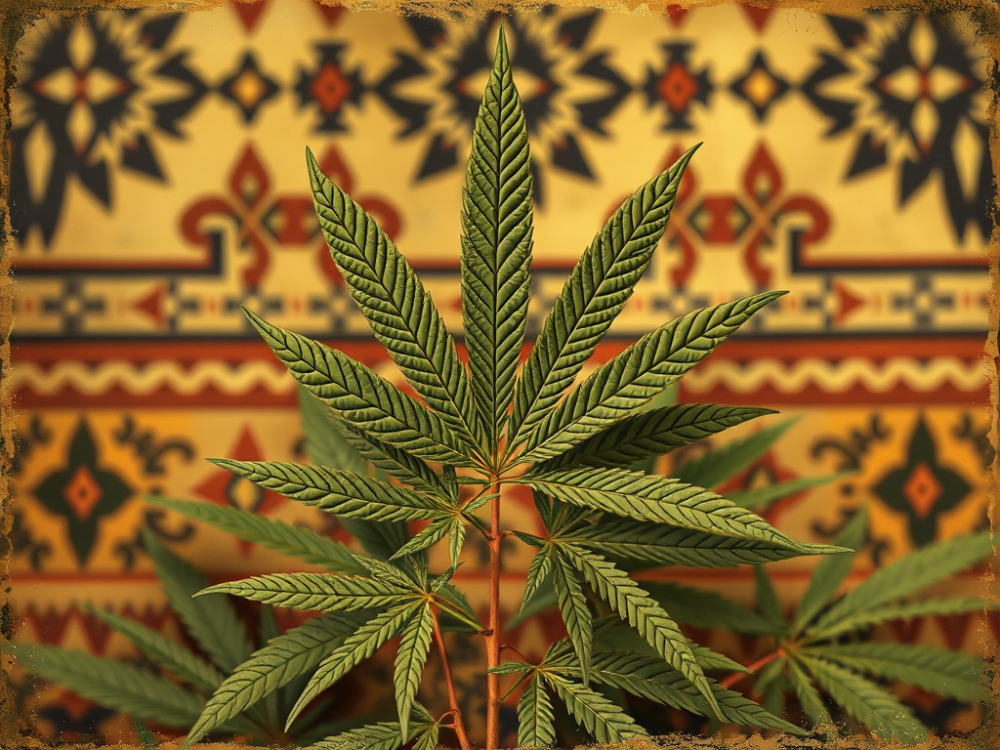
Ganja – one of the best-known slang words for cannabis in the world. Yet few people realise how deep the roots of this word go, or how it travelled across centuries and continents before settling firmly into music culture, slang and the everyday speech of millions of people. Let's take a look together at a story that begins in ancient India and is still going on today.
Sanskrit origins: where does the word ganja come from?
The history of the word ganja begins at least three thousand years ago – and probably even earlier. The word comes from Sanskrit, one of the oldest recorded languages in the world, where the term gañjā (गञ्जा) referred directly to the cannabis plant, or more precisely to its resinous flowers.
In the Hindu tradition, cannabis was associated with the god Shiva for centuries. According to some sacred texts, cannabis was one of the five sacred plants, and smoking or consuming it represented a ritual path to spiritual focus and meditation. Shiva's devotees, the so-called sadhus, consumed a mixture called bhang – a drink made from cannabis leaves and flowers – as part of a religious practice that survives in certain regions of India to this day.
The journey from India to the world
From the Indian subcontinent, both the word and the plant itself spread along trade and migration routes. Cannabis reached the Caribbean and South America together with Indian workers who, after the abolition of slavery in the 19th century, were brought by British colonial administrators to the plantations of Jamaica, Trinidad and Guyana. They brought with them not only seeds but also the name – ganja.
It was Jamaica that became the key link in the next chapter of the word's story. Local labourers adopted it as their own, placed it in a new cultural context and paved the way for its worldwide spread.
Rastafari: the spiritual dimension of the word ganja
Without the Rastafari movement, the word ganja would probably never have achieved such global fame. Rastafari emerged in Jamaica in the 1930s as a spiritual, cultural and political movement founded on African identity, resistance to colonial oppression and a deep spirituality derived from biblical texts.
In Rastafarian theology, ganja – also known as herb, kaya or wisdom weed – plays a truly exceptional role. It is not seen as a recreational drug but as a sacramental herb that opens the mind, deepens prayer and connects the believer with Jah (the Rastafarian name for God). Ritual smoking during so-called groundation sessions (shared meditations and discussions) is regarded as a path to inner knowledge and collective wisdom.
Biblical justification
To defend the sacramental use of ganja, Rastafarians quote a number of passages from the Bible, for example:
- Genesis 1:29 – "I have given you every herb bearing seed…"
- Psalm 104:14 – "He causeth the grass to grow for the cattle, and herb for the service of man…"
- Revelation 22:2 – "The leaves of the tree were for the healing of the nations."
Whatever your view of these interpretations, it is undeniable that the Rastafarian approach to cannabis is deeply considered, theologically grounded and completely different from the superficial use with which cannabis is often associated in public debate.
Bob Marley and reggae: ganja conquers the world
If Rastafari gave the word ganja its spiritual foundation, reggae – and Bob Marley in particular – gave it wings. From the 1960s and 70s onwards, the music of Jamaican artists carried the word ganja to literally every corner of the planet.
Bob Marley, Peter Tosh, Burning Spear, Bunny Wailer – these artists sang about ganja not only as a herb but as a symbol of freedom, resistance and spiritual awakening. Peter Tosh's song Legalize It from 1976 became one of the most influential anti-prohibition songs in the history of popular music. Reggae festivals all over the world, from London and Amsterdam to Prague, spread not only the rhythm but also the vocabulary.
Ganja in other music genres
The influence of reggae spilled over into other genres. Hip-hop, dancehall, ska, dub – all of these styles adopted not only rhythmic inspiration but also the lexicon associated with cannabis. The word ganja thus gradually found its way into the lyrics of artists who have nothing to do with Rastafari but use it as part of everyday slang.
You can read more about how various slang terms for cannabis resonate across cultures in our article on the term Chronic – another legendary slang word, this time from the world of American hip-hop culture.
Ganja across cultures and languages
One of the fascinating features of the word ganja is its surprising linguistic resilience. Unlike many slang expressions that die out with the generation that coined them, ganja survives and adapts. Today you will find it in dozens of languages, always with a slightly different connotation:
- English – ganja is a widely understood term for marijuana, most often with a Rastafarian undertone.
- Russian and Slavic languages – ganza or ganja occurs in certain layers of slang as a direct borrowing.
- Spanish (Caribbean region) – ganja is common especially in areas with Jamaican-Caribbean cultural ties.
- Hindi/Urdu – the word has returned to its roots and works in modern colloquial speech as a natural part of the vocabulary.
- Czech – it is used mainly in subcultural circles, in a musical context and in online communities devoted to cannabis.
How many words for cannabis are there?
Cannabis is probably the plant with the largest number of slang names in the world. Linguists and ethnobotanists have counted over 1 200 of them in English alone. Ganja, however, is one of those that have retained a clear cultural and historical commentary – it is not just a substitute word, it carries a story.
If you are interested in the terminology of this world, also read our article Blunt, joint and spliff: what are the differences?, where we similarly break down other terms from cannabis culture.
Ganja in a modern context: from subculture to mainstream
The last twenty years have brought dramatic changes in how society views cannabis – and therefore the word ganja too. Legalisation in US states, decriminalisation in dozens of countries, the boom in CBD products and growing scientific interest in the plant's therapeutic potential are gradually moving cannabis out of the dark corners of subculture onto pharmacy shelves, into the media and into public debate.
Meanwhile, the word ganja is undergoing an interesting transformation. On the one hand, it remains a firm part of the cannabis subculture and the reggae community. On the other, more and more people use it lightly, without any ideological charge – simply as a synonym for cannabis with a certain amount of cultural charm.
Ganja and the younger generation
Surveys and data show that young people's attitudes towards cannabis are changing significantly in the Czech Republic and across Europe. You can read more about how young Czechs perceive cannabis and what the current statistics are in the article 4:20 – Young Czechs and cannabis in numbers.
Generation Z and millennials approach cannabis without the stigma carried by the previous generation. The word ganja sounds natural to them, with no need for whispering or code words. At the same time, they are much better informed – they are interested in specific strains, cannabinoid content, the difference between CBD and THC and methods of consumption.
CBD and the blurring line
With the arrival of CBD products, the line between "ganja" and legal cannabis is becoming less sharp for many people. Products made from industrial hemp – oils, teas, cosmetics, food supplements – are legally available and their popularity is skyrocketing. The word ganja itself remains primarily linked to THC cannabis, but cannabis culture as a whole is making significant inroads into the mainstream thanks in part to the CBD wave.
Ganja, the law and public discourse
Despite cultural acceptance in many circles, cannabis remains subject to legal regulation in the Czech Republic and in most of the world. It is important to distinguish between the cultural and historical interpretation of the term ganja – which is the purpose of this article – and the current legal reality.
In the Czech Republic, possession of a small amount of cannabis for personal use (up to 10 grams) has been decriminalised since 2010, and in 2024 the legislation was relaxed further. Growing for personal use is tolerated under certain conditions. Nevertheless, the sale and distribution of THC cannabis remains illegal.
By contrast, cannabis with a low THC content (below 1 % in the Czech Republic) and products made from it are completely legal – and it is precisely in this area that Cannapio offers a wide range of seeds, CBD products and growing equipment.
Cultural acceptance versus the legal framework
One of the key topics of the current debate is whether the cultural and historical normalisation of cannabis – including the ubiquity of the word ganja in popular culture – should precede legislative change or, conversely, follow it. Different countries take different approaches, and the results are a fascinating laboratory for sociologists, economists and politicians alike.
Ganja as a cultural symbol: what can we take away?
The story of the word ganja is in many ways the story of cannabis itself – a plant that has accompanied humankind for thousands of years, played a wide variety of roles (spiritual, medicinal, industrial, recreational) and constantly balances between acceptance and prohibition.
What can the history of this single word teach us?
- Language preserves history. The term ganja carries traces of Hindu spirituality, colonial migration, Caribbean identity and global music culture – all in five letters.
- Culture comes before legislation. Ganja became part of global pop culture long before the first countries began to legalise cannabis.
- Words change their context. A term that was originally religious became political, then subcultural, and today it is an almost neutral synonym – depending on who says it and where.
- Globalisation works both ways. Ganja travelled from India to Jamaica, from there to the rest of the world, and today it is returning to Asia in the form of global cannabis culture.
Cannabis culture, which includes a vocabulary with terms such as ganja, is a living and constantly evolving entity. If you are interested in where this culture is heading from a professional and industrial point of view, we recommend the article The future of the cannabis industry: professionalisation.
Conclusion: more than just a word
Ganja is not just slang. It is a cultural artefact with a thousand-year history that condenses religion, migration, music, politics and social development. From temples dedicated to Shiva to Jamaican beaches and European music festivals – this word has travelled further and further without losing its charge.
At Cannapio, we believe that knowing the context and history of cannabis is just as important as knowing its botanical properties or growing techniques. That is why we bring you not only quality seeds, CBD products and growing equipment, but also content that helps you better understand the world of cannabis culture.
Whether you are new to this world or have been part of it for many years – you now carry the word ganja with you a little more completely. And that is worth it.
You might also be interested in: Rasta braids – history, style and culture