


 English (English)
 Deutsch (German)
 Čeština (Czech)
 Italiano (Italian)
 Hrvatski (Croatian)
 Română (Romanian)
 български език (Bulgarian)
 Magyar (Hungarian)
 Español (Spanish)
 Français (French)
 Nederlands (Dutch)
 Polski (Polish)
 Slovenčina (Slovak)
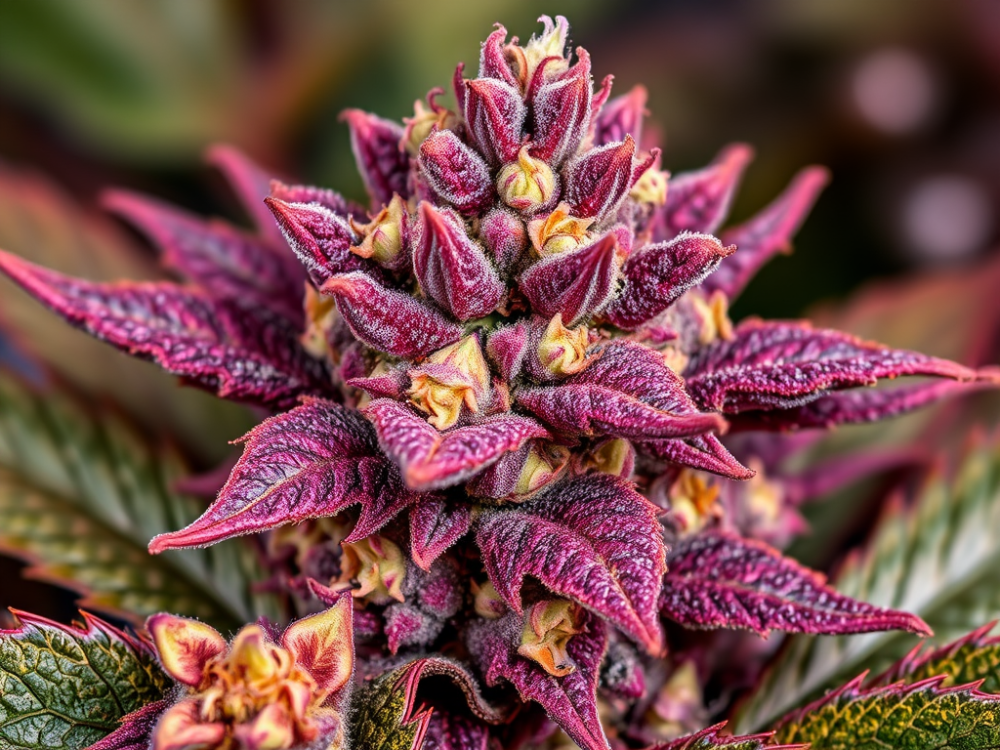

Forbidden Fruit is a strain whose name captures its essence perfectly – something tempting, fruity and hard to resist. The combination of Cherry Pie and Tangie genetics has given the world one of the most interesting strains of recent years. In this article, we take a detailed look at its origin, terpene profile, effects and practical tips for growers.
What is Forbidden Fruit? Origin and genetics
The Forbidden Fruit strain is the result of crossing two iconic American strains – Cherry Pie and Tangie. The outcome is a predominantly indica-dominant hybrid that has inherited the best of both parent lines.
Cherry Pie – the sweet indica base
Cherry Pie is a popular indica-dominant strain with roots in Granddaddy Purple and Durban Poison. It is known for its earthy sweetness, relaxing effects and firm bud structure. It is Cherry Pie that gives Forbidden Fruit its characteristic heaviness and depth of flavour.
Tangie – an energetic citrus sativa
Tangie is a sativa-dominant strain derived from the classic Tangerine Dream. It brings a distinct citrus note to the Forbidden Fruit profile – specifically tangerine and orange – along with a light, uplifting sativa base that freshens the whole experience and prevents an overly heavy finish.
The resulting hybrid and THC profile
The resulting hybrid usually has a THC content of around 23–26 %, which places it among the stronger strains. CBD content generally stays below 1 %. Phenotypes tend to be compact, densely covered in trichomes and show a characteristic purple colouring of the leaves – a legacy of Cherry Pie.
Terpene profile: Why does it smell so exceptional?
Terpenes are aromatic compounds that largely determine the character of each strain – its aroma, flavour and overall experience. Forbidden Fruit has one of the most complex terpene profiles among modern hybrids.
Dominant terpenes
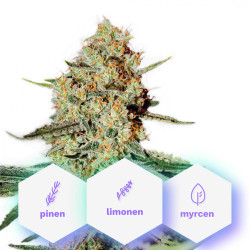
- Myrcene – the most abundant terpene, it provides an earthy, slightly herbal base and supports the relaxing effects. It is myrcene that is responsible for the "heavy" indica component of the experience.
- Limonene – a citrus terpene typical of Tangie, it adds freshness, orange and lemon notes and has an overall positive effect on mood.
- Caryophyllene – the only terpene that binds to the CB2 receptors of the endocannabinoid system; it adds a slightly spicy, peppery undertone and may contribute to the calming properties of the strain.
- Linalool – a terpene typical of lavender, it adds subtle floral notes and enhances the overall calming character.
- Ocimene – less abundant but distinctive, this terpene has sweet, tropical and slightly herbal notes that round off the flavour profile.
The resulting aroma of Forbidden Fruit is a fascinating combination of tropical fruit, fresh citrus and sweet cherries with a subtle earthy base. When you open the jar, you are immediately greeted by a scent reminiscent of a fruit cocktail – hence the name of the strain.
Effects of Forbidden Fruit: What to expect?
Thanks to its high THC content and indica-dominant profile, Forbidden Fruit is one of those strains best approached with respect – especially for less experienced users. The effects set in relatively quickly and are characterised by their depth.
Initial phase – euphoria and a relaxed mind
The onset tends to be pleasantly euphoric – limonene and the sativa component from Tangie show up as an improved mood, light mental alertness and a positive state of mind. This phase is ideal for creative activities or social gatherings in a calm setting.
Comedown – deep physical relaxation
As the effects build, the myrcene-rich indica base takes over. A gradual, pleasant physical relaxation sets in, which can turn into a state of "couch-lock" – being glued to the sofa. For this reason, Forbidden Fruit is most often consumed in the late afternoon or evening.
Who is it suitable for?
- Users looking for deep relaxation after a demanding day
- Those who appreciate a distinctive flavour and aroma experience
- More experienced consumers who prefer strong indica-dominant strains
- Evening and night-time use
If you are interested in how cannabis strains with pronounced effects influence mood and the mind, we recommend reading our article Exotic cannabis and depression – natural help with potential, where we look at the relationship between strains with a rich terpene profile and their possible influence on mental well-being.
Growing Forbidden Fruit: A practical guide
Forbidden Fruit is a strain that deserves the attention of a more experienced grower. It is not the most demanding strain on the market, but it rewards those who take care of the growing conditions. Below you will find the key information for a successful grow.
Basic growing parameters
- Growing type: indoor and outdoor, ideally indoor for control over conditions
- Flowering time: 8–9 weeks (indoor), outdoor harvest around October
- Plant height: compact, typically 60–100 cm (indoor)
- Indoor yield: 350–450 g/m²
- Outdoor yield: 400–500 g per plant under optimal conditions
- Growing difficulty: moderate
Temperature and humidity
Forbidden Fruit prefers temperatures between 20–26 °C in the vegetative phase and slightly cooler conditions (18–24 °C) during flowering. Cooler temperatures in the late flowering phase encourage the development of the characteristic purple pigments – anthocyanins – in the leaves, giving the buds a beautiful visual colouring.
Relative humidity should be around 50–60 % during vegetation; in the flowering phase, reduce it to 40–50 % and in the last two weeks before harvest to 35–45 %. Lower humidity at the end of flowering minimises the risk of mould and supports trichome production.
Nutrients and substrate
The strain responds well to a quality substrate with good drainage. A mix of premium garden soil with perlite (a ratio of roughly 70:30) is recommended. Forbidden Fruit has moderate nutrient requirements – it appreciates regular nitrogen feeding during vegetation and phosphorus and potassium in the flowering phase.
Plant training
Thanks to its compact indica structure, Forbidden Fruit is well suited to techniques such as LST (Low Stress Training) or ScrOG (Screen of Green), which maximise yield and improve light penetration to the lower levels of the plant. If you want to deepen your knowledge of shaping cannabis plants, read our detailed article Pruning cannabis: The difference between topping and classic pruning.
Step by step: Key phases of a successful grow
- Germinating the seed – soak the seed in lukewarm water for 12–24 hours, then transfer it to a damp paper towel or directly into the substrate.
- Seedling phase (1–2 weeks) – maintain high humidity (65–70 %) and a temperature of around 24 °C, light 18/6 hours.
- Vegetative phase (4–6 weeks) – regular watering, nitrogen feeding, shaping the plant using LST or topping.
- Switching to flowering – change the light cycle to 12/12 hours and switch to nutrients that support flowering.
- Flowering phase (8–9 weeks) – monitor humidity and lower the temperature in the final weeks to develop the purple colour.
- Harvest – check the trichomes with a magnifying glass or microscope; the ideal moment is when the trichomes are mostly milky white with a smaller share of amber ones.
- Drying and curing – dry at 18–22 °C and 50 % humidity for 7–14 days, then transfer to airtight jars for at least 2–4 weeks of curing to fully develop flavour and aroma.
For a complete overview of the whole process from seed to harvest, we recommend our popular guide 7 simple steps to successfully growing cannabis, which takes you through the entire process clearly and step by step.
Comparison with similar strains
Forbidden Fruit is not the only strain on the market with a pronounced fruity profile. But how does it differ from similar strains?
- Forbidden Fruit vs. Gelato – Gelato is also a strong hybrid with a fruity-sweet profile, but with a more pronounced balance between the indica and sativa components. Forbidden Fruit is generally "heavier" and more relaxing.
- Forbidden Fruit vs. Zkittlez – Zkittlez leans more towards tropical fruit and is somewhat less sedating. Forbidden Fruit adds depth thanks to the cherry and citrus notes from Cherry Pie and Tangie.
- Forbidden Fruit vs. Chronic – Chronic is a classic balanced strain with a gentler profile suitable for a wider range of users; Forbidden Fruit is aimed at those who prefer a more intense, fruity and exotic experience with an emphasis on relaxation.
Tips for consumption and storage
How is Forbidden Fruit best consumed?
Thanks to its rich terpene profile, Forbidden Fruit is ideal for consumption methods that preserve terpenes as fully as possible. Vaporizers with adjustable temperature are ideal – at temperatures around 170–185 °C, the citrus and fruity notes come through fully without the risk of combustion and loss of the more delicate aromas. At higher temperatures (190–210 °C), more of the sedating cannabinoids and myrcene are released.
Proper storage
To preserve the maximum quality, aroma and potency of Forbidden Fruit, follow these storage rules:
- Store in hermetically sealed glass containers
- The temperature should be stable, ideally 15–21 °C
- Protect from direct light – UV radiation degrades cannabinoids and terpenes
- The optimal relative humidity inside the container is 59–63 % (use humidity control packs)
- Avoid the fridge – temperature fluctuations encourage condensation and mould
Conclusion: Is Forbidden Fruit the right choice for you?
Forbidden Fruit is a strain that has earned its worldwide popularity entirely deservedly. A sophisticated terpene profile dominated by myrcene, limonene and caryophyllene, a beautiful visual presentation with purple hues and deep relaxing effects place it among the elite of modern hybrids. Its flavour – fruity, citrusy, with a hint of sweet cherries – is simply unforgettable.
From a grower's perspective, it is a strain of moderate difficulty that, under the right conditions, can surprise with a generous yield and exceptional bud quality. Whether you are an experienced grower or an enthusiast looking for a new flavour experience, Forbidden Fruit is worth your attention.
Would you like to know how to compare different consumption methods and what actually happens in the process? Read our article Vaporization and the Cheese strain – aroma, effects and use, where we look in detail at how different consumption methods affect the overall experience of a strain.
All information in this article is provided solely for educational and informational purposes. Cannapio.cz does not support or promote any illegal activity. Growing and consuming cannabis is subject to the laws in force in your country – always follow the current legislation.
You might also be interested in: Caramelo – a sweet strain from Delicious Seeds