


 English (English)
 Deutsch (German)
 Čeština (Czech)
 Hrvatski (Croatian)
 Română (Romanian)
 български език (Bulgarian)
 Magyar (Hungarian)
 Español (Spanish)
 Français (French)
 Italiano (Italian)
 Nederlands (Dutch)
 Polski (Polish)
 Slovenčina (Slovak)
In short: Sinsemilla (Spanish sin semilla, “without seed”) is cannabis flower from female plants that were never pollinated, so they formed no seeds. It is a condition, not a strain: any indica, sativa or hybrid can be sinsemilla. Seeds themselves are the opposite end of the same story.
| Literal meaning | “without seed” (Spanish sin + semilla) |
|---|---|
| Pronunciation (UK/US) | sin-suh-MEE-yuh or sin-suh-MIL-uh; Spanish [sinseˈmiʝa] |
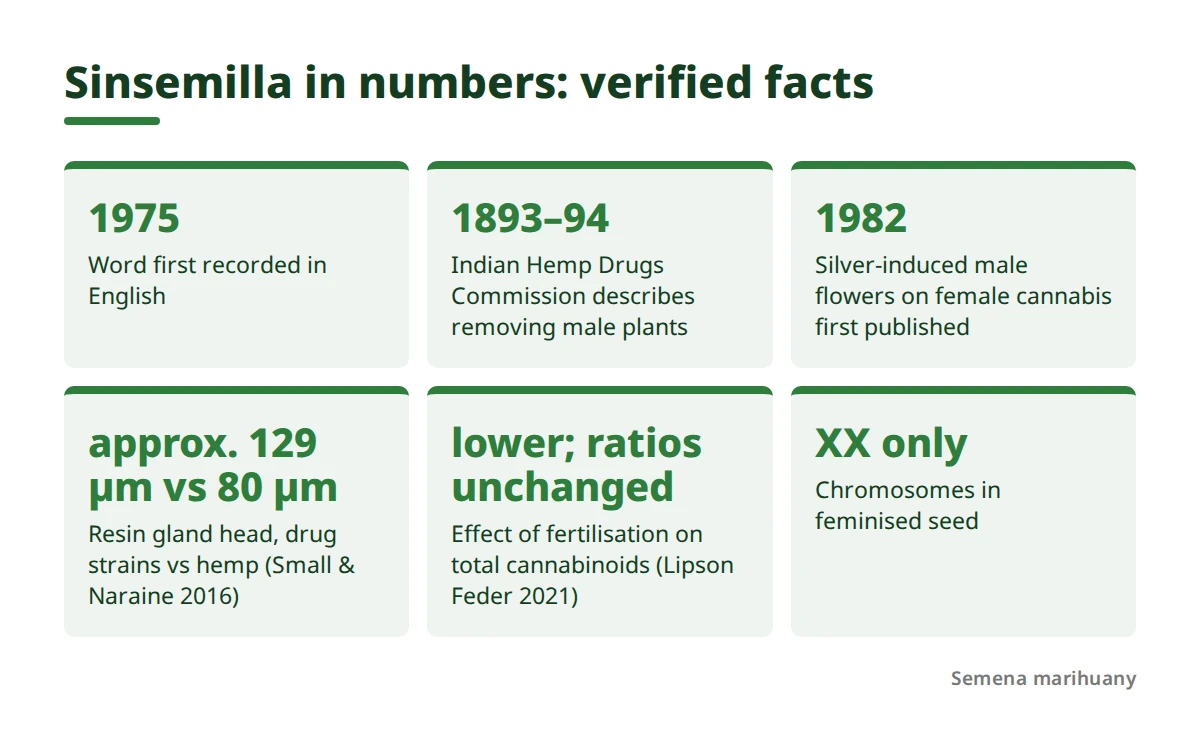
| First recorded in English | 1975 (Merriam-Webster; Dictionary.com: 1975–80) |
| Is it a strain? | No – it describes unpollinated female flower of any genetics |
| Common misspelling | “sensimilla” / “sensemilla”, from reggae and street slang “sensi” |
| UK law | Seeds are not controlled; cultivation is an offence (Misuse of Drugs Act 1971, s. 6 and s. 37) |
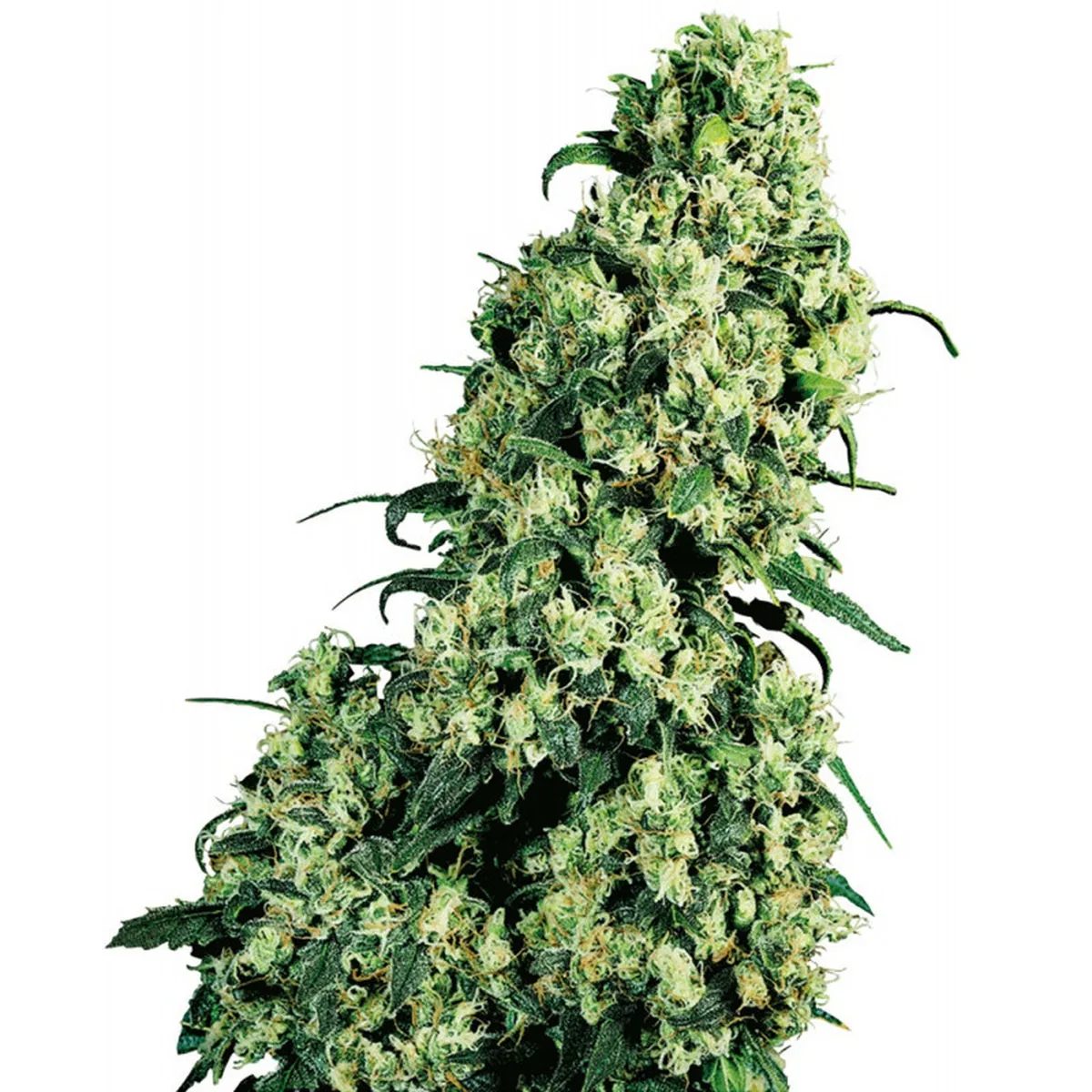
A typical situation: a collector sees a pack labelled “sinsemilla seeds” and wonders whether that is a strain, a quality grade or a marketing trick. It is the last one. Sinsemilla means the absence of seeds, so no seed can be sinsemilla. A seed can be feminised, regular or S1, and those labels are what matter. Here is the word, its history and the genetics behind it.
What does sinsemilla mean?
The word is Mexican Spanish: sin (without) and semilla (seed). Merriam-Webster dates its first use in English to 1975. It entered the language through American growers and buyers who needed a word for the new, seedless product that was replacing seed-filled imports.
English dictionaries record sin-suh-MEE-luh and sin-suh-MIL-uh. The Spanish original, with the double L read as a “y”, is closer to sin-seh-MEE-ya. All three are understood.
The key point is that sinsemilla describes a state, not a genotype. A Durban Poison, an Afghani or a modern dessert hybrid can be grown seeded or seedless from identical genetics. The difference is whether pollen reached the flowers.
Sinsemilla vs sensimilla: spelling and reggae culture
“Sensimilla” and “sensemilla” are folk spellings, influenced by the Jamaican slang “sensi” for high-grade herb. They are not separate products. Search engines treat them as the same query, which is why the UK results for “sinsemilla” are a mix of a CBD shop, a song on Spotify and YouTube videos.
The music link is real and verifiable. Sinsemilla is the third album by Jamaican roots reggae band Black Uhuru, released in 1980 on Island Records’ Mango label and produced by Sly Dunbar and Robbie Shakespeare. Barrington Levy had a big reggae-chart hit with “Under Mi Sensi” while touring the UK in 1984. Those records explain why the misspelling refuses to die.
Where sinsemilla came from: India, Mexico and California
The idea is older than the word. The Report of the Indian Hemp Drugs Commission (1893–94) describes ganja cultivators in British India cutting male plants down “at the root” as soon as they flowered, and repeating the job “as long as male plants are detected”. The report also notes that good ganja required “either the extirpation of the male plant or the isolation of the female plant”. That is the sinsemilla principle, written down more than 80 years before the Spanish term reached English.
In North America the story runs through Mexico. A timeline compiled by Humboldt State University notes that cannabis sold in Humboldt County in the 1960s was imported from Mexico, and that in the mid-1970s local growers began producing sinsemilla, “first for own use, then as a small cash crop”. Seeded imports gave way to seedless home-grown flower as the premium product.
Politics accelerated the shift. From 1975, a joint US–Mexican programme sprayed cannabis fields with the herbicide paraquat. By 1978 a US survey had found the herbicide in cannabis samples from the south-west, which pushed buyers towards domestic supply. The same timeline records a federally funded “Sinsemilla Strike Force” in 1978, and a CBS 60 Minutes segment titled “Sinsemilla” on Humboldt and Mendocino in 1980. Some accounts credit Mexican growers in Sinaloa instead, so treat any single “inventor” story with caution.
The biology: why pollination produces seeds
Cannabis is dioecious: most plants are either male (pollen-producing) or female (seed-bearing). Sex is mainly determined by X and Y chromosomes, with females XX and males XY. You can read more on how the two look in our guide to telling male and female cannabis apart.
Female flowers are clusters of calyxes, each with two pistils that catch airborne pollen. Once a calyx is fertilised, it starts building a seed. A sinsemilla flower is simply one whose calyxes never received pollen.
Does seed set really change the flower? Peer-reviewed work says yes, without the exaggeration of marketing copy. In a 2021 study in Frontiers in Plant Science, Lipson Feder and colleagues pollinated THC-rich and CBD-rich female plants with different males. Fertilisation lowered the total cannabinoid concentration of the inflorescences, while the ratio between cannabinoids stayed the same. Monoterpenes, the light aromatic compounds, followed a similar downward trend. It measured an outcome; the popular “energy goes into resin” explanation remains unproven.
Genetics matter more than seedlessness alone: Small and Naraine (2016) found resin gland heads of about 129 µm in high-THC strains versus about 80 µm in industrial hemp, a result of decades of selection.
Seeds, flower and genetics compared
Most confusion disappears once you separate what a term says about the flower from what it says about the seed.
| Term | What it describes | Genetic basis | Who it is for | Typical marketing claim to check |
|---|---|---|---|---|
| Sinsemilla | Unpollinated female flower, no seeds | Any genetics; a state, not a line | Not a product you can buy as seed | “Sinsemilla seeds” – a contradiction |
| Seeded flower | Female flower that was pollinated | Mother × whatever pollen reached her | Historic imports; accidental hermie pollination | “Bagseed is free genetics” – parentage unknown |
| Feminised seeds | Seed bred to give female plants | Female × female (pollen from a sex-reversed female), XX only | Collectors wanting predictable female phenotypes | “99.9 % female” – a seedbank claim, not an audited figure |
| S1 seeds | Feminised seed from one plant pollinating itself | Selfed female; reshuffles one genotype | Preserving a single selected mother | “Exact copy” – it is not a clone; traits segregate |
| Regular seeds | Seed from a true male × female | Roughly half XX, half XY | Breeders and collectors who need males | “Stable line” – ask for F-generation or BX details |
For the generation codes (F1, F2, BX, S1) see our explainer on what F1, F2 and S1 seeds are, and for the practical differences between the two main seed types our article on regular vs. feminised seeds.
How feminised seeds are made, at the genetic level
Feminisation is not genetic modification. It relies on a hormonal switch. Silver ions block the action of ethylene, a plant hormone involved in keeping female flowers female. A genetically female plant treated with silver then produces male flowers carrying pollen with only X chromosomes. Seeds made with that pollen are XX and should grow into females.
The method has a paper trail. In 1982, Mohan Ram and Sett reported in Theoretical and Applied Genetics that silver nitrate and silver thiosulphate (STS) induced fertile male flowers on female Cannabis sativa, with STS the more effective of the two. In 2018, Lubell and Brand at the University of Connecticut confirmed that STS foliar sprays produce male flowers on female hemp. Hobby breeders often use colloidal silver, which works on the same principle. Dutch Passion says it brought the first commercial feminised seeds to market in the late 1990s (its own history page gives 1997).
When a reversed female pollinates herself, the offspring are called S1. When she pollinates a different female, the result is a feminised cross. Either way, the seed producer is doing deliberately what a sinsemilla grower works to prevent: getting pollen onto female flowers.
Pollen chucking, hermaphrodites and “nanners”
Breeders call deliberate, small-scale pollination “pollen chucking”. It is the reverse of sinsemilla: a selected male (or a reversed female) supplies pollen, and the seeds carry the combined genetics. For a breeder the seeds are the product. Open pollination is also how landrace strains kept their regional character for centuries.
The unplanned version is the hermaphrodite: a female plant that produces some male flowers. Growers call the exposed, banana-shaped anthers “nanners”. A few of them can release enough pollen to seed nearby flowers, which turns a sinsemilla crop into a seeded one. The Indian commission noticed this in the 1890s too: cultivators called such plants “moria” and removed them from seed fields.
Hermaphroditism has a genetic and an environmental side: lines selected from plants that self-pollinated readily can pass the tendency on. Our article on hermaphrodite cannabis covers the signs and the debate in more detail.
What growers report: a reality check
We read 50 recent r/microgrowery threads returned by a search for “feminized hermie”. Twenty were identification questions (“is this a hermie or a male?”), and several of those turned out to be normal calyxes rather than male flowers. Six described finding seeds after harvest. Three blamed a specific stress such as a light leak. Three suspected an outright male from a pack sold as feminised. Six were breeders discussing STS, colloidal silver or S1 seed.
Two tendencies stand out. Buyers often assume “feminised” means “guaranteed seedless”; it does not. And the seedbanks named spread across many brands rather than one, which points to unstable lots and stress, not one bad company. Treat any “hermie-free” promise as marketing.
How to read a seed label: a collector’s checklist
- Ignore “sinsemilla seeds”. It tells you nothing about genetics.
- Find the seed type. Feminised, regular, S1 or autoflowering feminised. If the listing does not say, ask.
- Check the parents. A named cross from the breeder (for example Afghani × Colombian) beats a vague “indica-dominant hybrid”.
- Look for the generation. F1, F2, BX or S1 tells you how uniform the offspring are likely to be.
- Read the female percentage critically. Figures like 99 % come from the seedbank; there is no independent audit.
- Choose regular seeds if males matter. If you collect for preservation or breeding, feminised packs cannot supply males.
- Check the law where you live before doing anything with seeds beyond keeping them.
The legal position in the UK and Europe
In the UK, cannabis seeds are not a controlled drug. Section 37 of the Misuse of Drugs Act 1971 defines cannabis to exclude seed separated from the plant. Germinating them is a different matter: section 6 makes it an offence to cultivate any plant of the genus Cannabis without a Home Office licence. Seeds contain no THC; we sell them as collectables and for genetic preservation.
Elsewhere the rules differ. In Germany, adults 18+ may grow up to three plants at home under the KCanG. In the Czech Republic, from 1 January 2026 adults 21+ may grow up to three plants for personal use. Laws change, so always check the current law where you live.
FAQ
Is sensimilla a strain?
No. “Sensimilla” is a misspelling of sinsemilla, and sinsemilla describes unpollinated, seedless female flower of any genetics. Products sold under a “Sensimilla” name are brand names, not a distinct cannabis line.
What does sinsemilla mean?
It is Spanish for “without seed” (sin semilla). It refers to cannabis flower from female plants that were kept away from pollen, so they formed no seeds.
How do you pronounce “sinsemilla”?
Most English speakers say sin-suh-MEE-luh or sin-suh-MIL-uh. The Spanish pronunciation is close to sin-seh-MEE-ya.
Where can I buy sensimilla?
You cannot buy sinsemilla as seed, because the term means “without seed”. Seedbanks sell feminised and regular seeds as collectables. In the UK, buying and holding seeds is lawful, but germinating them is an offence.
Are feminised seeds the same as sinsemilla?
No. Feminised seeds are bred to produce female plants. Whether a female ends up seedless depends on whether pollen reaches her, including pollen from her own hermaphrodite flowers.
Recommended products
Seeds contain no THC. Figures for flowering plants come from the breeders.
- Skunk n.1 – feminised seeds, 5 pcs, Sensi Seeds: Sensi Seeds traces it to 1970s US West Coast breeding of Afghan and Colombian lines, the era when sinsemilla went mainstream.
- Acapulco Gold – feminised seeds, 5 pcs, Barney’s Farm: named after the Mexican import that defined cannabis before the seedless era; a good piece of history for a collection.
- Durban Poison – feminised seeds, 10 pcs, Dutch Passion: a South African landrace line from the seedbank that pioneered commercial feminisation.
- Amnesia Haze – feminised seeds, 5 pcs, Royal Queen Seeds: a widely documented modern feminised hybrid, useful as a reference genotype.
- Mexican Sativa – regular seeds, 10 pcs, Sensi Seeds: regular seed with Mexican heritage for collectors who want true males and females in the pack.
- Northern Lights – regular seeds, 10 pcs, Sensi Seeds: a classic regular line for breeders and genetic preservation.
Sources
- Dictionary.com: sinsemilla (etymology, pronunciation)
- Lipson Feder et al. (2021), Frontiers in Plant Science: fertilisation decreases phytocannabinoid accumulation
- Mohan Ram & Sett (1982), Theoretical and Applied Genetics: silver-induced male flowers in female Cannabis
- Humboldt State University: marijuana timeline for Humboldt County
- Report of the Indian Hemp Drugs Commission 1893–94 (National Library of Scotland)
- Misuse of Drugs Act 1971, section 6 and section 37
- Europaius: Czech Act 167/1998, § 5
Updated: November 2026
Author: Tomáš Brázda, editorial name of the Cannapio.