


 English (English)
 Deutsch (German)
 Čeština (Czech)
 Hrvatski (Croatian)
 Română (Romanian)
 български език (Bulgarian)
 Magyar (Hungarian)
 Español (Spanish)
 Français (French)
 Italiano (Italian)
 Nederlands (Dutch)
 Polski (Polish)
 Slovenčina (Slovak)
In short: TAC (total active cannabinoids) is the lab sum of all cannabinoids in a sample expressed in their active form, with acids such as THCa converted using the 0.877 factor. It is always higher than total THC, says nothing certain about strength, and seeds themselves contain no THC at all.
| TAC stands for | Total active cannabinoids (on microbial reports, TAC can also mean total aerobic count) |
|---|---|
| Total THC formula | Δ9-THC + (0.877 × THCa), as written in the US hemp rule, 7 CFR 990.1 |
| Why 0.877 | THCa loses a carboxyl group when heated; 314.5 ÷ 358.5 (molar masses) ≈ 0.877 |
| Typically included | THC, CBD, CBG, CBN, CBC, THCV and their acids, converted to active form; only what the lab's panel covers |
| Usual gap | TAC is commonly 1–3 percentage points above total THC in a THC-dominant flower |
| On a seed sheet | “THC up to 25 %” is the breeder's best phenotype, not a guarantee; seeds contain no THC |
A typical situation: you are comparing two strain pages on a seedbank. One says “THC 26 %”, the other says “TAC 28 %”, and a third, CBD-rich line just says “THC: medium”. Which number is the real one, and can you compare them at all?
What TAC means, and the two TACs on a lab report
TAC is short for total active cannabinoids. It is a single percentage that adds up every cannabinoid the lab measured, expressed in the form that exists after heating (the “active”, neutral form). A TAC of 25 % in dried flower means roughly 250 mg of cannabinoids per gram, measured on the lab's chosen basis.
Two points that most explanations skip:
- The acronym has a second meaning. On a full certificate of analysis, TAC can also stand for total aerobic count, a microbial test in colony-forming units per gram. If the number has “CFU/g” next to it, it is about microbes, not cannabinoids.
- Not every lab uses the same definition. Some labels show “total cannabinoids” as a raw sum of acids plus neutral forms, others show TAC with the acids converted. The raw sum is always the bigger figure, so two labels on the same flower can differ by several points without anyone lying.
More than 100 cannabinoids have been identified in cannabis, but a lab only counts what is on its potency panel, usually around a dozen or more compounds. A rare cannabinoid not on the panel is simply not in the TAC.
Total THC: the 0.877 formula, step by step
A living cannabis plant makes mostly acidic cannabinoids: THCa rather than THC, CBDa rather than CBD, CBGa rather than CBG. Heat removes a carboxyl group (decarboxylation) and turns the acid into the neutral compound. You can read the chemistry in more detail in our article on the difference between THC and THCa.
Because the carboxyl group has mass, 1 mg of THCa cannot become 1 mg of THC. The molar mass of THC is about 314.5 g/mol and of THCa about 358.5 g/mol, which gives 314.5 ÷ 358.5 ≈ 0.877. This is the factor used in the US federal hemp rule, which defines the decarboxylated value as Δ9-THC + (0.877 × THCa) (7 CFR 990.1). Commercial labs such as SC Labs print the same formula in the footers of their certificates, and use it for CBD (Δ9 replaced by CBD, THCa by CBDa).
For CBGa to CBG the ratio is slightly different (about 0.878), which is why some breeder blogs quote 0.878 for CBG. Note that 0.877 is a theoretical ceiling: real heating never converts 100 % of the acid, and some THC degrades to CBN along the way. Total THC is therefore a potential value, not a measured one.
Illustrative lab result: from raw numbers to TAC
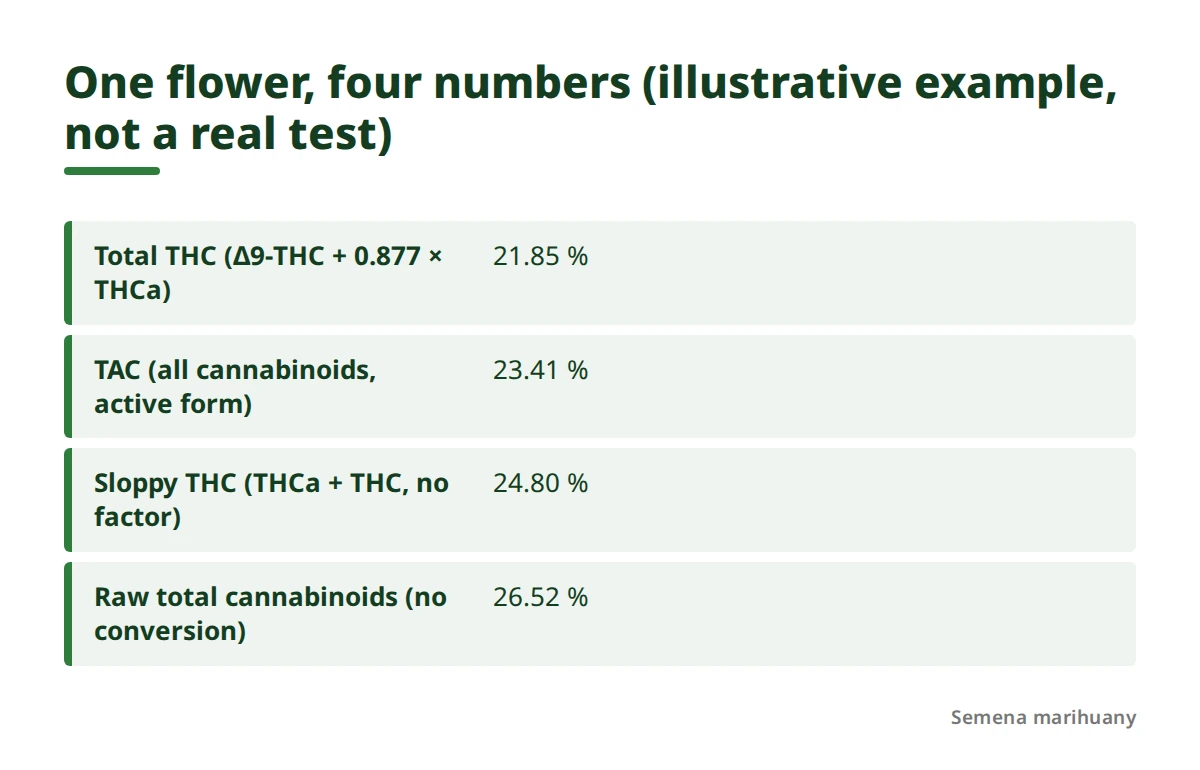
Important: the table below is an invented example built to show the arithmetic. It is not a real test of any product, strain or batch. The values are on a dry-weight basis and resemble a typical THC-dominant flower.
| Line on the report | Measured (%) | Conversion | Active value (%) |
|---|---|---|---|
| THCa | 24.00 | × 0.877 | 21.05 |
| Δ9-THC | 0.80 | none | 0.80 |
| Total THC | 0.80 + 21.05 | 21.85 | |
| CBDa | 0.10 | × 0.877 | 0.09 |
| CBD | 0.02 | none | 0.02 |
| CBGa | 1.20 | × 0.878 | 1.05 |
| CBG | 0.10 | none | 0.10 |
| CBC, CBN, THCV (together) | 0.30 | none | 0.30 |
| TAC (total active cannabinoids) | sum of active values | 23.41 | |
| Raw “total cannabinoids” (no conversion) | 26.52 | plain sum of column 2 | |
| Sloppy “THC” (THCa + THC, no conversion) | 24.80 | not a valid figure |
The same flower can therefore be advertised as 21.9 %, 23.4 %, 24.8 % or 26.5 %, depending on which line someone picks. Only 21.85 % is a correct “total THC”. The 24.8 % figure, made by adding THCa and THC without the factor, overstates THC by about 3 points and is the most common way numbers get inflated.
Why TAC is always higher than total THC
TAC contains total THC plus everything else. In a THC-dominant flower the “everything else” is small, mostly CBG at 0.5–1.5 % and traces of CBC and CBN, so TAC sits a point or two above total THC. In a balanced or CBD-rich chemotype the gap is huge: a plant with 7 % total THC and 8 % total CBD has a TAC of more than 15 %, yet half of it is CBD.
That is the trap. A high TAC does not mean a high THC content, and it does not reliably predict effect. CBD and CBG are not intoxicating in the way THC is, and the role of terpenes (the much-discussed “entourage effect”) has limited scientific support so far, as even seed company blogs now admit. For more on the aroma side, see our overview of cannabis terpenes.
Terms compared: THC, THCa, total THC, TAC and the rest
| Term | What it counts | Typical place you see it | Common mistake |
|---|---|---|---|
| THC (Δ9-THC) | Neutral THC already present | Lab report line, low in fresh flower (often under 1 %) | Reading a low Δ9 value as “weak” |
| THCa | The acid the plant actually makes | Lab report line, usually the biggest number | Adding it 1:1 to THC |
| Total THC | Δ9-THC + 0.877 × THCa | Labels, regulations, good seedbank sheets | Assuming it is measured, not calculated |
| TAC | All panel cannabinoids in active form | US dispensary labels, some breeder blogs | Treating it as a THC figure |
| Total cannabinoids | Often a raw sum of acids and neutrals | Some certificates of analysis | Comparing it with another lab's TAC |
| Total terpenes | Aroma compounds (myrcene, limonene…), not cannabinoids | Separate terpene panel, usually 1–4 % | Expecting it to be part of TAC (it is not) |
Why labs disagree on the same flower
Lab-to-lab differences are not just a theory. An analysis of more than 200,000 Washington State test results (Jikomes and Zoorob, Scientific Reports, 2018) found that cannabinoid levels differed systematically depending on which laboratory did the testing. The main reasons:
- Moisture basis. “Dry weight” and “as received” give different numbers. Our example's 21.85 % total THC on dry weight becomes about 19.7 % if the sample still holds 10 % water.
- Sampling. Top colas carry more resin than lower buds. A lab that receives the best bud from a batch reports a better number than one that receives a mixed sample.
- HPLC vs GC. Liquid chromatography (HPLC) keeps acids intact and reports THCa and THC separately, so the 0.877 conversion is applied afterwards. Gas chromatography (GC) heats the sample, converts acids during the test and cannot tell you how much was THCa; incomplete conversion and degradation can push results either way.
- Panel and definitions. One lab counts 8 cannabinoids, another 17; one prints TAC with conversion, another a raw sum.
How to read a strain sheet in 5 steps
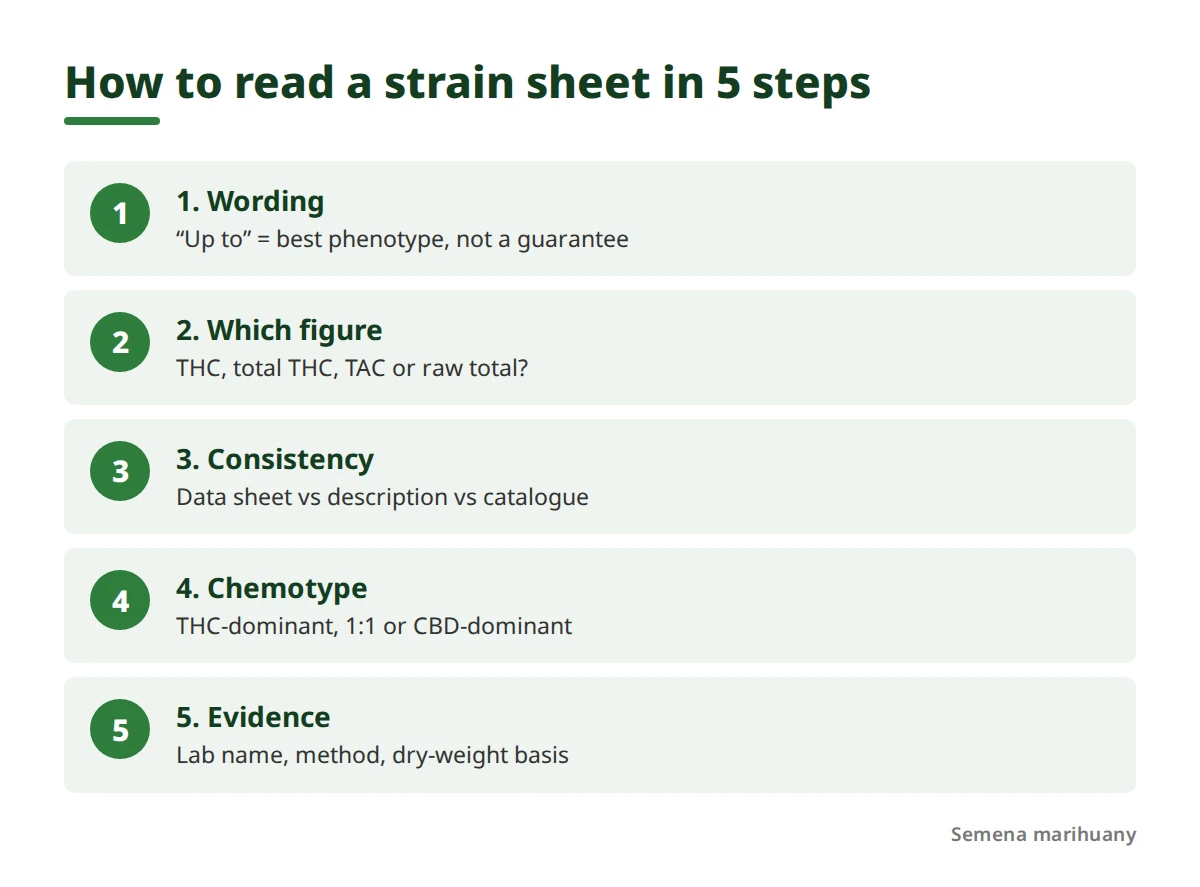
Seeds contain no THC. The percentage on a seed page describes what the breeder says flowers of that genetic line have reached, which makes it a statement about genetics, not about the product you hold. With that in mind:
- Find the wording. “Up to 25 %” is the top of the range, usually the best phenotype in the breeder's own conditions. A range such as “20–25 %” is more honest; a single number with no range is the least informative.
- Check which figure it is. THC, total THC, TAC or total cannabinoids? If the sheet does not say, assume it is the most flattering one.
- Look for consistency. Compare the data sheet with the description text on the same page and with the breeder's catalogue. Contradictions are common, as the products below show.
- Read the chemotype, not only the number. THC-dominant, balanced 1:1 or CBD-dominant matters more than whether a line is 24 % or 26 %, which is within normal lab and phenotype variation.
- Ask for evidence. A breeder who publishes a lab report (with lab name, method and basis) deserves more trust than one who prints “30 %+ THC” with nothing behind it.
For context on what counts as a “high” percentage today, see THC content in cannabis, and for the minor cannabinoid most often hidden inside TAC, our article on CBG.
What people get wrong: a look at forum threads
We went through 39 Reddit threads in r/weed and r/trees with “TAC” in the title (excluding posts about Seattle-Tacoma airport). Most of them, 25 of 39, are simply photos of jars or pre-rolls with a TAC percentage in the title, almost all from US states such as Massachusetts and Maine, where dispensary labels lead with TAC. 11 of 39 ask what TAC means or whether a higher TAC is stronger. In 3 of those 11 the poster thought TAC was a separate substance or a measure of pesticide cleanliness. For UK and EU collectors the practical takeaway is that seedbanks still quote THC, so TAC mostly appears in breeder blogs and US-made content.
Legal note for UK readers
In the UK, cannabis seeds separated from the plant are not included in the definition of cannabis in section 37 of the Misuse of Drugs Act 1971, so they can be bought and kept as collector's items. Cultivating cannabis is an offence under section 6 of the same Act. Rules differ elsewhere: Germany allows adults aged 18+ up to three plants at home, and the Czech Republic from 1 January 2026 allows adults aged 21+ up to three plants for personal use. Always check the law where you live.
FAQ
What is TAC in cannabis?
TAC means total active cannabinoids: the sum of all cannabinoids a lab measured, with acids such as THCa and CBDa converted to their active form using the 0.877 factor. It includes THC, CBD, CBG, CBN, CBC and others on the lab's panel.
Is TAC the same as THC?
No. THC is one cannabinoid; TAC is all of them together. TAC is always equal to or higher than total THC, and in CBD-rich strains it can be twice as high.
Is a higher TAC stronger?
Not necessarily. A high TAC can be driven by CBD or CBG, which are not intoxicating like THC. Compare total THC and the THC:CBD ratio instead.
How is total THC calculated?
Total THC = Δ9-THC + (0.877 × THCa). With 24 % THCa and 0.8 % THC, the result is 21.85 %, not 24.8 %.
Do cannabis seeds contain THC or TAC?
No. Seeds contain no THC and have no TAC. Percentages on seed pages describe flowers grown by the breeder from that genetic line.
Recommended products
All four are feminised seeds sold as collector's items. Seeds contain no THC; the figures are those stated by the breeders, and we have noted where their own pages disagree.
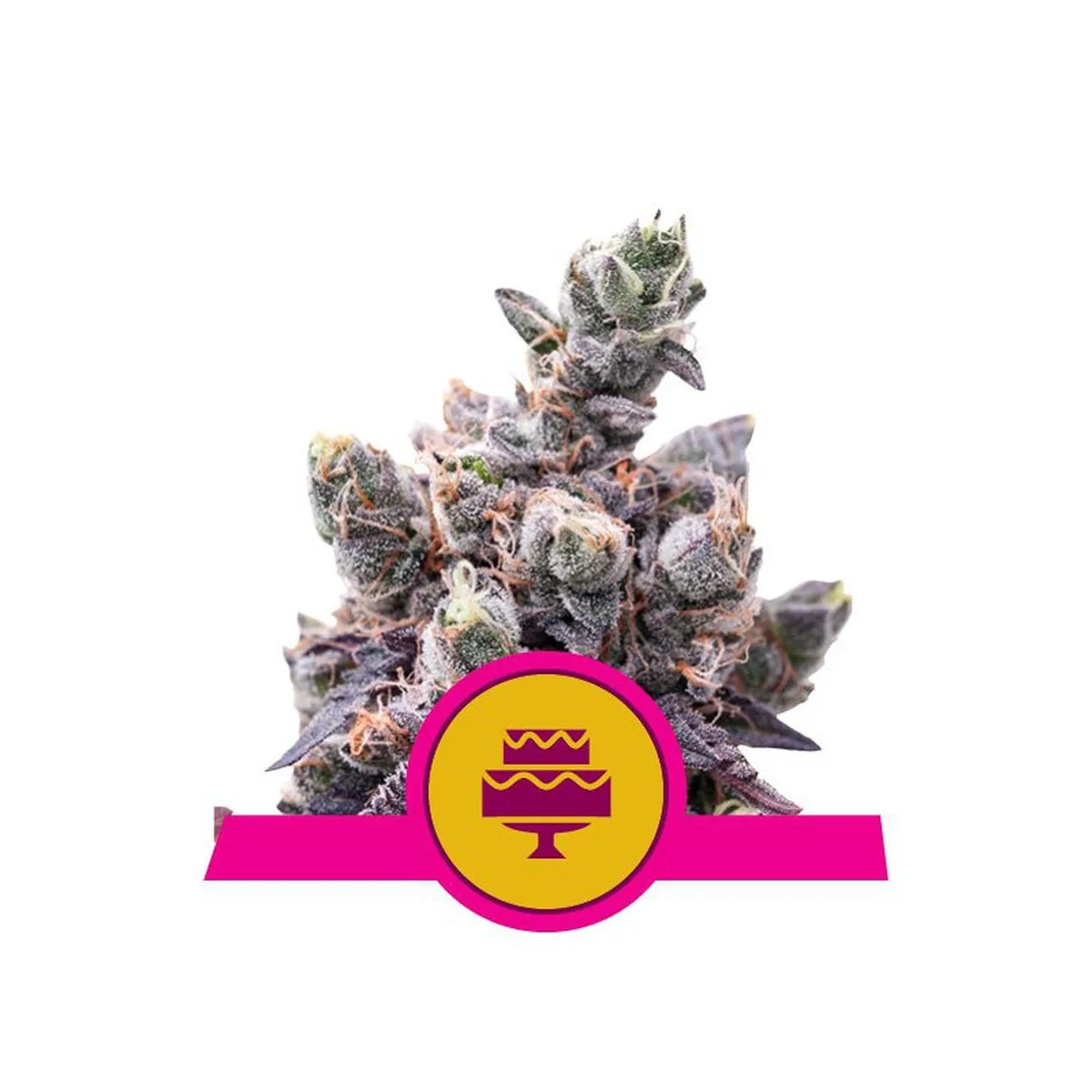
- Wedding Gelato – feminized seeds 3 pcs, Royal Queen Seeds: the data sheet says “THC: up to 25 %, CBD: low”, while the description gives 20–25 %. A good real-world example of “up to” versus a range.
- Critical Kush – feminized seeds 5 pcs, Barney's Farm: Critical Mass × OG Kush, listed at 26 % THC in the specifications and “up to 26 %” in the text; a classic THC-dominant line where TAC would add only a point or two.
- CBD Kush® – feminized seeds 3 pcs, Dutch Passion: CBD-dominant, CBD:THC ratio between 1:1 and 4:1 according to the breeder. Weak point: the specifications say 7.5 % CBD, the description “at least 4 %”, and THC is only “medium”.
- CBD Skunk Haze® – feminized seeds 3 pcs, Dutch Passion: bred as a balanced 1:1 line, the perfect case where TAC is roughly double total THC. The breeder's catalogues list it anywhere from 5 % to 10 % THC and 5–8 % CBD, depending on the edition.
Sources
- 7 CFR 990.1 – Definitions (decarboxylated value, total THC), US Domestic Hemp Production Program
- Jikomes N., Zoorob M. (2018): The cannabinoid content of legal cannabis in Washington State varies systematically across testing facilities. Scientific Reports 8, 4519
- Dutch Passion: THC vs TAC – why total active cannabinoids matter
- Misuse of Drugs Act 1971, section 37 (definition of cannabis) and section 6 (cultivation)
- Czech Act No. 167/1998 Coll., § 5 (Europaius)
Updated: November 2026
Author: Tomáš Brázda, editorial name of the Cannapio.