


 English (English)
 Deutsch (German)
 Čeština (Czech)
 Italiano (Italian)
 Hrvatski (Croatian)
 Română (Romanian)
 български език (Bulgarian)
 Magyar (Hungarian)
 Español (Spanish)
 Français (French)
 Nederlands (Dutch)
 Polski (Polish)
 Slovenčina (Slovak)
In short: Sativa grows to 2–4 metres, has narrow leaves and flowers for 10–16 weeks; its effects are described as mentally stimulating. Indica usually measures 60–150 cm, flowers for 7–9 weeks and is associated with physical relaxation and a sedative effect. Most strains on the market today are hybrids, so the overall chemical profile is what really matters.



| Height – sativa | 2–4 m, even more outdoors in the tropics |
|---|---|
| Height – indica | usually 60–150 cm |
| Flowering time – sativa | 10–16 weeks |
| Flowering time – indica | 7–9 weeks |
| Typical terpenes | sativa: limonene, pinene, terpinolene; indica: myrcene, linalool, caryophyllene |
| Origin | sativa: equatorial regions; indica: mountainous regions of the Hindu Kush |
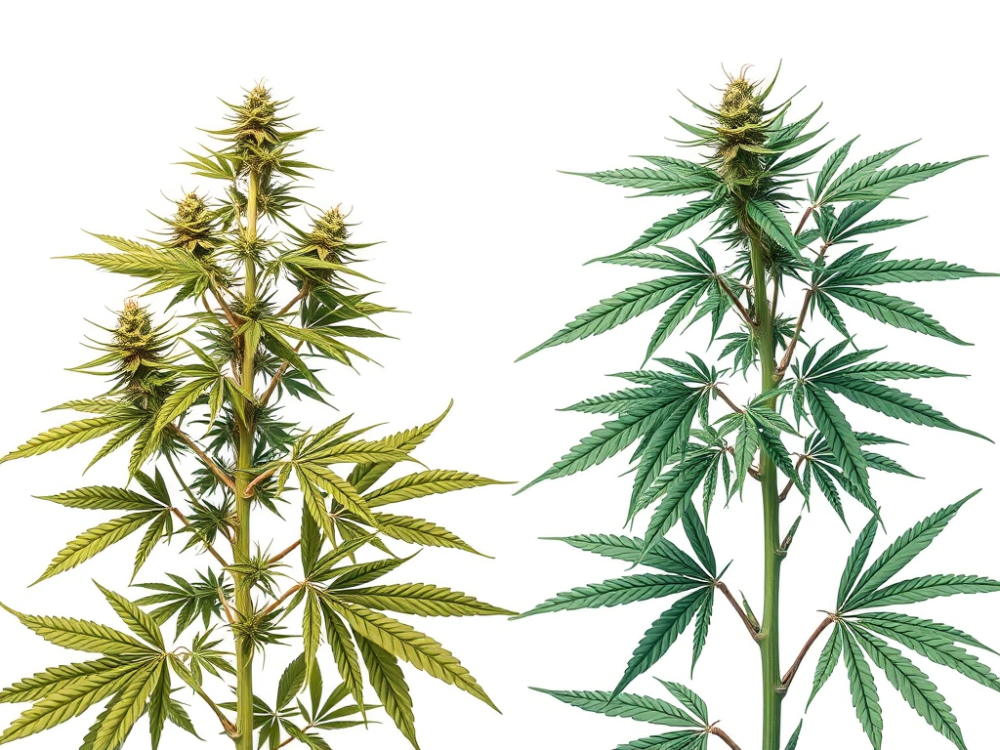
If you have ever explored the world of cannabis, you have surely come across one of its most basic questions: sativa vs indica – what is actually behind these two terms and why does it matter? Whether you are interested in growing or simply want to better understand the differences between strains, this article will give you a complete overview. We will look at the appearance of the plants, their effects, ideal growing conditions and how to choose the right variety for your needs.
Origin and botanical classification: where do sativa and indica come from?
Cannabis is one of the longest-cultivated plants in the world – its history goes back thousands of years. The botanical division into Cannabis sativa and Cannabis indica dates back to the 18th century, when the Swedish botanist Carl Linnaeus (sativa) and the French biologist Jean-Baptiste Lamarck (indica) described these two distinct plants.
- Cannabis sativa originally comes from equatorial regions – Central America, Southeast Asia and Africa, where long summers with plenty of sunshine prevail.
- Cannabis indica has its roots in the mountainous regions of the Hindu Kush (Afghanistan, Pakistan, India), where seasons are shorter and conditions harsher.
This geographical separation meant that the two plants adapted to their environments in completely different ways – and this is reflected both in their appearance and in their chemical composition.
Plant morphology: how to tell them apart at first glance
You can tell sativa and indica apart almost immediately once you see the two plants side by side. Their morphology is so different that experienced growers need no complicated tests.
Cannabis sativa – the tall, slender climber
- Height: sativa easily reaches 2–4 metres, even more outdoors in the tropics
- Leaves: long, narrow fingers – the characteristic “cannabis star” with thin segments
- Structure: tall, slender, airy; branches are spread out and sparse
- Colour: lighter shades of green
- Flowering time: longer – typically 10–16 weeks
- Yield: can be very high, but the plant needs more space and light
Cannabis indica – compact and dense
- Height: usually 60–150 cm, ideal for growing indoors
- Leaves: broad, short and dark green, with pronounced fingers
- Structure: bushy, dense, compact – more like a shrub than a tree
- Colour: rich dark green, sometimes with purple hues
- Flowering time: shorter – 7–9 weeks
- Yield: dense, resinous buds in a smaller area
It is precisely indica's compact size that makes it a popular choice for indoor growers. If you are planning to grow at home and are looking for tips, read our detailed guide Watering cannabis: how to grow from seed at home.
Chemical composition: terpenes, THC and CBD
The different effects of sativa and indica are not down to the “type” of plant alone – the chemical profile of each strain plays a key role. The two most important components are cannabinoids (especially THC and CBD) and terpenes (aromatic compounds).
THC to CBD ratio
- Sativa generally tends to have a higher THC content and a lower CBD content. The result is a cerebral, mentally stimulating effect.
- Indica tends to be richer in CBD and has a different terpene profile, which contributes to physical relaxation and sedative effects.
It is important to note, however, that this rule is not absolute. Modern breeding has produced a huge number of hybrids, and the resulting effect always depends on the specific strain and its chemical profile – not just on whether it is classified as sativa or indica. If you are interested in how CBD works in the body, we recommend the article How does CBD affect the endocannabinoid system in the body?
Terpenes and their influence
Terpenes are volatile aromatic substances that give cannabis its characteristic scent and also help shape the overall experience through the so-called entourage effect. In sativa strains you will often come across:
- Limonene – citrus scent, uplifting effect
- Pinene – pine needle scent, mental alertness
- Terpinolene – floral and fruity note
Indica strains, on the other hand, typically contain more:
- Myrcene – earthy, musky scent; relaxing and sedative effect
- Linalool – lavender note, calming properties
- Caryophyllene – spiciness, anti-inflammatory potential
Effects: energy vs relaxation
This is probably the most frequently discussed difference – and also the one that interests beginners and experienced users alike. Put simply: when it comes to effects, sativa vs indica is like day and night.
Effects of sativa – mental stimulation and creativity
Sativa strains are typically associated with the so-called head high – an effect that is felt mainly in the mind:
- Increased energy and motivation
- Creative thinking and free-flowing associations
- Euphoria and a positive mood
- Sociability and talkativeness
- Heightened perception of sounds and colours
Sativa is therefore suited to daytime activities – creative work, walks in nature, social situations or sports. It is less suitable for evening rest, however, as it can disrupt sleep.
Effects of indica – physical relaxation and calm
Indica works differently – its effect is described as a body high, a feeling of relaxation and heaviness in the body:
- Deep muscle relaxation
- A calmer mind and fewer intrusive thoughts
- Sedative effects – ideal before sleep
- A sense of physical well-being and the “couch-lock” effect (literally being “glued to the sofa”)
- Increased appetite
Indica is the choice for evening relaxation, unwinding after a demanding day or moments when you need to switch off and rest. Many users appreciate its potential in states of tension, stress or difficulty falling asleep.
Growing: where does each type thrive best?
Choosing between sativa and indica is not just a question of effects – it also has a major impact on how and where you will grow. If you are considering cultivating your own plants, take the following factors into account.
Sativa in the grow room and outdoors
- Indoor: more demanding because of its height – it requires either a large space or intensive training such as LST, topping or SCROG. You can read more about shaping techniques in the article Pruning cannabis: the difference between topping and classic pruning.
- Outdoor: sativa loves warmth, sun and a long growing season. In the Czech climate it can be grown outdoors, but it requires the right timing and a suitable location.
- Light cycle: it needs a longer photoperiod – switching to 12/12 triggers flowering, which lasts longer than with indica.
Indica – the king of indoor growing
- Indoor: compact size, fast flowering and high yields per unit of area make indica the ideal choice for grow tents and grow cabinets.
- Outdoor: indica copes with shorter summers too; thanks to its fast flowering time it manages to ripen even in Central European conditions.
- Resilience: it is generally more resistant to cold, humidity and mould than sativa.
Whichever type you choose, proper care from the very beginning lays a good foundation. You will find a comprehensive guide in the article 7 simple steps to successfully growing cannabis.
Hybrids: the third way that dominates the market
In practice, the vast majority of strains available on the market today are neither pure sativa nor pure indica – they are hybrids. For decades, breeders have crossed strains to achieve a specific profile of effects, aroma, yield or flowering time.
Hybrids are divided into three groups according to which type prevails:
- Sativa-dominant hybrids – mental, energising effects prevail, but they are milder and more balanced than pure sativa
- Indica-dominant hybrids – physical relaxation with a subtle mental component
- Balanced hybrids (50/50) – combine the traits of both – popular for their versatility
An example of a well-balanced hybrid strain with a distinctive profile is Cheese – if you are interested in specific strains and their terpene profiles, read the article Vaporising and the Cheese strain – aroma, effects and use.
How to choose the right strain for you
The choice between sativa, indica and a hybrid should be based on your specific needs, lifestyle and experience. Below is a practical overview:
Choose sativa if…
- You are looking for energy and motivation for daytime activities
- You want to boost creativity or focus better
- You are planning social gatherings or outdoor activities
- You prefer a lighter, airy effect without too much “heaviness”
- You grow outdoors with plenty of space and warmth
Choose indica if…
- You want to truly unwind and relax in the evening
- You suffer from muscle tension or physical discomfort
- You are looking for help calming your mind before sleep
- You grow indoors and have limited space
- You are more of a beginner and want a predictable, controllable effect
Choose a hybrid if…
- You want the best of both worlds
- You are looking for a specific profile – such as relaxation without drowsiness or energy without anxiety
- You are experienced and want to experiment with different strains
Indica, sativa, hybrid and autoflower in one table
For growers, the division into indica and sativa is mainly information about how the plant will behave in a grow box or in the garden. The figures are approximate; a specific strain may differ.
| Parameter | Indica-dominant | Sativa-dominant | Balanced hybrid | Autoflower |
|---|---|---|---|---|
| Indoor height | 60–120 cm | 120–200 cm and more | 80–150 cm | 50–100 cm |
| Stretch during flowering | small | up to double | medium | small |
| Flowering time | 7–9 weeks | 10–14 weeks | 8–10 weeks | whole cycle 9–12 weeks |
| Outdoor harvest in the Czech Republic | late September to early October | usually does not manage to ripen | early to mid-October | depending on sowing date, from July |
| Main risk | mould in dense colas | height and short season | depends on the dominant parent | stress in the first weeks slows down the whole cycle |
You will find compact strains with short flowering in the overview of the ten best-known indica strains, and tall, late-flowering ones in the ranking of sativa strains. If you want to shorten the season, the comparison of autoflower, feminised and regular seeds will help.
Why an indica or sativa label alone is not enough
Linnaeus described Cannabis sativa in 1753, Lamarck described Cannabis indica in 1785. Today most botanists place all cannabis in a single species, Cannabis sativa L., and the division into indica and sativa in seed catalogues mainly describes the shape of the plant: broad or narrow leaves, short or tall growth.
Almost all strains on offer are hybrids with a long pedigree. How a strain acts and smells is better indicated by its THC to CBD ratio and terpene profile than by its “indica” percentage. When choosing seeds, look for the following information in the strain description:
- Flowering time: for outdoor growing in the Czech Republic, ideally up to 9 weeks.
- Height and stretch: decides whether the plant will fit under the lamp.
- THC to CBD ratio: determined by genetics, you cannot change it through care.
- Dominant terpenes: myrcene, limonene, pinene or caryophyllene hint at the aroma; more in the article on terpenes in cannabis.
- Mould resistance: for outdoor growing, more important than THC percentages.
Conclusion: sativa vs indica is not a black-and-white choice
The traditional division of sativa vs indica is a great starting point for finding your way in the world of cannabis, but as we have shown, reality is more varied. Modern science and practice show that the key to understanding a strain is its overall chemical profile – cannabinoids, terpenes and their interplay – not just whether it is labelled sativa or indica.
Whether you are interested in growing, choosing seeds or want to learn more about specific strains, the Cannapio.cz range offers a wide selection with detailed descriptions to help you find your way. We wish you an enjoyable journey through the world of cannabis – with good sense, curiosity and respect.
Frequently asked questions
What is the difference between indica and sativa?
Indica grows short and dense, has broad leaves and flowers for roughly 7–9 weeks. Sativa is tall and sparse with narrow leaves and flowers for 10 weeks or more. As for effects, people tend to report physical relaxation with indica and stimulation with sativa, but the specific chemical profile of the strain is what decides.
Which is stronger, indica or sativa?
Neither in general. THC content is a property of a specific strain, not of the type. Among both indicas and sativas you will find strains with low as well as high cannabinoid content.
Which is better for growing outdoors in the Czech Republic?
Indica-dominant strains or autoflowers. A photoperiod sativa starts flowering in August and usually does not ripen by mid-October, when damp weather and light frosts arrive.
What does indica dominant or sativa dominant mean?
It is a hybrid in whose pedigree one type prevails. For growers, this means that in shape and flowering time the plant will be closer to indica or to sativa respectively.
Can I tell indica and sativa apart by the leaf?
With pure lines, yes: indica has broad, short leaf fingers, sativa narrow, long ones. With modern hybrids the leaf is often somewhere in between, and the breeder's strain description is more reliable.
Recommended products
- Afghani 1 feminised, Sensi Seeds (3 pcs): a landrace indica with short flowering, a typical representative of the compact type.
- Durban Poison feminised, Dutch Passion (3 pcs): a sativa from a South African line which, unlike other sativas, ripens relatively early.
- Skunk n.1 feminised, Sensi Seeds (5 pcs): a classic balanced hybrid of indica and sativa.
- Northern Lights Automatic, Sensi Seeds (3 pcs): an indica-dominant autoflower for a balcony or a short season.
You might also be interested in: Pinene – the terpene with the scent of a pine forest