
Gut Microbiota and Endocannabinoid System
- New research published over the past five years reveals important facts about billions of bacterial "companions" living in our intestines
- As hosts of these microbes, we share a unique symbiotic relationship with them
The so-called intestinal microflora of each of us is composed of approximately 100 billion cells (which is 10 times more cells than in the rest of the human body). Moreover, about 160 different microbial species reside in each of us, with the total number of discovered types hovering around 1,500. Some of these microbial species are found in the basic microflora of most individuals, while others are quite unique.
The overall composition of human intestinal microflora is highly relative - the resulting composition reflects factors such as geographical location, dietary habits, and last but not least, physical activity and overall lifestyle.
When modification of an individual's microflora is needed, prebiotics (found in indigestible parts of food, such as fiber) are often recommended in combination with probiotics (live microorganisms capable of positively enriching intestinal microflora).
Current studies demonstrate the capabilities of intestinal microflora that influence a wide range of physical and mental body functions, extending far beyond mere digestion.
The state of these microorganisms is closely related to other bodily functions, such as:
- Immune system
- Inflammation control
- Defense against unwanted pathogens
- Metabolism of fats, proteins, and carbohydrates
- Mental performance (an unhealthy biome can lead to depression and anxiety)
"Undesirable fluctuations in gut microflora composition are the most common cause of disease and health dysfunctions."
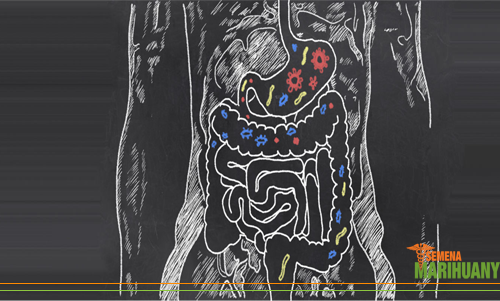
Communication between the Endocannabinoid System and Gut Microflora
Currently, more and more data is emerging confirming the interconnectedness of gut microflora and the endocannabinoid system. (More in the article "Introduction to the Endocannabinoid System")
From previous research, we already know that human endocannabinoids are most often produced in body organs responsible for proper metabolism, energy balance, and body weight (such as the brain, pancreas, adipose tissue, and muscles).
We further learned that endocannabinoids are responsible for controlling:
- Gastric emptying
- Gastrointestinal motility
- Feeling of satiety
- Appetite
- Fat storage
- Blood sugar response after eating
Gut microflora is also responsible for:
- Controlling energy utilization by regulating fat storage in adipose tissue
- Regulating insulin sensitivity
As you can see, the functions of gut microflora and the endocannabinoid system are closely interconnected.
The connection between these two systems was first mentioned in a 2007 study, where mice experiments observed a reduction in abdominal pain after administering the probiotic Lactobacillus, which resulted in increased production of intestinal endocannabinoids.
Obesity is often associated with the condition of a "leaky gut", where there is increased permeability of the gastric wall and subsequent absorption of unwanted bacterial components that increase inflammation of the entire digestive system. Increased gastric wall permeability further leads to increased endocannabinoid production by the immune system and adipose tissue, which ultimately accelerates the division and growth of fat cells (adipogenesis).
The function of the gastric wall and intestinal permeability was also under scrutiny in another study, which demonstrated the positive effect of administering probiotic bacteria, resulting in increased production of certain cannabinoid types and simultaneous reduction of others. According to scientists, these findings are a clear indicator that gut microflora function is closely linked to the endocannabinoid system, with the function of endocannabinoids being either to increase or decrease gastric wall permeability.
All these facts and findings clearly show that there exists a certain connecting axis or mechanism between the stomach, intestines, and the endocannabinoid system, similar to the axis between the intestines and the brain (e.g., serotonin production – a hormone regulating mood and feeling of freshness, among other things).
This consequently explains the positive effect of exogenous cannabinoids (for example, through the administration of medicinal cannabis) on inflammatory bowel diseases or reducing the chances of diabetes development.
Source: leafly.com
Translation: Filip Maral
Images: honeycolony technologynetworks
References:
Cani PD, Plovier H, Van Hul M, Geurts L, Delzenne NM, Druart C, Everard A. Endocannabinoids – at the crossroads between the gut microbiota and host metabolism. Nat Rev Endocrinol. 2015 Dec 18.
Geurts L, Everard A, Van Hul M, et al. Adipose tissue NAPE-PLD controls fat mass development by altering the browning process and gut microbiota. Nat Commun. 2015 Mar 11;6:6495.
Bajzer M, Olivieri M, Haas MK, Pfluger PT, et al. Cannabinoid receptor 1 (CB1)antagonism enhances glucose utilisation and activates brown adipose tissue in diet-induced obese mice. Diabetologia. 2011 Dec;54(12):3121-31.
Rousseaux C, Thuru X, Gelot A, et al. Lactobacillus acidophilus modulates intestinal pain and induces opioid and cannabinoid receptors. Nat Med. 2007 Jan;13(1):35-7.
Muccioli GG, Naslain D, Bäckhed F, et al. The endocannabinoid system links gut microbiota to adipogenesis. Mol Syst Biol. 2010 Jul;6:392.