
Medical cannabis is not just about THC
The effect of medicinal cannabis is a highly complex matter
The human body during marijuana's effect does not react only to THC, but also to CBD and other cannabinoids in combination with various terpene ratios
What happens when you lock a bunch of different cannabis growers in one room? Of course, they'll start going at each other like rabid dogs, with everyone wanting to mark their territory with a plant with the highest THC content. Every passionate grower naturally has an emotional relationship with their creation, and after several successful grows, their ego can grow to the point of claiming that their model is simply the best and strongest on the market. Watching two adults bicker childishly about "my model yields much more... no, mine has so much THC you can't handle it" can be quite comical.
Does THC content not equal strain potency?
The most common part of the debate is, of course, the resulting potency of the models. Even though the scene with medicinal cannabis is beginning to change and growers and users are starting to realize that model selection is not just about how quickly it can put a person to sleep, believe that right now certain groups of growers are still fantasizing about growing something that would lock even someone like Snoop Dogg into a chair after one puff.
The constant focus on the strength and potency of marijuana strains is slowly but surely leading us to the question: How much do we really want to get "stoned"? Is it even necessary to continually increase THC content? After all, people have been using medicinal cannabis for millennia, and in no historical records will you find a cannabis smoker complaining that this or that plant didn't catapult them straight into the center of the universe when smoking.
Today's modern cannabis consumers, and especially wealthier customers of legal cannabis dispensaries, are increasingly looking only for models with THC content exceeding 20%. The more THC, the better. Most such customers feel that if they don't sink into a chair for at least a few hours and find themselves on the brink of total dysfunction after purchasing a strain, then they've essentially thrown their money away.
"Some of them are, of course, the same ones who, due to their passion and desire to outdo each other in consumption, often find themselves in cannabis-induced states of paranoia."
Cannabis Tolerance X THC Content
To thoroughly understand the neurology of THC's pleasurable effect for some, we still lack several breakthrough studies. However, it is becoming clear that the level of the user's tolerance has possibly more to do with the strength of the cannabis effect rather than the actual THC content of the consumed strain. Therefore, one can expect that a daily user will not be knocked out by cannabinoid-packed models like Ayahuasca or L.S.D. For weekend and occasional consumers, however, it's a completely different story. They should carefully consider before listening to friends and getting drawn into more and more puffs from a joint or vaporizer.
"Everything depends on the person's consumption history and their tolerance to THC effects." Richard Miller, Professor of Pharmacology, Feinberg University
Behind the euphoric feeling after consuming medicinal cannabis lie certain neurobiological mechanisms that we partially understand. Each of us is equipped with our own endocannabinoid system, which contains certain types of receptors capable of capturing THC and thus activating a chain of mechanisms leading to feelings associated with cannabis consumption. However, the more frequently we use these receptors (which we can think of as small generators), the more worn out they become and the smaller effect they can achieve.
"Receptors function more or less depending on how much we flood them with cannabinoids. If receptors are exposed to constant waves of THC, they will naturally try to react less. This is essentially a self-regulation of the system, which is precisely what the entire endocannabinoid system serves in the body."
If the user's tolerance is the decisive factor in the final strength of the effect, then theoretically buying very expensive models with extreme THC contents is a waste of money. Studies from the University of British Columbia confirm that the percentage of THC indeed does not play such a significant role in the psychoactive effect as initially thought, but that the ratio of other seemingly non-psychoactive cannabinoids to THC is much more important.
"Some of the unique medical effects of cannabis strains may not necessarily be due to typically high-percentage cannabinoids like CBD or THC," explains Elizabeth Mudge, the author of the aforementioned study, in an interview with Science Magazine.
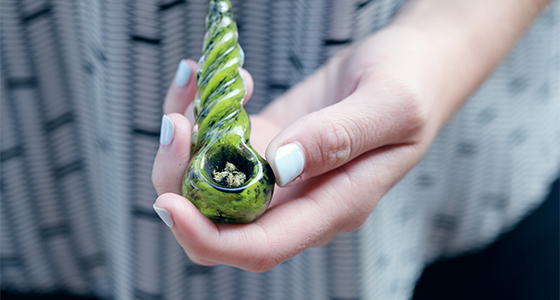
Growing cannabis strains purely based on THC content? Times are changing...
During the cultivation and breeding of such a diverse herb as cannabis, it's about much more than just trying to "squeeze out" as much THC from the model as possible. More and more experienced cannabis connoisseurs now know how significant a role the so-called chain effect of cannabis compounds plays in the effect. This involves connecting all the effective components of a given flower - cannabinoids, terpenes, and flavonoids, which support or suppress each other, and as you can imagine, there are many such combinations. A sad fact, however, is that in some areas where cannabis is already legal, growers are forced to cultivate models with the highest THC content for the simple reason of best sellability.
For example, in Alaska, regular consumers won't settle for anything other than models extremely packed with THC levels bordering on normality.
"The only models that sell commonly in Alaska are, for example, the California-popular Blue Dream or Durban Poison, which typically have THC content over 20%."
In any case, it's time for customers to receive better education and for us as patients and recreational users to start realizing that medicinal cannabis contains a much broader spectrum of effects and experiences than may initially appear, and that these effects have much less to do with THC content than the average user mistakenly thinks.
Source:
cannabisnow.com
Adams, ByMike. "Come On, How High Can a Person Really Get?" Cannabis Now, 26 Nov. 2018, cannabisnow.com/come-on-how-high-can-a-person-really-get/?fbclid=IwAR3Rr0b_WtDJsA_kgPJKAiiS71zQmh7an1kQsmqwQkbjii4OXQl4dnO8u3Q
Author:
Mike Adams
Similar Articles
- High CBD Doses Reduce Methamphetamine Cravings (Study)
- Most Significant Studies and Events from the World of Medicinal Cannabis
- Scientists Discover Rare Moss Containing THC-Like Substances
- How to Fight Migraines? Cannabis Users Choose 5 Medicinal Strains
- Paranoia and Anxiety (Associated with Marijuana and Not): How to Treat Symptoms?