
Synergy of Cannabis Therapeutic Substances
- Studies show that the therapeutic effect of natural cannabis is more beneficial than its synthetic isolates
- The therapeutic effect of cannabinoids lies in their synergy - the so-called "entourage effect"
- Only 1.8% of patients prefer synthetic THC over natural, studies prove
If you look closely at medicinal cannabis buds, you'll surely notice they are covered with a layer of sticky crystalline resin. This resin contains hundreds of therapeutically active substances, known as cannabinoids and terpenoids. We assume you are already familiar with THC and CBD. (If not - more here)
These two cannabinoids are only part of many other substances that contribute to the overall effect of cannabis. The interactive synergy between cannabis components is called the "entourage effect" in English. Once you understand the function of synergy, you'll realize why medications containing only isolated THC and CBD are insufficient for treating most health issues.
Artificial "Marijuana" or Synthetic Cannabinoids
In the United States, there are medications like Marinol (dronabinol) or Cesamet (nabilone), which contain only synthetically isolated THC. In the Czech Republic, there is a similar drug called Sativex, which contains synthetic THC and CBD in a 1:1 ratio. Marinol or Cesamet are usually prescribed to treat nausea in cancer patients. However, their effectiveness remains questionable.
A 2011 survey examining various methods of medicinal cannabis consumption shows that only 1.8% of 953 patients prefer synthetic THC in pill form over inhaling vapors or consuming cannabis extracts. Moreover, the time it takes for the desired effects of synthetic THC to occur can take several hours, while vapor inhalation acts immediately.
CBD treatment in the form of capsules, concentrates, or even sublingual sprays has been in the spotlight in recent years after the media frenzy surrounding Charlotte's Web. Charlotte's Web is a non-psychoactive strain with low THC content (< 0.3%) and high CBD content, which was used as a treatment for epilepsy for a little girl from Colorado, Charlotte Figi. This miraculous treatment prompted several American states to legalize CBD.
Synthetic CBD and THC isolates or extracts from industrial hemp are still a good choice for most patients, especially if they don't have access to complete medicine. Synthetic alternatives play an important role in medicine and as a cornerstone for introducing complete cannabis legalization. However, treatment using the whole cannabis plant can offer us much more.
Complete Plant Medicine
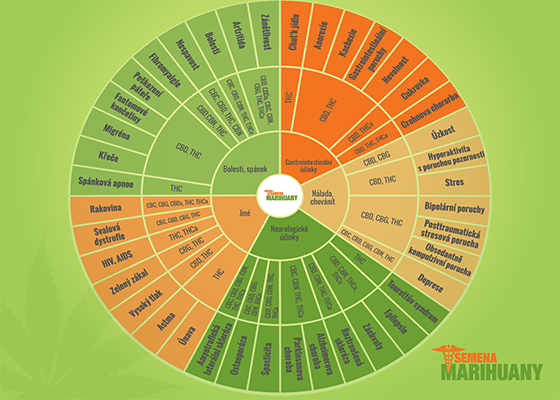
The English term "whole plant medicine" is used to describe treatment using the entire spectrum of medicinal substances found in cannabis. In the image above, you can see the most common cannabinoids and a description of their properties and effects. If you want to view the image in higher resolution, visit our Instagram profile.
As you can see, cannabis contains many other substances that, through synergistic action, can achieve much better therapeutic effects than isolated THC or CBD. Currently, the trend is to grow cannabis with the highest possible THC content, but with the continuous development of new strains, awareness of the diversity of other cannabinoids and terpenes in cannabis is slowly growing. Hopefully, in the future, we will see varieties that, in addition to balancing the ratio between CBD and THC (CBD Varieties), will also emphasize other cannabinoids and terpenes.
Synergy between Cannabinoids and Terpenes
The diversity of chemical substances in the cannabis plant is fascinating in itself, but research investigating the collaboration between cannabinoids and terpenes reveals an entirely new level of complexity.
Neurologist Dr. Ethan Russo is a long-time expert in the science of cannabinoid function in the human body. In his study "Taming THC: potential cannabis synergy and phytocannabinoid-terpenoid entourage effect", he describes in detail how substances in medicinal cannabis interact and change their original mechanisms.
Even a slight difference in the plant's terpene profile can have a significant impact on the final effect. For example:
- The terpene myrcene increases the permeability of the blood-brain barrier, through which a greater amount of medicinal substances can pass.
- The terpene pinene reduces the negative effects of THC on cognitive functions and memory.
- The combination of myrcene, pinene, and caryophyllene helps alleviate anxiety.
- The joint application of terpenes limonene and linalool with the cannabinoid CBG shows promising results in treating MRSA (Methicillin-resistant Staphylococcus aureus)
- The combination of the same terpenes and the cannabinoid CBD has potential in treating acne.
- THC together with CBN induces a powerful sedative effect.
However, these examples are just the tip of the iceberg. Treatment using the whole cannabis plant offers much more. If we can understand the true function of terpenes and their mutual synergies, a completely new world of medicine will open up to us. The idea of how many human lives could be changed for the better by deciphering this complex medical mystery is truly overwhelming.
Sources: leafly.com ncbi onlinelibrary
Similar articles
Tags
- CBD
- Medicinal Cannabis
- Marijuana Varieties
- Seed Bank
- Studies
- Synthetic Marijuana
- Therapeutic Effects of Cannabis