
Why Grow in Rockwool
Rockwool cubes used in hydroponic growing contain mineral wool composed of miniature mineral fibers. Mineral wool can be made from natural or synthetic materials. Artificial mineral fibers are generally used mainly for producing industrial insulation boards suitable for building insulation. Natural mineral fibers specially made into solid growing cubes are primarily used in hydroponics and are very suitable for this purpose, as they ensure sufficient aeration of the plant root system.
Rockwool Use in Hydroponics
The main advantage of hydroponic growing in mineral wool is that this material can absorb large amounts of water while maintaining sufficient air circulation. It seems to be an ideal growing medium, as its characteristic properties help rich root growth and ensure sufficient nutrient intake for the plant. The solid fibrous composition of these cubes also has good physical properties to keep the plant in a stable position.
The disadvantage of using this material can be the complex balancing of growing environment acidity, as mineral wool is sensitive to any pH fluctuations. Dry Rockwool may cause temporary irritation when in contact with sensitive skin. When Rockwool is wet, there are no skin irritation problems at all.

New Growing Methods
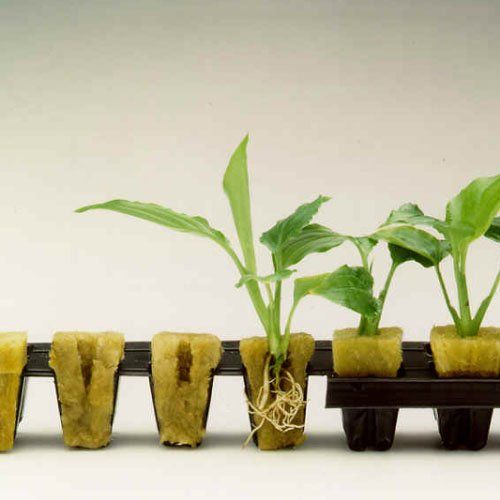
Most modern growers use these special Rockwool cubes available in specialized stores in several size variants. Smaller cubes of mineral wool are usually used for growing small seedlings or for proper rooting of plant clones.
Larger cube sizes are primarily used in hydroponics as a growing medium and to ensure proper plant stability. Large cubes usually have a pre-prepared hole on one side, into which a smaller cube can be easily inserted, solving the problem of plant transplanting. Small clones pre-grown in small cubes can be easily inserted into the hole in the large cube, and the root system will continue to grow.
As a grower, if you ensure free water drainage from the Rockwool container, you will maintain the correct moisture level inside the growing medium. Cubes can be directly placed on a nutrient-rich water bath, and mineral wool ensures proper absorption to the roots. In combination with expanded clay or hydroton, mineral wool is an ideal hydroponic medium.
Rockwool cubes are also completely recyclable, which is a significant advantage over competing products. Essentially, this means you can wash them thoroughly after completing one growing cycle, remove old root remnants, and reuse them for further growing. However, we recommend using these cubes for a maximum of four growing cycles and then purchasing new (sterilized) cubes, as the dead plant root system tends to remain inside the medium, and after a certain time, the mineral wool becomes too contaminated to be 100% sterilized. If you want to start using Rockwool, it is not too financially expensive for beginners.
Rockwool cubes can also be an excellent helper in plant cloning. Some growers prefer Rockwool for seed germination. As we mentioned earlier, Rockwool can maintain moisture for a longer time without being completely submerged in water, which is an ideal characteristic for the germination process.
pH Reduction
Newly purchased Rockwool cubes have a more alkaline environment, so you should use methods to reduce it to an ideal value around 6 - 6.5. The best way to achieve this is to create a water bath with a reduced pH around 5.5 and leave the Rockwool soaked in it for 24 hours. Ideally, you should reduce the acidity of the mineral wool environment to around 6.5. You can simultaneously add elements suitable for proper rooting of small plants, such as root stimulator or fish emulsion. This pH reduction process will reliably balance the acidity level in your Rockwool, making it a perfect, oxygen-rich medium, which will naturally lead to high-quality flowering production. We recommend checking the medium's pH every time you add nutrients, as some hydroponic fertilizers can increase the water's final acidity.