
Without ventilation, it won't work
When growing cannabis indoors, ventilation must not be forgotten. Without it, it simply wouldn't work. First and foremost, we are concerned with oxygen and carbon dioxide. With a lack of these two elements, plant growth will slow down or completely stop, leaves will start to yellow, and the flowering will be poor. Therefore, regular ventilation is extremely important, not only for oxygen supply but also to achieve the desired temperature and humidity in the grow room.
Moreover, ventilation helps plants fight against mold and pests. However, remember the placement. Air intake is placed in the lower half of the grow room, while air extraction is in the upper half. To achieve the right temperature and sufficient fresh air supply, switches and speed regulators are useful. However, this varies. Somewhere a fan running non-stop is sufficient, elsewhere ventilation needs to be controlled to prevent excessive cooling or overheating.
On the market, we can encounter two basic types of fans. The first are duct fans, which serve to bring in and extract air from the grow room. The second type are circulation fans, which mix air in the grow room.
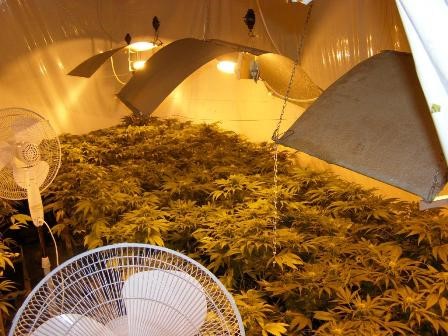
Types of Fans:
Duct Fans
When installing this type of fan, it is necessary to consider that the more bends in the duct, the more the usable performance is reduced. When deciding which fan to buy, it is good to focus on noise level and capacity.
Snail Fan
Fans in the shape of a snail find their use mostly in large grow rooms and where there are long air ducts. They operate on the principle of sucking air from a drum and quickly pushing it into the outlet. One disadvantage is that the snail itself does not allow connection to distribution pipes.
Multi-Speed Fans
These fans certainly appreciate the ability to adjust performance according to current needs and thus save energy consumption. For small plants, there is not such a need for ventilation as for mature plants. Fans are equipped with built-in speed regulators, but there is also the option to connect an additional speed regulator. This allows absolutely smooth speed control from zero to one hundred percent.
Noise-Reduced Fans
A common problem with fans is their noise, whether caused by the motor or driven air. Since this is an undesirable factor, it must be limited. This is done by installing the fan in a three-layer box. The first layer, which is supposed to cover the fan, can be made of wood or sheet metal. The material for the second layer is suitable from polystyrene or rockwool insulation and should meet the noise isolation condition. The third layer is similar to the first, made of wood or sheet metal, and ensures the stability of the second layer. In this example, we have shown how we can make a noise-reduced fan ourselves. Those who do not want to can buy an already noise-reduced fan.
UFO Fans
Higher performance at lower speeds is ensured by large propeller blades. Because of this, it is also less noisy than fans with smaller blades. They are excellently used in small and medium-sized grow rooms. For utilizing the full potential, long air ducts are not recommended.
TD (TT) Fans
They are characterized by a smaller propeller diameter than UFO fans. The propeller is overall wider and shorter. They can be used for air intake everywhere and for exhaust in grow rooms up to 15m2 in size.
Circulation Fans
Just as important as air intake and exhaust is the constant mixing of air in the grow room. From a logical point of view, we know that hot air pushes upwards and cold air remains on the ground.
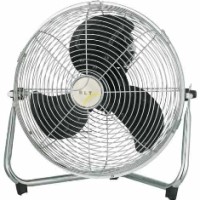
Circulation fans are used to remove temperature differences. They can be run non-stop.
Air Conditioning
Air conditioning appears to be another helper suitable for maintaining temperature in the grow room. Its advantages include: cooling (heating) according to current needs, with powerful air conditioning, the need for grow room ventilation is eliminated, and some air conditioning is also a dehumidifier. The major drawback is the purchase price, higher energy consumption, and sometimes its size.
Noise Suppressors
Since air flowing through hoses creates noise, this negative factor must be eliminated. Noise-reduced hoses and noise suppressors are used for this. With noise suppressors, the insulation layer is thicker and somewhat more effective than with noise-reduced hoses. Working with them is not difficult. They are simply placed on the fan.
And lastly, regarding ventilation, it's worth mentioning carbon odor filters. Thanks to carbon, the air is rid of most odors, so when leaving the grow room, it is odorless. On the market, we encounter either an end or flow-through filter. The end filter is placed at the air extraction point, and the flow-through filter is placed before or after the fan. The effectiveness of carbon decreases over time, so replacement in the odor filter is necessary.